 ChatGPT
 Claude
 Perplexity
Data Quality Dimensions With Examples (Salesforce 2026)
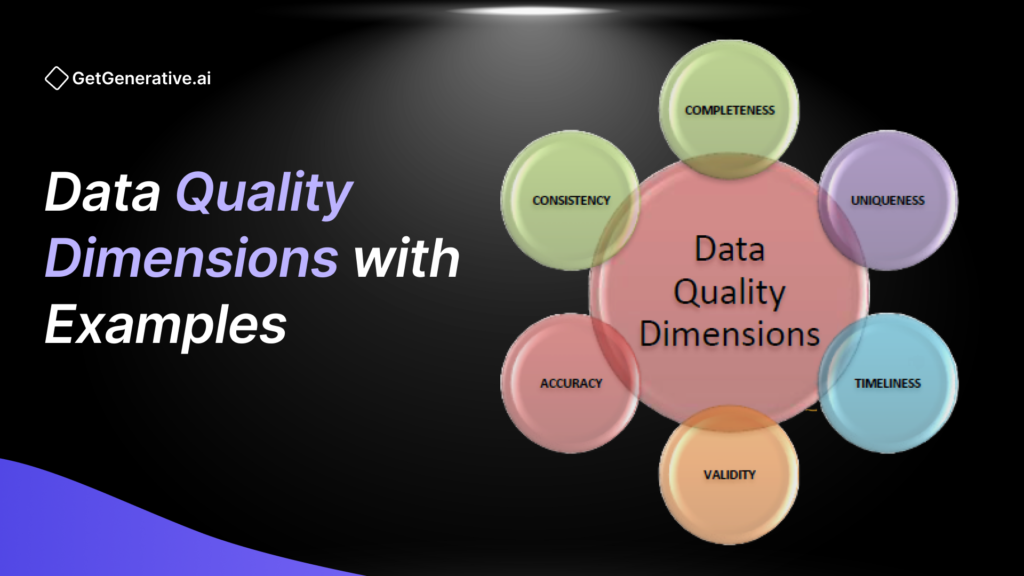
The six data quality dimensions are accuracy, completeness, consistency, timeliness, validity and uniqueness. Each describes a different way data can be wrong, and each fails differently, which is why treating data quality as a single score tells you almost nothing about what to fix.
Published lists disagree on the count. Some replace timeliness with freshness, some add integrity, and some add usefulness, which is why you will see five, six, seven and eight-dimension frameworks presented with equal confidence. The six below are the set DAMA’s data management body of knowledge popularised and the set most tooling measures against, so they are the practical default.
Six data quality dimensions describe six different failures
Dimension | The question it answers | Example of failure |
|---|---|---|
Accuracy | Does the value match reality? | A contact’s job title says Analyst; they were promoted to Director eighteen months ago |
Completeness | Is the required value present? | 40 percent of accounts have no industry, so segmentation silently drops them |
Consistency | Does the value agree across systems? | ERP shows the customer as active, CRM shows churned |
Timeliness | Is the value current enough for the decision? | Order status refreshes nightly; the customer asks at 10am about a 4pm dispatch |
Validity | Does the value conform to its format or rule? | A postcode in a free-text field that no address service can parse |
Uniqueness | Does the entity appear exactly once? | John Smith and J. Smith are the same person with different open cases |
The distinction that matters operationally is between accuracy and validity, because they are routinely confused. A validation rule catches invalid data. It cannot catch inaccurate data, because a well-formed value can still be wrong. Most orgs have strong validity controls and no accuracy controls at all.
Each dimension has a measurement inside a Salesforce org
Generic definitions do not tell you what to run on Monday. These do.
Dimension | How to measure it in Salesforce | Where it usually breaks |
|---|---|---|
Completeness | Field population percentage per object, restricted to the fields actually in use | Fields added for a project and never populated afterwards |
Validity | Count of records failing an equivalent validation rule when evaluated retrospectively | Data loaded before the rule existed |
Uniqueness | Duplicate rule and matching rule results, plus duplicate record sets | Records created through integrations that bypass duplicate rules |
Timeliness | Age distribution of Last Modified Date on the fields in question | Objects fed by nightly batch integrations |
Consistency | Reconciliation counts against the source system of record | Any object with two write paths |
Accuracy | Sampled verification against a trusted external source | Everywhere, because nothing detects it automatically |
Accuracy has no automated test, which is the uncomfortable part. Every other dimension can be measured with a report. Accuracy requires someone to check a sample against reality, which is why it is the dimension most often declared healthy without evidence.
Uniqueness runs on matching rules, and matching rules have limits
Uniqueness is the dimension Salesforce gives you the most direct control over, through duplicate rules and the matching rules underneath them. Three published constraints shape what is possible.
You can activate up to five matching rules per object, with a limit on total matching rules across the org. Duplicate rules run by default when a user completes fields on a record rather than when the record is saved, which means an integration writing through the API does not necessarily trigger them. And a single matching rule run can reassign up to 100 duplicates into a duplicate record set.
The practical consequence is that duplicate prevention protects the user interface far better than it protects your integrations. If uniqueness is degrading in an org with duplicate rules switched on, the entry path is almost always an integration rather than a person.
Each dimension breaks a different agent behaviour
This is where the dimensions stop being an abstraction. An AI agent grounded on your CRM inherits every one of these failures, and each produces a distinct symptom.
Dimension | What the agent does wrong | How it looks to the customer |
|---|---|---|
Accuracy | States something false with full confidence | Trust damage, and a complaint that is hard to answer |
Completeness | Omits a material fact it never had | The customer contacts again, so deflection fails |
Consistency | Contradicts what another channel told them | The organisation looks disorganised |
Timeliness | Answers from a stale state | Tells them an order is pending after it shipped |
Validity | The action fails at execution | The conversation stalls with no explanation |
Uniqueness | Picks the wrong record of two | Personalises to the wrong person entirely |
Read the first row again. Accuracy is the dimension with no automated test and the worst agent failure mode, which is why sampling matters more once agents are reading your data than it did when only humans were.
The full set of thresholds an agent needs before switching on is in quality requirements for agents.
Measure the fields agents read, not the whole org
Org-wide data quality scores are close to useless because they average a healthy object against a broken one and produce a number nobody can act on.
The narrower question is far more useful: for each agent or process in scope, list the objects and fields it reads, then measure the six dimensions on that list only. Forty fields take an afternoon. The whole org takes six weeks and delays the thing you were trying to enable.
That scoping decision is also what makes remediation fundable, because a specific list with specific gaps is a piece of work, whereas “improve data quality” is a budget request nobody approves. To turn the measurement into a prioritised programme, scoring org data readiness covers the assessment method.
Data quality programmes stall in six places
Failure | What happens | Correction |
|---|---|---|
One composite quality score | Healthy objects hide broken ones | Score per object and per dimension |
Validity treated as accuracy | Well-formed wrong data passes every check | Add sampled verification against a trusted source |
Duplicate rules assumed to cover integrations | Uniqueness degrades despite rules being on | Check whether the write path triggers them |
Cleansing without fixing the entry path | Quality decays back within two quarters | Fix the source before the backlog |
Whole-org profiling before a project | Six weeks spent, project delayed | Profile the fields in scope only |
Quality measured once | Nobody notices the drift | Re-measure on a cadence tied to a real event |
The fourth is the one that wastes the most money. A cleansing exercise with no change to how data enters the org buys a temporary improvement at permanent cost.
The six data quality dimensions, condensed
Item | Detail |
|---|---|
The six | Accuracy, completeness, consistency, timeliness, validity, uniqueness |
Commonly added seventh | Integrity, or freshness in place of timeliness |
Only dimension with no automated test | Accuracy |
Most confused pair | Accuracy and validity |
Salesforce control for uniqueness | Duplicate rules and matching rules, up to five active per object |
Most common uniqueness entry path | Integrations that bypass duplicate rules |
Right scope to measure | The fields in scope for the process or agent |
Worst agent failure | Accuracy, because it is confident and undetected |
Agents fix the data quality dimensions that gate them
Data quality work is easier to fund when it is attached to something specific rather than proposed as an improvement programme. Agent activation is the clearest trigger available, because the thresholds are concrete and the failure modes are visible to customers.
GetGenerative.ai starts that with a review of the org and the fields in scope, then remediates against a prioritised list rather than a general cleanse. The fixed-price Agentforce packages include the readiness work in a defined scope, which is usually easier to approve than an open-ended data project. Where the underlying platform question is unification rather than cleanup, Data 360 is the layer that resolves consistency across systems.
Questions teams ask about data quality dimensions
What are the six data quality dimensions?
Accuracy, completeness, consistency, timeliness, validity and uniqueness. Each describes a distinct failure, and a single composite score across all six hides which one is actually broken.
What are the seven data quality dimensions?
Seven-dimension frameworks usually add integrity, meaning whether relationships between records hold. Some replace timeliness with freshness or add usefulness. The core six are stable across frameworks; the additions vary by vendor.
What is the difference between accuracy and validity?
Validity asks whether a value conforms to its format or rule. Accuracy asks whether it is true. A perfectly formatted email address for a person who left the company two years ago is valid and inaccurate, which is why validation rules cannot substitute for verification.
How do you measure data quality in Salesforce?
Field population rates for completeness, retrospective rule evaluation for validity, duplicate and matching rule results for uniqueness, Last Modified Date distribution for timeliness, source reconciliation for consistency, and sampled checking against a trusted source for accuracy.
Which dimension matters most for AI agents?
Accuracy, because it is the only one with no automated test and the worst failure mode. An agent grounded on inaccurate data states something false confidently, which damages trust faster than an agent that declines to answer.
How often should data quality be measured?
Tie it to events rather than a calendar: before enabling an agent, after any migration, and after any change to an integration that writes records. Measuring once produces a number that is out of date before anyone acts on it.
