Solutions
Implementation Org Review Org Monitoring Managed Services
Agents
Discovery Agent Metadata Agent Design Agent Build Agent Test Agent Governance Agent Support Agent
Industry Solutions
Financial Services
Healthcare & Life Sciences
NDIS & Disability Services
Nonprofit
Not-for-Profit
Other Industries
Recruitment & Staffing Real Estate Cosmetic Procedures
Agentforce Claudeforce Blogs Pricing

Salesforce Implementation Cost in 2026: Full Breakdown and How AI Cuts It

Every article about Salesforce implementation cost gives you a range and a table of factors. The range is invented, the factors are obvious, and neither survives contact with an actual quote.

The reason is structural. In 2026, Salesforce implementation cost is not one number that a project produces. It is four separate meters running at four different speeds, three of which keep running long after the project ends. Two of those meters are published by Salesforce, one is arithmetic almost nobody performs, and one is not published at all.

Every price in this article was read from Salesforce’s own pricing pages on 2 September 2026.

Salesforce implementation cost runs on four meters that move at different speeds

Before any figure means anything, sort the cost into the four mechanisms that behave differently. Confusing them is why budgets approved in January become change requests in April.

MeterWhat sets itWhen it movesWho controls it
SubscriptionPer user per month, by editionAt renewal and when headcount changesProcurement
Percentage-linkedA percentage of net spend or net license fees, depending on the itemAutomatically, the moment subscription changesNobody, once the edition is chosen
ConsumptionAgent actions drawn from a credit poolContinuously, with usageWhoever designs the agent
Delivery laborScope, complexity, delivery modelDuring the project onlyThe delivery model you buy

Only the fourth meter stops. The first three become permanent operating cost, which is why a project appraised on its implementation fee alone is appraised wrong.

Salesforce publishes subscription list prices, and the edition sets more than the license

Sales Cloud list pricing is public, billed annually except where noted, per user per month in USD.

EditionList priceDetail that changes the total
Starter Suite$25Billed monthly or annually
Pro Suite$100Premier Support is an add-on
Enterprise$175Web API. Agentforce available, but AI is added separately
Unlimited$350Premier Success Plan and Full Sandbox bundled
Agentforce 1 Salesfrom $550Unmetered employee agent usage, 1M Flex Credits and 2.5M Data Cloud Credits per org per year

The right-hand column matters more than the price column, and the Enterprise row is where budgets break.

Enterprise lists Agentforce as a feature. The same page carries the footnote “AI can be added to Enterprise and above.” Read those together and the meaning is that the edition makes Agentforce available, not that agent usage is free. Usage is still paid for through Flex Credits or a per-user add-on, both priced in the next section. A buyer who saw Agentforce on the Enterprise feature list and budgeted nothing for AI has already missed a meter.

The Unlimited comparison is also more calculable than it looks. Unlimited at $350 bundles the Premier Success Plan and a Full Sandbox, and both are charged as percentages at lower editions. At Enterprise list price with no discount, Premier at 30 percent adds $52.50 per user per month and a Full Copy sandbox at 30 percent adds another $52.50, so the equivalent Enterprise stack costs $280 against Unlimited at $350. The real gap is $70 per user per month, not $175, and for sixty users that is $50,400 a year rather than $126,000. Discounts move the arithmetic, but the method holds.

One inconsistency is worth knowing before you negotiate. Salesforce’s Sales Cloud page states Agentforce 1 Sales includes 1M Flex Credits and 2.5M Data Cloud Credits per org per year, while the Agentforce pricing page describes Agentforce 1 Editions as including 2.5M Flex Credits per org per year. Get the inclusion written into your order form rather than inferred from a web page.

Sandboxes and success plans price themselves against two different percentage bases

This is the meter buyers discover late, because it has no line of its own until it appears. It also has two bases, and Salesforce words them differently on purpose.

Salesforce prices environments as a percentage of net spend rather than as a flat fee.

Sandbox typeCostDataRefresh interval
DeveloperIncluded with CRM licenses200 MB1 day
Developer Pro5% of net spend1 GB1 day
Partial Copy20% of net spend5 GB5 days
Full Copy30% of net spendAll production data29 days

Support is priced on a different base. Salesforce prices the Premier Success Plan at 30 percent of net license fees, and states it is bundled with Unlimited Edition. The Standard Success Plan is included with all licenses, and Signature is quoted. Net spend and net license fees are not guaranteed to resolve to the same figure once discounts, add-ons and multi-cloud lines are involved, so confirm the base for each percentage in writing rather than assuming one number drives both.

Two consequences follow, and both are delivery consequences rather than finance ones.

Percentage pricing means the environment bill re-prices itself every time the subscription changes. Add forty users and the Partial Copy sandbox costs 20 percent more without anyone raising a purchase order.

The 29-day refresh interval on Full Copy is the constraint that quietly shapes a test plan. A program that assumes it can refresh production-like data whenever it wants has to be rebuilt around a monthly cycle, and rebuilding a test plan late is labor, which is the fourth meter.

Flex Credits convert every agent action into a metered unit of cost

The newest meter is the one almost no cost article computes, so here is the arithmetic in full.

Salesforce prices Flex Credits at $500 per 100,000 credits, which is half a cent per credit. A standard Agentforce action consumes 20 Flex Credits. An Agentforce Voice action consumes 30.

That resolves to a per-action price:

  • Standard agent action: $0.10
  • Voice agent action: $0.15
  • 100,000 credits buys 5,000 standard actions

Now apply it. A service agent handling 8,000 cases a month at three actions per case consumes 24,000 actions, or 480,000 credits, at $2,400 a month and $28,800 a year. That is a real operating line, and it appears in no implementation quote.

Salesforce sells the alternative as well. The Agentforce add-on costs $125 per user per month for Sales, Service and Field Service, $150 for Industries clouds, and makes employee agent usage unmetered. A separate Agentforce User License at $5 per user per month gives every employee metered access with limited CRM object visibility, and still requires Flex Credits.

So there is a crossover, and it is calculable. For sixty users, the add-on costs $90,000 a year. At ten cents an action, $90,000 buys 900,000 actions, which is 75,000 a month, or roughly 1,250 agent actions per user per month. Below that volume, metering is cheaper. Above it, the unmetered add-on is. Agentforce Foundations remains $0, so the experiment that establishes your real volume costs nothing but time.

Salesforce offers three buying models, Pre-Purchase, Pre-Commit and PayGo, and a Digital Wallet for tracking consumption. Choose the model after you have measured, not before. Deeper consumption modeling sits in what agent consumption costs.

Delivery labor is the largest meter and the only one nobody publishes

Here is the honest part that other cost articles obscure with a range.

Salesforce publishes subscription pricing, sandbox percentages and credit rates. Nobody publishes delivery labor, because it is not a price. It is the output of a staffing model, and staffing models differ by an order of magnitude for identical scope.

The industry data explains why. The 2026 SPI Research Professional Services Maturity Benchmark, drawing on input from more than 8,000 project and services organizations, records average billable utilization falling to 66.4 percent in 2025, down from 68.9 percent, the lowest in the nineteen years SPI has run the study and a fourth consecutive annual decline. SPI treats 70 percent as the minimum for a healthy firm.

When a third of paid capacity is not billing, a firm recovers margin in one of two places: the rate, or the number of people on your project. Neither is visible in a proposal that quotes a total. This is why two quotes for the same scope can differ threefold, and why the number in front of you tells you about the seller’s cost base rather than about your project.

Two things follow for a buyer. Ask for the team shape rather than the total, because five people at a blended rate and two people at a senior rate can produce the same figure and very different software. And treat any inherited complexity as a separate estimate, since what technical debt adds to the number is the most common reason a fixed price becomes a change request.

A sixty-user Sales Cloud build shows how the meters stack

Assume sixty users on Sales Cloud Enterprise, one Partial Copy sandbox, and one service agent at the volume above. Every figure below is derived from published list prices.

LineBasisYear one
Subscription60 × $175 × 12$126,000
Partial Copy sandbox20% of net spend$25,200
Agent consumption480,000 credits per month$28,800
Delivery laborNot published, varies by staffing modelQuoted separately
Platform subtotal$180,000

The platform meters alone total $180,000 before a single day of delivery is quoted. A buyer who negotiated hard on the implementation fee and never modeled the sandbox percentage or the credit consumption has optimized the smallest controllable number.

Year two removes one meter and keeps three running

The renewal conversation is where the framing pays for itself.

Delivery labor ends. Subscription, percentage-linked environments and agent consumption all continue, and the third one grows, because a successful agent handles more volume than a pilot. In the example above, year two starts at $180,000 with no project attached, and agent consumption rises with adoption rather than falling with it.

That inverts a familiar assumption. Traditional Salesforce cost curves fall after go-live. A curve with a consumption meter in it rises with success, which means the business case has to be built on the value the agent produces per action rather than on a one-time efficiency saving. Building that argument properly is covered in estimation you can defend.

Agents reduce the labor meter and leave the other three untouched

Every vendor claiming AI cuts Salesforce implementation cost should be asked which meter it cuts. The honest answer is one of four.

AI does not reduce subscription pricing, which is set by Salesforce. It does not reduce percentage-linked sandbox cost, which is a function of subscription. It increases consumption cost, because agents are the thing consuming credits. What it reduces is delivery labor, and it reduces it by removing artifact production rather than by removing judgment.

That distinction is measurable rather than rhetorical. The same SPI benchmark records generative AI use on client projects rising 40 percent in a single year to 27.1 percent of projects, so the substitution is already happening across the sector rather than being one vendor’s claim.

The work that moves is specific: requirement capture, solution documentation, configuration, test case generation, and the delivery documentation nobody writes. The work that does not move is architecture, prioritization, stakeholder alignment and accountability. A firm claiming AI savings on the second category is describing something it cannot deliver, and the difference between the two models is set out in FDE delivery versus traditional consulting.

GetGenerative.ai prices the platform at $200 per month against a consulting day rate

Because this is a cost page, the numbers should be ours as well as Salesforce’s.

GetGenerative.ai publishes a 7-day free trial at $0 with full access to every agent, no credit card, and up to three AI-powered deliverables. Pro costs $200 per month billed annually and includes unlimited agent access with 10,000 platform credits, an admin dashboard with usage statistics, and team members. Enterprise is quoted, and adds custom implementation and integrations, the customization studio, bring-your-own-data and bring-your-own-model, and a dedicated customer success manager.

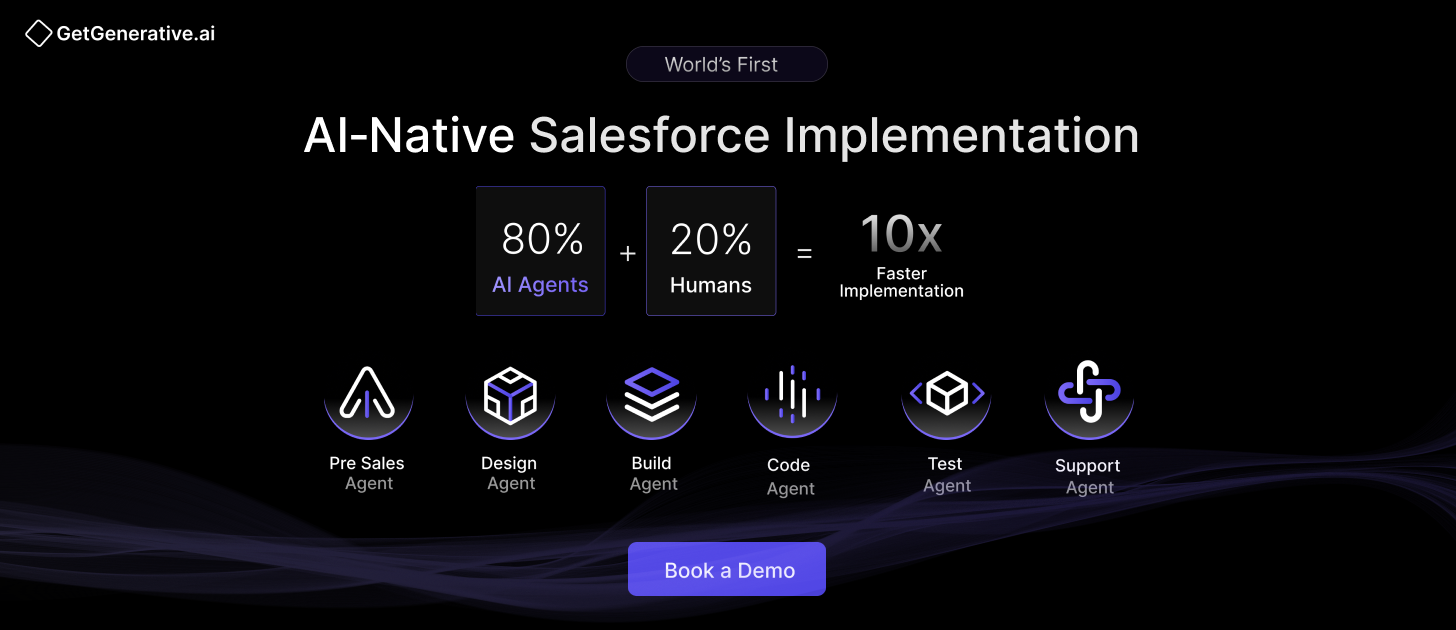
Six agents cover discovery, metadata, design, build, testing and support, and each delivery pod is led by a Forward Deployed Engineer who reviews what the agents produce. Delivery is AI-first and human-reviewed, which is a statement about where accountability sits rather than a claim that the agents run unsupervised.

Set $200 a month against the day rate of a single consultant and the comparison makes itself. The relevant question is not whether the platform is cheaper than a person. It is which of the four meters the platform actually touches, and the answer is the fourth one.

Teams that want the labor meter costed properly can start with AI-first Salesforce implementation services.

Five questions expose the cost a Salesforce proposal has not shown you

Each of these is answerable in one meeting, and each maps to a meter.

  1. Which sandbox types are in scope, and at what percentage of net spend? If the proposal names environments without naming percentages, the environment cost is not in the total.
  2. What is our projected Flex Credit consumption at steady state? A partner who cannot model actions per case has not designed the agent, only demonstrated it.
  3. What is the team shape, not the team cost? Number of people and seniority distribution. The total conceals both.
  4. What does the number assume about our existing org? Inherited complexity is the most common source of change requests.
  5. What does year two cost with no project running? If nobody has produced that figure, the business case is incomplete.

Questions buyers ask about Salesforce implementation cost

How much does a Salesforce implementation cost in 2026?

Any single range is misleading, because the cost runs on four separate meters. Subscription, percentage-linked environments and agent consumption are all published by Salesforce and can be calculated exactly. Delivery labor is not published and varies by an order of magnitude for identical scope depending on the staffing model. A sixty-user Sales Cloud Enterprise build with one Partial Copy sandbox and one moderately used service agent totals about $180,000 a year in platform cost alone, before delivery.

What does Sales Cloud cost per user in 2026?

Salesforce lists Starter Suite at $25, Pro Suite at $100, Enterprise at $175, Unlimited at $350 and Agentforce 1 Sales from $550, all per user per month billed annually except Starter, which can be billed monthly. Unlimited bundles the Premier Success Plan and a Full Sandbox, which are charged separately at lower editions. At list price the equivalent Enterprise stack costs $280, so the real Unlimited premium is $70 per user per month rather than $175.

How much do Salesforce sandboxes cost?

Developer sandboxes are included with CRM licenses. Developer Pro costs 5 percent of net spend, Partial Copy 20 percent and Full Copy 30 percent. Because they are priced as a percentage rather than a flat fee, environment cost re-prices itself automatically whenever subscription spend changes. Support is priced separately, with the Premier Success Plan at 30 percent of net license fees and bundled into Unlimited Edition.

How much does an Agentforce action cost?

Salesforce prices Flex Credits at $500 per 100,000 credits, which is half a cent per credit. A standard Agentforce action consumes 20 credits and therefore costs 10 cents. An Agentforce Voice action consumes 30 credits and costs 15 cents.

Is the Agentforce add-on cheaper than paying per action?

It depends on volume, and the crossover is calculable. The add-on costs $125 per user per month, so sixty users cost $90,000 a year, which buys 900,000 metered actions at 10 cents each. That works out to roughly 1,250 agent actions per user per month. Below that, metering is cheaper. Above it, the unmetered add-on is.

Does AI actually reduce Salesforce implementation cost?

It reduces one of the four meters. AI does not change subscription pricing or percentage-linked sandbox cost, and it increases consumption cost because agents are what consume credits. It reduces delivery labor by absorbing artifact production such as requirement capture, documentation, configuration and test case generation, while architecture, prioritization and accountability stay with a human.

What is the biggest hidden cost in a Salesforce implementation?

Percentage-linked environment cost and steady-state agent consumption, because neither appears as a line in a typical implementation proposal and both continue after the project ends. Year two carries three of the four meters with no project attached.
Salesforce Technical Debt: How to Find It, Measure It and Pay It Down

Salesforce technical debt is the accumulated cost of configuration and code that works today and constrains change tomorrow. It raises the price of every subsequent project, and most organizations carry it without a number attached to it.

This page does three things in sequence. It defines technical debt using the measurements that exist rather than metaphors. It shows the native Salesforce instruments that expose debt at no cost. It sets out how remediation gets sequenced, and where AI both helps and hurts.

McKinsey defines technical debt as off-balance-sheet technology work

The most useful definition comes from finance rather than engineering.

McKinsey’s research on measuring and taming technical debt describes it as the off-balance-sheet accumulation of all the technology work a company needs to do in the future, and compares it to dark matter: you know it exists, you can infer its impact, and you cannot see or measure it directly.

That framing matters for Salesforce specifically. A Salesforce org does not present a bill for its debt. It presents a slower change request, a longer estimate, a failed deployment, or an admin who declines to touch a flow nobody documented. The cost is real and it arrives distributed across every future project rather than as a line item.

Salesforce technical debt takes a particular shape because the platform is configurable by people who are not developers. Fields, flows, validation rules, permission sets and page layouts all accumulate without a code review, which means debt in Salesforce grows through clicks as readily as through code.

Technical debt consumes over 20 percent of the technology budget at 30 percent of companies

The numbers on this subject come from a McKinsey survey of 50 CIOs at financial services and technology companies with revenue above $1 billion, alongside analysis of 220 companies across five geographies and seven sectors.

FindingFigure
CIOs who believe more than 20% of their new-product technology budget is diverted to tech debt30%
CIO estimate of tech debt as a share of total technology estate value, before depreciation20% to 40%
Firms that completed modernization programs and still failed to reduce technical debtAlmost half
Revenue growth advantage of the 80th percentile Tech Debt Score against the bottom 20th20% higher
Increased likelihood of incomplete or canceled modernization in the bottom 20th percentile40%
Share of IT change spend the bottom 10th percentile puts into applications they would retireAlmost half

Two of those findings deserve isolating.

Almost half of completed modernization programs failed to reduce technical debt. Spending money on modernization does not, on its own, pay debt down. McKinsey attributes this to organizations modernizing applications that were not major debt contributors.

Age does not predict debt. McKinsey reports little correlation between the age of an enterprise and its level of technical debt, and cites a bank founded more than fifty years ago that reached the top 20 percent of Tech Debt Scores. A five-year-old Salesforce org can carry more debt than a fifteen-year-old one.

One insurer in the same research found technical debt amounted to 15 to 60 percent of every dollar spent on IT, a figure absent from the business cases that had been failing to win approval.

Salesforce groups technical debt into security gaps, conflicting truth and outdated automation

Most articles on this topic borrow a generic software-engineering taxonomy. Salesforce publishes its own, and it is more useful because it is platform-specific.

The Trailhead technical debt module is an intermediate-level, administrator-audience badge running roughly one hour forty-five minutes, structured in four units:

UnitWhat it targets
Manage Technical DebtPrioritizing debt by risk
Close Security GapsPermissions, profiles and access that accumulated without review
Maintain One Version of the TruthDuplicate and conflicting sources of the same data
Update AutomationsLegacy automation that still runs and is no longer supported

Read those four together and Salesforce is making a claim about where debt actually concentrates in its platform: access, data truth, and automation. Not code volume. Not field counts.

The module sits on the Build Your Architect Career trail, and Salesforce lists AI Ethics and Trust among the skills it develops. That inclusion on a technical debt module is a signal in itself: Salesforce connects org hygiene to whether AI can be trusted to act on the org.

A messy org differs from technical debt in what cleanup can repair

The distinction decides whether your remediation plan should be a tidy-up or a redesign, and teams frequently pick the wrong one.

Clutter is unused fields, duplicated reports, inconsistent naming and stale dashboards. Clutter slows people down. Disciplined cleanup removes it.

Technical debt is brittle architecture. Three automations firing on the same object in an order nobody controls. A data model where one business concept lives in four objects. A permission structure where nobody can say who sees what. Cleanup does not fix any of that, because the problem is the shape rather than the volume.

The test is simple. Ask whether deleting things would solve it. If yes, it is clutter. If deleting things would break something and nobody is confident which thing, that is debt.

Both are worth addressing. Only one of them justifies a project.

Salesforce exposes technical debt through six native instruments at no cost

Vendor tools for this problem are good and most organizations buy one eventually. Before that, the platform already reports on itself, and these six are free.

Org Check. Salesforce retired the Optimizer app with the Winter ’26 release, and the Salesforce Labs project Org Check replaced it. It reports unused and inefficient components, maps technical debt across metadata, and scores the org against best practice. It installs from AppExchange or runs as an sf CLI plugin against any org.

Security Health Check. Scores the org’s security settings against a Salesforce baseline and lists every setting below it. This is the Close Security Gaps unit made measurable.

The Usage tab in the Automation Lightning App. Shows flow dependencies and the impact of a change before you make it. The instrument that prevents remediation from creating new incidents.

Field usage and object limits in Setup. Custom field counts per object against edition limits give a hard ceiling, and objects approaching that limit are usually the ones carrying the most unexamined history.

Apex test results and code coverage. Coverage above the 75 percent deployment threshold with assertions that verify nothing is a specific and common form of code debt. Reading the tests matters more than reading the percentage.

Debug logs and the Apex exception email. Recurring runtime errors nobody has claimed are debt that has already started charging interest.

None of those requires budget approval. All of them produce numbers you can put in front of a finance leader, which is the step that most remediation proposals skip.

Deployment time inflation measures Salesforce debt better than component counts

Component counts describe size. They do not describe cost. An org with 900 fields and clean architecture is healthier than an org with 300 fields and six competing automations.

The measurement that tracks the actual burden is how long a standard change takes now against how long the same change took a year ago.

Pick three representative changes and time them:

  1. Add a custom field to a core object and expose it to one profile. Baseline: under an hour.
  2. Modify a validation rule on an object with existing automation. Baseline: under half a day including verification.
  3. Deploy a small change from sandbox to production. Baseline: same day.

If those take multiples of the baseline, the difference is the interest payment. That number converts directly into money, and it is the number that gets remediation funded, because it answers the question a CFO asks: what is this costing us now.

Two supporting measures are worth tracking alongside it. Failed deployment rate indicates hidden dependency debt. Time from ticket raised to root cause identified indicates documentation debt, because a team that understands its own org diagnoses quickly.

AI code generation adds technical debt faster than most teams measure it

This deserves a direct answer from a firm that builds with agents, because the concern is legitimate and currently one of the most active discussions in the Salesforce practitioner community.

Generative tools produce Salesforce configuration and Apex at a speed no human matches. Output volume is no longer the constraint. Three failure modes follow from that.

Generated code inherits no architectural context. A model asked for a trigger produces a working trigger. It does not know that two other automations already fire on that object, and it does not know your naming convention or governance standard unless the surrounding system supplies them.

Review capacity becomes the bottleneck. Debt accumulates when the rate of change exceeds the rate of considered review. Faster generation without faster review is a debt accelerator, whatever the quality of any individual output.

Plausible output passes inspection. Generated Apex reads well. Reading well and behaving correctly against ten thousand records under governor limits are different properties, and the first one is easier to mistake for the second.

The determining factor is not whether AI writes the code. It is whether the system generating the code holds context about the org and whether a senior engineer owns the judgment. Generation without org context and without review produces debt at scale. Generation grounded in the org’s actual metadata, with an experienced engineer accountable for what ships, does the opposite.

GetGenerative.ai agents review, remediate and run Salesforce orgs

Our managed services model is built around this problem, and three agents map to three stages.

Metadata Agent reviews. It builds a complete as-is view of the org from metadata, configuration, code, architecture patterns and Salesforce MCP connections. It identifies technical debt, detects architecture drift, surfaces risk and complexity, and prioritizes remediation actions.

Build Agent remediates. It converts remediation priorities into implementation workbooks, configuration changes, code updates and deployment-ready fixes, then deploys to sandbox.

Support Agent runs. It handles bugs, enhancements and business-as-usual requests with AI-led triage, impact analysis, fix generation, testing and documentation.

The reason this addresses the AI debt problem rather than adding to it sits in the context layer. The platform connects four sources before recommending anything: business process, metadata, code base and Salesforce MCP. An agent that can see the automations already firing on an object, the dependencies attached to a field, and the business process behind both, produces different output than one working from a prompt alone. Salesforce FDEs then own architecture alignment, quality and governance.

The full loop runs review, prioritize, remediate, resolve, validate, improve. Because analysis, documentation, fix preparation and testing absorb most of the manual effort in traditional support, automating them is what takes managed services cost down by up to 80 percent while experts stay in control.

If you want the measurement before the commitment, the complimentary Org Review produces a health check, a technical debt assessment, a remediation roadmap and five open support tickets fixed in one day, with 30 days of platform access, at no cost. Details are on AI-powered managed services, and the wider health-check framework sits in the org assessment that finds it.

Remediation sequences by risk rather than by ease

The instinct is to start with the easiest items. The evidence argues against it: McKinsey found almost half of completed modernization programs failed to reduce technical debt, largely because organizations modernized what was convenient rather than what was expensive.

A defensible sequence runs in four passes.

Pass one: security and access. Overlapping permission sets, profiles nobody owns, sharing rules with no stated purpose. This is first because it carries compliance exposure as well as change cost, and because Salesforce puts it first.

Pass two: unsupported automation. Anything still running on retired tooling. It works, nobody supports it, and every release is a risk carried without a support path.

Pass three: duplicate truth. Two fields holding the same business concept, two objects modeling one process, two reports producing different answers to the same question. This is the pass that restores trust in reporting.

Pass four: clutter. Unused fields, stale dashboards, orphaned components. Worth doing, and worth doing last, because it produces the least risk reduction per hour spent.

Two disciplines make the sequence hold. Delete rather than deactivate, because a deactivated component still counts against limits and still confuses the next person. And check dependencies before every change, using the Usage tab, because remediation that creates an incident stops the program.

McKinsey’s operating-model recommendation applies here too: price technical debt into all IT services, so that the cost of the debt any new work creates is visible at the point the work is approved rather than three years later.

Salesforce technical debt, condensed

DefinitionOff-balance-sheet accumulation of technology work a company must do in future
Salesforce concentration pointsSecurity gaps, conflicting sources of truth, outdated automation
Share of technology budget divertedOver 20% at 30% of surveyed companies, per McKinsey
Debt as share of technology estate value20% to 40%, per CIO estimates
Modernization programs that failed to reduce debtAlmost half
Revenue growth advantage of the top TDS percentile20% higher than the bottom 20th percentile
Correlation with company ageLittle to none
Best free measurement toolsOrg Check, Security Health Check, Automation Usage tab, field and object limits, Apex coverage, debug logs
Best business measureDeployment time inflation against a prior baseline
Remediation orderSecurity, unsupported automation, duplicate truth, clutter
Biggest new riskGeneration speed exceeding review capacity

Questions teams ask about Salesforce technical debt

What is Salesforce technical debt?

Salesforce technical debt is the accumulated cost of configuration and code that functions now and constrains change later. McKinsey defines technical debt generally as the off-balance-sheet accumulation of technology work a company needs to do in the future. In Salesforce it accumulates through clicks as well as code, because configuration changes rarely pass through review.

How much does technical debt cost?

McKinsey’s survey of CIOs at companies with revenue above $1 billion found 30% believe more than 20% of their new-product technology budget is diverted to resolving technical debt, and that CIOs estimate debt at 20% to 40% of the value of their entire technology estate before depreciation. One insurer found debt equaled 15% to 60% of every dollar spent on IT.

How do I measure technical debt in a Salesforce org?

Start with free instruments: Org Check for unused components and limit usage, Security Health Check for access gaps, the Usage tab in the Automation Lightning App for flow dependencies, field counts against object limits, Apex coverage and assertion quality, and recurring debug log errors. Then measure deployment time inflation, which converts the finding into a cost.

What are the main types of Salesforce technical debt?

Salesforce’s own Trailhead module organizes it into security gaps, multiple conflicting versions of the truth, and outdated automations, with prioritization by risk running across all three. Configuration debt, code debt, architectural debt, integration debt and documentation debt are useful sub-categories underneath that structure.

Is a messy Salesforce org the same as technical debt?

No. Clutter is volume and cleanup fixes it. Technical debt is architecture, and cleanup does not fix it. The practical test is whether deleting things would solve the problem. If deleting would break something and nobody is confident which thing, that is debt.

Does AI increase or reduce Salesforce technical debt?

Both, depending on the surrounding system. Generation without knowledge of the org’s existing automation, naming standards and dependencies produces debt at speed, and review capacity becomes the bottleneck. Generation grounded in the org’s metadata, business process and code base, with an experienced engineer accountable for what deploys, reduces debt instead.

Where should remediation start?

With security and access, then unsupported automation, then duplicate sources of truth, then clutter. McKinsey found almost half of completed modernization programs failed to reduce technical debt, largely because organizations modernized what was convenient rather than what was costly.

Does technical debt affect business performance?

McKinsey’s analysis of 220 companies found companies in the 80th percentile of its Tech Debt Score had revenue growth 20% higher than those in the bottom 20th percentile, and that bottom-percentile companies were 40% more likely to have incomplete or canceled IT modernization programs.

Salesforce Org Analysis: The Toolchain Is Collapsing, and One Agent Replaces It

For fifteen years, understanding a Salesforce org meant assembling a toolkit. One tool for unused fields. Another for security settings. A third for static code analysis. A fourth for dependencies, a fifth for adoption dashboards, a spreadsheet to hold it all together, and a consultant to interpret the result.

That toolchain is now visibly falling apart, and not because the tools got worse. Salesforce Salesforce itself has started retiring the pieces, and because the questions businesses now ask of their orgs have outgrown what any single-lens tool can answer.

This is the story of what each tool covered, what has been retired, and why AI-driven analysis makes the entire assembly unnecessary.

Org analysis was never one discipline. It was six tools taped together.

Ask what is really happening inside a Salesforce org and you are actually asking six different questions: what exists, what is used, what is safe, what is well built, what is at its limits, and what it all costs the business. The ecosystem answered each with a different instrument.

Salesforce Optimizer was the closest thing to a native org analysis report. It flagged unused fields, unassigned page layouts, inactive validation rules, profile sprawl and limit consumption. It is gone. Orgs created after 31 March 2025 never received it, and the Winter ’26 release removed it for everyone else. Salesforce’s replacement guidance, published under the title “Optimization without Salesforce Optimizer”, splits the old report’s functions across Setup pages and third-party channels. The official successor is Org Check, a Salesforce Labs project shipped as an AppExchange app and an sf CLI plugin: useful, free, and by its own definition a scanner rather than an assessment.

Security Health Check survives, but it was never an org analysis tool. Salesforce’s own documentation for Security Health Check scopes it precisely: identify and fix vulnerabilities in security settings, from a single page. Password policies, session settings, sharing defaults, login access. The score is a comparison against a baseline, weighted by risk category. It tells you nothing about how many flows fire on Opportunity, whether your Apex compiles against the current API version, or which fields nobody has touched since 2022.

Static code analysis tools read the codebase and flag rule violations. Salesforce Code Analyzer is the native example, a unified tool that runs in the Salesforce CLI, VS Code, GitHub Actions and DevOps Center Testing, bringing together scanning engines including PMD and RetireJS. Powerful within their lane, blind outside it. A static analyzer sees an Apex class. It does not see the flow that duplicates the class’s logic, the integration that depends on it, or the business process it exists to serve.

Dependency and impact tools map what touches what, at the metadata level. DevOps platforms track what changed and when. Adoption dashboards count logins and page views. Each answers its one question. None of them talk to each other, and the developer experience of running an assessment is stitching their outputs together by hand.

The result was predictable. A proper org assessment became a one-week, two-person engagement covering extraction, correlation, interpretation and report, and it was obsolete within a quarter because the org kept changing while the document did not.

The tools were never the problem. The seams between them were.

Every serious org finding lives in a seam that no single tool can see.

An integration user with Modify All Data is a line item in a security review. The same finding becomes urgent when you know that user authenticates a callout with no retry handling, sitting under the order fulfillment process, on an object where a flow and an Apex trigger both write the same field. Four tools each hold a quarter of that sentence. The finding is the sentence.

A field with no recent history is a cleanup candidate in Optimizer’s old report. Whether it can actually be deleted depends on whether a report filter reads it, an integration payload carries it, and a team three time zones away keys a manual process off it. The delete decision lives across data, metadata and usage at once.

This is why the pile of tool outputs never became a decision. Tools produce component-level facts. Businesses need system-level judgment. Bridging that gap was the expensive human part, and it is precisely the part AI now does.

What changes when one agent reads everything at once

GetGenerative.ai built its Org Review Agent on a simple architectural bet: give a single AI agent live, read-only access to the data, the metadata, the codebase and the setup configuration at the same time, and the seams disappear. The agent inventories metadata, extracts source XML, maps dependencies, reads the automation and the code as one system, and translates all of it into natural-language documentation with every finding linked back to the source component that proves it.

Read-only by default, customer-controlled access, no production changes without approval. The point is not another scanner. The point is that the six questions that used to need six tools now get answered by one system that can hold them together. Here is what that makes possible, starting with the analyses the old toolchain could not perform at all.

Adoption health check

Adoption tooling counted logins. An agent with simultaneous access to data and metadata measures something different: whether the business process as designed is the business process as run. It traces an end-to-end journey, a lead-to-cash flow for example, and reports where users follow the designed path and where they route around it: stages skipped, fields left empty at the moment they mattered, records created through side doors the process never anticipated. The same lens applies to case management, data quality regimes, and any process the org was built to run. Adoption stops being a login count and becomes a per-process, per-team finding with evidence attached: which teams have absorbed the platform, which are working against it, and where enablement investment should actually go.

Integration architecture review

Because the agent reads code, automation, objects and configuration together, it reconstructs the full integration picture: how each integration is built, what authenticates it and at what privilege, which business processes depend on it, what volume moves through it, and where the failure points sit. It surfaces exactly the seam-dwelling risks described above: the over-permissioned integration user, the callout with no error path under a revenue-critical process, two systems writing the same object with no ordering guarantee. The output is a system map with business impact and fragility scored, not a list of connected apps.

Deep code and configuration analysis

This goes past what static analysis alone can reach. The agent reads the entire repository file by file against architectural best practice, covering code quality, configuration quality, standards violations, logic leaked between layers, and patterns that survive today’s volume but break at tomorrow’s. Because it sees code and configuration side by side, it catches the class of problem single-lens scanners structurally miss: automation duplicated between flow and Apex, hard-coded references that will not survive a sandbox refresh, bulk-unsafe logic waiting for the first mass data load. Every finding lands with the reason it matters and the shape of the fix.

Reverse-engineered org documentation

Most orgs run on documentation that stopped being true several release cycles ago, if it existed at all. The agent rebuilds it from the one source that cannot lie: the org itself. It stitches objects, fields, data and automation into generated business-process diagrams, entity relationship diagrams, automation maps, integration architecture and security-access maps. The org is explained in business language, derived from metadata rather than memory. Teams can then interrogate it directly: what updates Opportunity Stage? Which processes depend on this field? Show me every automation that can change Opportunity Amount and the systems affected downstream. Documentation becomes something you query, and because the agent can re-run continuously, it stays true as the platform changes.

Migration assessments

For teams weighing a platform move, whether an older quoting solution to the current revenue platform or a horizontal cloud to its industry-specific successor, the agent runs the fit-gap between what has been built and the capabilities of the target: which customizations the new platform absorbs natively, which need rebuilding, which should be retired rather than carried across, and where the data model translates cleanly versus needs rework. From that it sequences how migration and activation would actually run: what moves first, what runs in parallel, where risk concentrates. What used to be a multi-week paid discovery engagement becomes an assessment artifact produced from the org as it stands.

Legacy architecture identification

Orgs accumulate yesterday’s best practice, and nobody circles back to retire it. With current industry knowledge and live research capability, the agent compares the org against what the ecosystem does now: superseded patterns, products running past end-of-life, workarounds built for platform limitations that no longer exist, decisions that were right five years ago and are liabilities today. Each finding arrives as a fit-gap against the modern approach with the target solution attached. It is not a diagnosis that the org is dated, but the specific path to current.

One review, twelve lenses, three audiences

The agent evaluates the catalog it builds through twelve review lenses. They are architecture and design quality, technical debt, security and access, data quality and model, automation quality, performance and scalability, integration health, usage and adoption, release health and environment drift, maintainability, business-process fit, and AI and Agentforce readiness, with everything assessed against Salesforce Well-Architected principles.

And because one report satisfying everybody satisfies nobody, the output splits by audience. Leaders receive the Overall Health Check: an executive scorecard, risk summary, value leakage, critical findings heatmap and a phased roadmap, with every score linked to the findings and source metadata behind it. Architects and admins receive the evidence layer: the technical debt inventory, which is the artifact behind measuring technical debt, the Well-Architected alignment review, the searchable metadata catalog with natural-language descriptions and XML. Remediation teams receive focused worklists that export straight into a delivery backlog, which is where planning an org cleanup begins. The roadmap itself phases naturally: stabilize and de-risk in the first ninety days, simplify and strengthen over three to nine months, modernize and re-platform beyond that.

The last tool the old model could never ship: the one that keeps watching

Here is the deepest flaw in toolchain-era org analysis, deeper than fragmentation: every output was a photograph. The org kept moving the moment the report was rendered. New releases, configuration changes, shifting volumes, permission updates and integration failures all move an org quietly toward risk, and periodic reviews reveal only a moment in time.

Org Monitoring AI closes that gap. The monitors cover the same ground as the review lenses, covering metadata and configuration drift, automation health, data quality, security and access, performance and limits, integrations, releases, adoption, and business outcomes like conversion and SLA trends. Custom monitors are built from a plain-language objective rather than query writing. Describe the risk, and the AI suggests the signals, baselines and conditions. The final rule stays visible and under your control.

When a monitor trips, the alert does not die in a channel. It becomes a structured ticket in the Support Agent, carrying the evidence forward: affected scope, correlated changes, likely root cause and recommended resolution. Recovery is verified against the originating monitor. Signal, context, ticket, triage, resolution, verified recovery. The assessment stops being an event and becomes a state the org is kept in, which is the one deliverable the old toolchain was structurally incapable of producing.

Where to start

The entry point is an Org Review. Authorize read-only access, define scope and objectives, and receive the health check, the technical debt assessment, the living documentation and the remediation roadmap, with monitors added afterward so the picture never goes stale. Teams typically start one before a transformation, after years of accumulated change, following team or partner turnover, ahead of a major release, during an audit, or when Salesforce ROI has become hard to explain.

The toolchain era gave you six instruments and left you to be the system that connected them. That job now belongs to the agent, working alongside the Forward Deployed Engineers who act on what it finds.

Questions teams ask about Salesforce org analysis

Is Salesforce Optimizer still available?

No. Orgs created after 31 March 2025 never received the app, and the Winter ’26 release retired it for all remaining organizations. Salesforce published replacement guidance titled “Optimization without Salesforce Optimizer”, and the Salesforce Labs project Org Check, an AppExchange app and sf CLI plugin, is the recognized successor for metadata scanning.

What does Salesforce Security Health Check actually cover?

Security settings only. It compares your configuration against a baseline, by default the Salesforce Baseline Standard, weighted by risk category. It reports nothing about metadata volume, code quality, automation, adoption, data quality or limits.

Why do traditional org assessments require so many tools?

Because each tool answers one question: Optimizer-class scanners covered unused metadata, Health Check covers security settings, static analyzers cover code, dependency tools cover impact, and adoption dashboards cover usage. The findings that matter most sit in the seams between those views, which is the correlation work that historically required manual effort.

How is an AI-driven org review different from running these tools?

A single agent reads the data, metadata, codebase and configuration simultaneously, so findings arrive already correlated: an access risk connected to the integration it authenticates and the business process it endangers. Every finding links to the source metadata that proves it, and the analysis re-runs continuously instead of expiring.

Does the Org Review Agent make changes to the org?

No. Access is read-only by default and customer-controlled, findings are linked to source metadata, and no production change happens without approval.

Can the agent document an org nobody understands anymore?

Yes. It reverse-engineers living documentation from the org itself: natural-language explanations of every component, dependency maps, and generated diagrams covering business processes, entity relationships, automation paths, integration architecture and access models, all of it searchable and interrogable in plain English.

What happens after the review?

Findings become a phased remediation roadmap and can be exported into a delivery backlog. Org Monitoring AI then watches for drift, degradation and emerging risk, turning material alerts into structured support tickets with evidence attached and verifying recovery once resolved.

The Forward Deployed Engineer Model for Salesforce Delivery

A Forward Deployed Engineer builds and deploys software inside the customer’s organization rather than from a distance. In the Salesforce ecosystem that role has moved from borrowed terminology to formal structure in under two years: Salesforce stood up its own FDE team in April 2025, committed to hiring a thousand of them, and launched a partner network around the methodology in April 2026.

The numbers below are from Salesforce’s own reporting and announcements. So is the case for the model, and so are its limits.

Palantir pioneered the forward deployed engineer role in the early 2010s

The provenance matters because it explains what the role was designed to solve, and Salesforce documents it directly rather than leaving it to inference.

Salesforce’s own account of the role states that Palantir pioneered the forward deployed engineer in the early 2010s, embedding engineers directly with customers, mostly government agencies, to help implement products. Palantir called these engineers Deltas, and until 2016 the company had more Deltas than software engineers.

That ratio is the most instructive fact about the model’s origins. A software company with more customer-embedded engineers than product engineers is making a specific bet: that the hard part is not building the software but making it work inside one organization’s data, permissions and processes.

The role stayed niche for a decade. It moved when AI deployment created the same problem at scale, and the venture firm a16z summarized why in a line Salesforce quotes: enterprises buying AI are like your grandmother getting a smartphone, in that they want to use it but need someone to set it up.

Forward deployed engineer job postings grew more than 800% in nine months

The scale of the shift is measurable rather than anecdotal.

Salesforce cites analysis by Indeed and the Financial Times finding that job postings for this role soared by more than 800% between January and September 2025.

Three data points give that number context:

SignalDetail
Salesforce team launchApril 2025
Salesforce hiring commitmentA team of 1,000 FDEs
Other companies hiring the titleOpenAI announced FDE teams; Amazon Web Services and Anthropic hire under it
Salesforce’s own posted rangesForward Deployed Consultant roles listed at $99,400 to $186,300; FDE mid and senior roles listed at $88,970 to $287,910

The salary spread on those two Salesforce postings is the detail worth pausing on. A range from roughly $89,000 to roughly $288,000 under a single job title tells you the market has not settled on what the role is. Employers are using one label for work that ranges from senior consulting to principal engineering.

Salesforce FDE pods pair one deployment strategist with two engineers

Salesforce publishes how its own teams are structured, which gives buyers a reference model rather than a marketing description.

Many Salesforce FDEs work individually with a customer. Others work in pods of one deployment strategist and two forward deployed engineers. The division of labor is explicit:

The deployment strategist identifies the best use case for the company and creates the overall AI strategy.

The two FDEs design, build and deploy the agent. Salesforce describes them as the team’s technical architects and primary coders.

Pods focus full time on one client for about three months, or as long as it takes to deploy an agent for one or two use cases. Some travel to the customer and embed in day-to-day work.

Two things in that structure are worth copying regardless of who delivers your project. Strategy and build sit in the same pod rather than in separate contracts, and the engagement is scoped to one or two use cases reaching production rather than to a feature list.

Salesforce launched the FDE Partner Network on 15 April 2026

The model moved outside Salesforce’s own delivery organization sixteen months after the team launched.

Salesforce launched the Forward Deployed Engineering Partner Network on 15 April 2026, extending its engineering expertise and product roadmap access to a selected group of partners.

Launch partnersAccenture and Deloitte
Total membershipOver 30 firms
Named global membersCapgemini, Cognizant, IBM Consulting, KPMG, PwC, Slalom, Tata Consultancy Services
Named regional membersInspireAI, OSF Digital, Rosetree Solutions, TerraSky, Twoday Oy, plus more than 20 additional firms
Product Development OutsourcersAppiphony, Aquiva Labs, Bridgenext, applying the same standards to AgentExchange apps

Salesforce describes the network as an exclusive designation that prioritizes technical rigor and production outcomes over firm size or tenure, and states that member firms have driven one third of all successful Agentforce implementations to date.

Members receive a direct line to internal Salesforce product teams. The stated reason for the network is an execution gap: Salesforce cites IDC FutureScape predicting that over one third of organizations will remain stuck in the experimental, point-solution phase of AI and need to shift focus to enterprise use cases to deliver return.

The FDE Partner Network ties partner incentives to agents reaching production

One clause in the announcement changes the commercial logic of Salesforce delivery, and it deserves isolating.

Salesforce states that by tying partner incentives to agents reaching production, every engagement is oriented toward measurable business value.

Traditional implementation economics reward hours billed and milestones accepted. A project can be fully invoiced, formally signed off, and produce nothing anyone uses. Attaching the incentive to production removes that outcome from the partner’s win condition.

Salesforce’s President of Global Professional Services frames the shift as a change of discipline rather than a change of process: getting AI into production is engineering, and the network extends internal skills and standards outward. Deloitte’s Salesforce alliance lead describes the same thing as a move from traditional implementation to embedded engineering.

For a buyer, that produces one question worth asking every candidate: what does your commercial arrangement actually reward? If the answer is a signed milestone, the incentive and the outcome are not aligned.

Salesforce structures FDE delivery into four defined components

The April 2026 announcement publishes an example delivery model. It is unusually specific for a vendor and works as a checklist against any proposal.

Solution architecture design. Before code is written, the FDE defines how the agent connects to enterprise data, what permissions govern its actions, and where compliance controls sit. Salesforce is explicit that this is aligned to best practice from day one rather than retrofitted at the end.

Agentic design. A blueprint for how the agent behaves in production. Every decision, action and escalation path is mapped, with trust guardrails and compliance checks in place before the build phase starts.

Go-live and post-activation hypercare. Engineers stay engaged after launch to monitor agent behavior, resolve issues that only appear in production, and tune for sustained performance. Salesforce’s framing is that launch day is the starting line rather than the finish line.

Adoption and change management. The stated reasoning is that the most technically perfect agent fails if users do not trust it, so readiness, onboarding and long-term usage sit inside the engagement.

A proposal covering build and go-live while treating hypercare and adoption as paid extras is not describing this model, whatever it is called.

Forward deployed engineers supervise agents rather than write every line

This is where the role diverges most sharply from the consultant it superficially resembles, and it explains why the model surfaced now rather than a decade ago.

Conventional software behaves identically every time. Specify it, build it, test the output against the specification, done. An agent reasons over data, selects among permitted actions, and produces outcomes that are acceptable in aggregate rather than identical on repeat.

That changes supervision in three specific ways.

Correctness becomes a range, not a match. Testing an agent means observing behavior across many inputs. Nobody performs that from outside the customer’s data.

Guardrails become a design artifact. What the agent may do, what it must escalate, and what evidence it may act on are decisions made before build, which is exactly what Salesforce’s agentic design component covers.

Production reveals behavior a sandbox cannot. Agents meet inputs nobody imagined, which is why hypercare sits inside delivery rather than in a support contract.

The same logic applies to the agents doing the delivery work. When agents draft requirements, generate configuration and produce test cases, someone senior has to judge whether the output is right for this organization. Volume of output stops being the constraint. Judgment becomes the constraint, and that is the job.

Agentforce Observability originated as FDE customer feedback

The clearest evidence that the model produces something beyond faster projects is what it has already changed in the product.

Salesforce reports that early FDE customers asked for better ways to measure agent performance. The engineers passed that back to product and engineering, and Salesforce built Agentforce Observability, a set of tools for analyzing, monitoring and improving agent performance. Customers also wanted to understand how agents arrived at answers, which produced session-data tracing in Agentforce.

That is the two-way street the role is designed to create. A partner implements what exists. An embedded engineer reports what is missing, and in these two cases the gap became product.

Salesforce also describes the failure the role exists to prevent, in a line from FDE director Sarah Khalid: without FDEs, the risk is thousands of customers stuck in pilot purgatory, signed up but never successfully deployed. Set that against the IDC prediction above and the two describe the same problem from opposite ends.

FDE access runs through the Momentum program by account executive nomination

Worth knowing before assuming Salesforce’s own engineers are available to any customer who asks, because at present they are not.

To work with Salesforce FDEs, a customer must be nominated by their account executive for the Momentum program, which is offered to selected customers at no cost. Salesforce describes it as an investment in its customers, and has said that within the following year customers will also be able to purchase FDE services.

Two practical consequences follow.

Availability is rationed. A thousand engineers against Salesforce’s customer base means most organizations will not access the internal team, which is precisely why the partner network exists.

Salesforce distinguishes FDEs from partners deliberately. Its own description is that partners do the detailed work of implementing technology, while FDEs contribute behind-the-scenes product knowledge a partner may not hold. The two are complementary rather than competing, and the partner network is the attempt to put both in one team.

The role carries constraints its advocates rarely publish

A category page that only sells the category is not useful, so here is the other side.

Seniority is structural, not preferable. The model depends on someone able to make architecture decisions in the room without escalating. Salesforce’s own skills list puts problem-solving first, ahead of technical ability, and requires business acumen and customer-facing communication alongside it. Firms staffing these engagements with junior consultants are selling the label.

Onboarding is substantial. Salesforce runs a six-week program called Ready in Six for new FDE hires, including technical training, field work and a capstone project with a two-week on-site intensive. A role needing six weeks of dedicated onboarding at the vendor is not one a partner can staff casually.

The work does not suit everyone. Reporting on the role notes engineers who find it undesirable, citing travel and the pressure of solving customer problems on short timeframes.

It does not suit every project. Stable, well-understood scope is served better by a conventional fixed-price implementation. Embedded engineering buys flexibility, and paying for flexibility you will not use is waste. Where projects go wrong for other reasons is covered in why traditional delivery fails.

GetGenerative.ai runs FDE pods with six agents supervised by one engineer

Salesforce’s pod pairs one strategist with two engineers. Our version replaces the second engineer with agents, for a specific reason: the work that second engineer historically absorbed was largely artifacts rather than decisions.

Each GetGenerative.ai pod is led by a Forward Deployed Engineer with a minimum of twelve years of Salesforce delivery experience. Six purpose-built agents work inside the pod as team members:

AgentWhat it produces
DiscoveryBusiness and solution context from workshops and existing material
MetadataA read of the existing metadata in the org
DesignSolution designs, user stories and acceptance criteria
BuildConfiguration and code
TestTest plans, execution and quality evidence
SupportIssue diagnosis and resolution across environments

The engineer owns architecture, judgment, stakeholder alignment and delivery leadership. The agents absorb requirement capture, design documentation, configuration, test cases and the documentation nobody writes. Pods scale from one for a focused single-cloud build, to two or three for multi-workstream programs, to several under shared architecture and common governance for multi-cloud or multi-region work.

Delivered to date: 200+ projects across 8+ countries and 7+ industries, on a platform trained across 30+ Salesforce clouds spanning core, industry clouds, Data 360 and Agentforce.

Where that lands against project duration by size is set out in realistic timelines by size, and the pod structure in detail sits at FDE-led delivery pods.

The Forward Deployed Engineer model, condensed

DefinitionA customer-facing engineer who builds and deploys inside the client organization
Pioneered byPalantir, early 2010s, engineers called Deltas
Delta ratioPalantir had more Deltas than software engineers until 2016
Job posting growthMore than 800% between January and September 2025, per Indeed and Financial Times analysis
Salesforce team launchApril 2025
Salesforce hiring commitment1,000 forward deployed engineers
Salesforce pod shapeOne deployment strategist plus two engineers, roughly three months full time on one client
Customer accessNomination by account executive into the Momentum program, currently at no cost
Partner network launch15 April 2026, Accenture and Deloitte plus over 30 firms
Network track recordOne third of all successful Agentforce implementations
Incentive modelPartner incentives tied to agents reaching production
Four delivery componentsSolution architecture design, agentic design, go-live and hypercare, adoption and change management
Products the model producedAgentforce Observability, session-data tracing
OnboardingReady in Six, a six-week program for new Salesforce FDE hires

Questions teams ask about the Forward Deployed Engineer model

What is a Forward Deployed Engineer?

An engineer who builds and deploys software inside the customer’s organization rather than remotely, working alongside that customer’s people for a defined period. Salesforce describes the role as part technical expert, part business consultant, and states that Palantir pioneered it in the early 2010s under the internal name Deltas.

Does Salesforce employ Forward Deployed Engineers?

Yes. Salesforce launched its FDE team in April 2025 and has committed to building a team of 1,000. Some engineers work individually with customers and some work in pods of one deployment strategist and two engineers, typically full time on one client for about three months.

How do customers get access to Salesforce FDEs?

Currently by nomination from their account executive into the Momentum program, which Salesforce offers to selected customers at no cost. Salesforce has said customers will also be able to purchase FDE services within the following year.

What is the Salesforce FDE Partner Network?

A partner network launched on 15 April 2026 that extends Salesforce’s engineering methodology and product roadmap access to selected firms. Accenture and Deloitte were the launch partners, joined by over 30 firms including Capgemini, Cognizant, IBM Consulting, KPMG, PwC, Slalom and Tata Consultancy Services. Salesforce states member firms have driven one third of all successful Agentforce implementations.

How is an FDE different from a Salesforce consultant?

A consultant generally starts from signed scope and finishes when requirements are accepted. An FDE starts from a business problem, works inside the customer’s environment, and finishes when the solution runs in production and is used. Salesforce’s own model includes post-activation hypercare and adoption inside delivery rather than as separate contracts.

Why did FDE demand grow so quickly?

Because deploying AI agents into real enterprises requires work that cannot happen at a distance: reasoning over proprietary data, operating inside existing security models, and tuning behavior that only appears in production. Job postings for the role grew more than 800% between January and September 2025 according to Indeed and Financial Times analysis.

What skills does a Forward Deployed Engineer need?

Salesforce lists five: problem-solving first, then technical breadth across everything from Apex to custom JavaScript, communication with non-technical stakeholders, business acumen to identify what a customer actually needs rather than what they requested, and a continuous learning mindset. New Salesforce FDE hires go through a six-week onboarding program called Ready in Six.

Is the FDE model right for every Salesforce project?

No. It fits uncertain requirements, difficult data and agent deployments, where the answer has to be found inside the customer’s environment. Stable, well-defined scope is usually better served by a conventional fixed-price implementation, and embedded engineering there buys flexibility that goes unused.

How much do Salesforce Forward Deployed Engineers earn?

Salesforce’s own job postings list a range of roughly $99,400 to $186,300 for Forward Deployed Consultant roles, and roughly $88,970 to $287,910 for mid and senior FDE roles, with selected cities in San Francisco and New York treated separately. The width of that spread reflects a market that has not yet settled on what the title covers.

The Fear SaaS’s Demise due to AI Are Greatly Exaggerated

Will AI Kill Off SaaS?
There’s a growing chorus in tech claiming that advances in AI Coding tools and AI development assistants will flip the “buy vs. build” equation on its head. Some have even heralded “the end of SaaS” in this new era. The logic goes like this: If generative AI and drag-and-drop platforms make it easy for any company to build software, why would businesses keep paying for SaaS subscriptions? Why not have your team (or an AI) create a custom CRM or HR system tailored exactly to your needs?

It’s an attention-grabbing idea: SaaS is dead; every company will now become a software company. But is that really what’s about to happen? Just because you can build something custom now, doesn’t mean you should, or that most companies actually will. In fact, there are plenty of reasons to be highly skeptical that AI will spell the end of SaaS for the vast majority of businesses. Let’s break down why the “SaaS is doomed” narrative is largely hype, and why off-the-shelf software isn’t going away anytime soon.

Core Competence Over DIY Ambition

Most businesses succeed by focusing on their core competencies, the products, services, and innovations that make them competitive, and offloading the rest. Running great software systems is crucial, yes, but for a bank or a retailer, that’s a means to an end, not the end itself. SaaS exists to let companies offload complexity, things like maintenance, compliance updates, security, and integration headaches, to specialized providers, so the company can focus on what it truly excels at. In other words, if you’re, say, a healthcare firm, your time is better spent developing better patient services, not coding yet another customer management tool from scratch.

AI can crank out code, and low-code platforms let non-engineers create apps. But owning your code isn’t the same as owning your customers or outperforming your competitors. A custom CRM that saps your team’s time and budget won’t automatically give you an edge with customers. In fact, it might distract you from serving them. That’s why for decades the default decision was to buy, not build software for common needs, and that rationale isn’t magically gone. Many industries using vertical SaaS (think construction, hospitality, nonprofits, etc.) don’t even have the technical teams to leverage AI development tools in the first place. These companies are often still modernizing from spreadsheets (or pen and paper) to cloud software. The notion that they’ll suddenly start churning out sophisticated internal apps is pretty far-fetched.

The Hidden Challenges of Building It Yourself

Proponents of the “build it internally” trend often gloss over a big fact: Building great software is about a lot more than writing code. Sure, today’s AI copilots can help generate code snippets or even entire app scaffolds. But what about the whole lifecycle of a production software product used by hundreds or thousands of employees or customers? Here’s where the realities set in:

Depth of Features & Best Practices: Enterprise SaaS products, such as Salesforce or Workday, have been refined over many years. They embody countless features and industry best practices learned from serving thousands of customers. Rebuilding such depth isn’t a weekend project for an AI; it’s an endless journey. SaaS vendors specialize in their domain and ship improvements faster than most in-house teams ever could.

User Experience (UX): Designing an intuitive and efficient UX is challenging. SaaS companies invest heavily in UI/UX research because a better user experience is their competitive advantage. An internal app built by a small team is unlikely to match the polish of a market-leading SaaS that’s been refined through feedback from millions of users. Poor UX can tank adoption. Employees will resist using a homegrown tool that’s clunky or buggy, gravitating back to familiar commercial solutions.

Maintenance & Upgrades: Software is never “done.” Who will patch your custom app when bugs inevitably arise? Who will update it for new regulations or when your business processes change? In the SaaS model, the vendor handles all that. You wake up to new features and fixes on a routine basis. When you build in-house, you own the ongoing maintenance burden. That means dedicating engineering time indefinitely. It also introduces risk: internal tools can become outdated or insecure if not diligently maintained.

Security & Compliance: In an age of relentless cyber threats and evolving data privacy laws, security is a massive responsibility. Reputable SaaS providers have dedicated security teams, undergo regular audits, and comply with standards such as SOC 2 and GDPR. If you take things in-house, you assume all those obligations. You’ll need to implement proper authentication, encryption, access controls, audit logging, and continuously update them as new vulnerabilities and regulations emerge. Many organizations simply lack the in-house security expertise or resources to match what a focused vendor can do.

Integration: Modern business tech stacks are a web of integrations. Your CRM likely integrates with your email, analytics tool, finance system, and other systems. Top SaaS platforms come with rich APIs and pre-built integrations or an ecosystem of third-party plugins. A custom-built solution starts as an island. You’ll have to integrate it into everything else. That’s doable, but it’s a significant effort. Each integration is another thing to maintain whenever other apps update their APIs. With off-the-shelf software, much of this connectivity is handled or supported by the vendor and community.

Support & Reliability: When using a SaaS product, you typically have support contracts or SLAs. If something breaks, you call the vendor. If your internally built system goes down at quarter-end or loses data, guess who is on the hook? You are. That means on-call engineers for your “side” software project, and fire-fighting in the middle of the night for an app that isn’t even your core business. And what if the key developer who built your internal tool leaves the company? There’s a knowledge gap that can be painful. With a SaaS, you don’t care which engineers come and go at the vendor. The service continuity is their problem.

Building software is the easy part; building enterprise-grade software and running it smoothly at scale is the hard part.

Data Check: SaaS Isn’t Dying, It’s Evolving

If AI were indeed sounding SaaS’s death knell, we would expect to see companies massively cutting SaaS spending. In reality, SaaS usage and spending are still rising. Gartner projected SaaS end-user spending to grow about 20% in 2024 to reach $247 billion. And despite tighter budgets in 2023-24, global SaaS spend still grew by ~17.9% over a 12-month span.

At the same time, the low-code/no-code market is also growing, expected to hit around $32 billion by the end of 2024. However, note the order of magnitude difference: the SaaS market is approximately an order of magnitude larger. Companies are indeed adopting low-code tools (Gartner noted that by 2024, upwards of 75% of enterprises were using multiple low-code platforms for app development). However, they’re mostly using them to augment their operations with niche apps and automations, not to replace mission-critical enterprise systems wholesale. The rise of low-code is producing lots of small, specific applications inside organizations (think custom forms, simple workflows, department-level tools). It’s not producing thousands of full-blown alternatives to Salesforce or SAP overnight. In fact, many of those citizen-developed apps still rely on the data and foundation provided by core SaaS platforms.

The 10% (or Less) Who Should Build

To be fair, none of this is to say no company should ever build internal software with AI. There are absolutely cases where it can make sense, and those will likely increase somewhat with improved tools. If a company has truly unique processes or niche needs that off-the-shelf software can’t meet, an internal build can be justified. Additionally, organizations with already established strong engineering teams and a tech-centric culture (such as large banks or Fortune 500 companies with sizable IT departments) may be able to sustainably develop certain internal systems.

Startups, too, might choose to build a lightweight tool instead of paying for an expensive enterprise product, especially if the available SaaS is overkill.

There will be selective victories for the build approach in the coming years. Particularly, internal tools that wrap around existing systems or address very company-specific workflows. These are prime candidates for AI-assisted development, since they don’t need to be commercial-grade products with broad scope.

Conclusion: SaaS Isn’t Dead, Just Because You Can Build It Doesn’t Mean You Will

The bottom line: AI development tools are exciting, they lower barriers and will undoubtedly enable more software to be created by a wider range of people. Some businesses will take advantage of this to craft bespoke apps and maybe replace a few SaaS subscriptions. But the idea that this spells doom for SaaS as a whole is overblown. Companies have finite time, talent, and attention. For the lion’s share of needs, it’s still going to make sense to buy the solution and get back to doing what your company is actually in business to do.

Rather than the end of SaaS, we’re more likely to see an evolution of SaaS. The future is one where SaaS platforms incorporate AI and offer more flexibility, and businesses integrate a few custom-built pieces where it truly counts. It’s a hybrid model: use off-the-shelf for what’s standard, build in-house for what’s unique.

Salesforce Agentforce Pricing Guide: Plans & Costs for 2025

Salesforce Agentforce Pricing Guide: Plans & Costs for 2025

Salesforce Agentforce has quickly become one of the most talked-about innovations in enterprise AI, transforming how organizations think about automation and digital labor. With 8,000+ customers already onboard and $900 million in AI and Data Cloud revenue within just six months of launch, Agentforce signals a major shift from traditional software licensing toward outcome-based AI investment.

Yet, beneath this impressive growth lies a complex pricing structure that CIOs and enterprise leaders must navigate carefully. A recent Salesforce CIO AI Trends study revealed that 90% of CIOs believe managing AI costs limits their ability to maximize value. In response, Salesforce has rolled out multiple pricing models in 2025—from per-user licensing to consumption-based Flex Credits—creating both opportunities and challenges for buyers.

This blog breaks down Agentforce’s pricing in detail, explains the hidden costs, and compares it against alternatives like Microsoft Copilot and OpenAI Enterprise.

Understanding Agentforce’s Revolutionary Pricing Evolution

The Shift from Conversations to Actions

When Agentforce launched, Salesforce adopted a $2 per conversation pricing model. While simple, it failed to account for enterprise workflows where a single query could trigger multiple backend processes.

To address this, Salesforce introduced Flex Credits in May 2025, charging $0.10 per action. Each action consumes 20 Flex Credits, with packages sold at $500 for 100,000 credits. Unlike conversation-based pricing, this action-based model ties costs directly to real business outcomes, ensuring organizations pay only for the actual work AI agents perform.

Three Payment Models to Fit Different Needs

Salesforce unveiled three distinct pricing models, recognizing that enterprises vary in maturity and AI adoption patterns:

  1. Pay-as-you-go – Best for pilots and unpredictable workloads. Companies pay monthly for actual Flex Credit usage, ensuring maximum flexibility.
  2. Pre-commit – Offers discounted rates in exchange for upfront commitments, ideal for enterprises with predictable AI usage.
  3. Pre-purchase – The most cost-effective option for high-volume users, letting organizations buy credits in bulk and use them over time.

This tiered structure allows enterprises to match their investment strategy with business certainty and scalability goals.

Also Read – Salesforce Agentforce Limitations You Should Know in 2025

Comprehensive Pricing Structure Breakdown

Standard Add-ons: The Foundation Layer

At the heart of Agentforce pricing are standard add-ons at $125 per user/month. These cover Agentforce for Sales, Service, and Field Service, including unlimited employee-facing agent usage inside Salesforce.

Compared to building AI solutions in-house, which takes 6–12 months, Agentforce can be deployed in just 4–6 weeks. This speed translates into faster ROI, with early adopters reporting measurable value within weeks.

Premium Industry Solutions: Vertical Specialization

For organizations in highly regulated industries, Salesforce offers premium add-ons at $150 per user/month. These include solutions for:

  • Financial Services Cloud – with built-in compliance and risk management.
  • Health Cloud – with HIPAA-ready AI agents trained on medical terminology.
  • Manufacturing Cloud – optimized for industry-specific workflows.

The 20% markup reflects specialized compliance, workflows, and integrations that would otherwise be costly to build independently.

Public Sector Pricing: Maximum Compliance & Security

At the high end, Agentforce for Public Sector is priced at $650 per user/month. This reflects the stringent security measures required for government adoption, including FedRAMP High authorization and advanced compliance monitoring.

A case in point: City of Kyle, Texas, adopted Agentforce for citizen services, compliance checks, and recruitment workflows—showing how government entities can leverage autonomous AI while meeting the strictest standards.

Flex Credits in Action

To understand real-world Flex Credit usage, here are common workflows:

  • Case Management – 3 actions → 60 credits → $0.30 per case
  • Field Service Scheduling – 6 actions → 120 credits → $0.60 per appointment
  • Employee Onboarding – 1 action → 20 credits → $0.10 per query

For a 100-user mid-sized company handling 3 cases/day across 20 workdays, monthly Flex Credit costs equal roughly $1,800—showing how granular pricing directly reflects business outcomes.

Total Cost of Ownership (TCO) 

While subscription and Flex Credits cover direct costs, true TCO extends far deeper. Enterprise customers consistently report hidden costs in three key areas:

1. Professional Services

Agentforce requires prompt engineering, workflow configuration, and Salesforce integration. This leads to upfront implementation costs ranging from $50,000 to $150,000, with ongoing consulting averaging $10,000–$25,000/month.

2. Training & Certification

User training costs $2,000–$5,000 per user, while admin certifications cost $5,000–$10,000 per admin. Technical teams also need prompt engineering training, which runs $15,000–$30,000.

3. Change Management

AI adoption requires significant cultural and operational change. Without investment in governance and structured rollout, enterprises risk low adoption despite high spend.

Also Read – Agentforce Security in Salesforce: Key Features, Use Cases, and Tips

Calculating Real-World TCO by Organization Size

To understand the true financial impact of Agentforce, it’s essential to evaluate Total Cost of Ownership (TCO) across different company sizes. This includes licensing, implementation, and training—well beyond the headline subscription price.

Organization Size

Licensing (Annual)

Implementation

Training

First-Year Cost

3-Year TCO

Small (10 users)

$34,800

$35,000

$57,500

$140,220

$166,060

Mid-Market (50 users)

$174,000

$134,000

$225,000

$646,580

$873,740

Large (200+ users)

$696,000+

$800,000+

$900,000+

$2,427,320

$3,783,960

Key takeaway: While small organizations face relatively modest investments, mid-market and enterprise-scale deployments quickly escalate into multimillion-dollar commitments. This underscores why careful budgeting and phased rollouts are critical to success.

How Fast Can Enterprises Break Even?

Despite the high upfront spend, Agentforce’s promise of 5x faster ROI is backed by real-world examples:

  • Early adopters report ROI within 4–6 weeks, compared to 6–12 months for in-house AI builds.
  • A telehealth provider achieved ROI in under three weeks by automating just 10% of order validation processes.
  • Enterprises implementing 3–5 high-value use cases initially see the fastest payback, often expanding adoption once value is proven.

This rapid ROI potential is one of the strongest drivers behind Agentforce’s adoption in 2025.

Competitive Landscape Analysis

Microsoft Copilot: Familiar but Limited

  • Price Point: $30 per user/month (with Microsoft 365 licenses).
  • Strength: Seamless productivity integration.
  • Limitation: Focused on AI assistance, not autonomous execution.
  • Architecture Difference: Microsoft positions Copilot as an orchestration layer; Salesforce embeds AI directly into workflows.

Insight: While cheaper at face value, Copilot lacks the depth of automation needed for enterprise-scale digital labor.

OpenAI Enterprise: Direct API Approach

  • Pricing: $10 per million input tokens, $40 per million output tokens.
  • Advantage: Cost-effective for lightweight use cases.
  • Challenge: Enterprises must build security, compliance, and integration layers themselves.
  • Reality Check: A chatbot serving 10,000 queries/day might cost just $150/month in tokens—but with integration and compliance overheads, overall spend can easily surpass Agentforce.

ServiceNow: Workflow-Centric Competition

  • Focus: IT service management and backend workflows.
  • Pricing: Module-based, less transparent than Salesforce.
  • Strength: IT operations and service automation.
  • Weakness: Limited customer-facing workflow integration.

Also Read – Everything You Need to Know to Implement Salesforce Agentforce in 2025

Strategic Implementation Considerations

1. Start Small, Scale Smart

The most successful deployments begin with 3–5 high-value use cases, validating ROI before enterprise-wide rollout. Pay-as-you-go Flex Credits are ideal for pilots.

2. Invest in Change Management

AI adoption is as much cultural as it is technical. Training, governance, and executive sponsorship are essential to achieving 25–30% productivity improvements reported by early adopters.

3. Integration Matters

  • Mature Salesforce orgs → Faster, cheaper deployment.
  • New Salesforce customers → Higher integration costs and longer ramp-up times.

4. Track the Right Metrics

Agentforce’s Command Center gives visibility into:

  • Cost per action
  • Customer satisfaction scores
  • Agent performance trends
  • Employee productivity gains

Organizations that monitor these holistic KPIs secure faster expansion funding and stronger internal buy-in.

Market Trends and Future Outlook

Explosive Market Growth

The enterprise AI agent market is forecasted to surge from $7.92B in 2025 to $236.03B by 2034 at a 45.82% CAGR. Agentforce is already positioned as a frontrunner, with 50% of Fortune 100 using Salesforce AI + Data Cloud.

Evolving Pricing Models

  • Shift from seat-based licensing to usage/outcome-based pricing.
  • Flex Agreements let enterprises convert user licenses ↔ Flex Credits, reflecting the fluid nature of AI adoption.

Competitive Pressures

  • Microsoft is pushing aggressively with Copilot, despite tensions with OpenAI.
  • Specialized AI agent startups are emerging, promising niche workflows at lower cost.
  • Salesforce’s integrated ecosystem + market presence gives it a defensive moat.

Conclusion 

Agentforce is not “just another Salesforce add-on”—it’s a new AI-native delivery model. With standard add-ons at $125/user, industry-specific add-ons at $150/user, and Flex Credits for consumption-based pricing, Salesforce offers unmatched flexibility to align spend with business outcomes.

salesforce consulting services

At GetGenerative.ai, we’ve reimagined Salesforce implementation—built from the ground up with AI at the core. This isn’t legacy delivery with AI added on. It’s a faster, smarter, AI-native approach powered by our proprietary platform.

👉 Explore our Salesforce AI consulting services

The Hidden Costs of Salesforce Implementation

The Hidden Costs of Salesforce Implementation

Industry research shows that nearly 70% of software projects face budget overruns, and Salesforce implementations are particularly vulnerable because of the platform’s depth, customization needs, and ecosystem complexity. While organizations may allocate $25,000 to $500,000+ upfront, the total cost of ownership often doubles within the first two years.

Recognizing and preparing for these hidden costs is not simply about tighter budget management. It’s about making strategic choices that determine whether Salesforce becomes a competitive advantage or an unexpected liability.  

Why Visible Costs Tell Only Half the Story

Beyond the License Fee Foundation

Executives often start their Salesforce evaluation by reviewing subscription tiers, which range from $25 per user monthly for basic plans to $500+ per user for unlimited functionality. But licensing accounts for only 30–40% of the total implementation budget.

The real costs lie beneath the surface, much like an iceberg:

  • Implementation services: 35–45% of budgets
  • Data migration: 15–20%
  • Training and change management: 10–15%
  • Ongoing support: 5–10% annually

These figures shift based on the size, industry, and complexity of an organization. What remains consistent is that the hidden 60–70% of costs often go unaccounted for in early planning.

The Compounding Cost Phenomenon

Unlike one-off expenses, Salesforce costs reinforce each other. For example:

  • A complex customization increases the need for API calls, which inflates integration expenses.
  • Adding third-party applications consumes extra storage, leading to overage fees.
  • Every system change requires additional user training, raising change management costs.

Analysts note that organizations beginning with $500,000 annual Salesforce budgets frequently exceed $1 million annually within three years. This pattern is not merely scope creep; it reflects the interconnected nature of the Salesforce ecosystem, where one decision creates ripple effects across the cost structure.

Customization Costs: The Double-Edged Sword of Flexibility

The Customization Trap

Salesforce’s adaptability is its biggest strength—and its most dangerous cost driver. Organizations spend $10,000 to $85,000 on customizations on average, but these expenses extend beyond development. They include:

  • Ongoing maintenance and optimization
  • Adjustments during Salesforce’s three annual updates
  • Technical debt created by over-customization

Research suggests that for every dollar invested in custom development, $0.41 of technical debt is generated. Over time, this creates significant obligations that organizations rarely anticipate.

Performance can also degrade with complex workflows, excess custom fields, or non-standard configurations, forcing costly remediation projects. Worse, every new Salesforce release can break custom elements, leading to recurring testing and reconfiguration expenses.

Strategic Customization Management

High-performing organizations balance flexibility with sustainability by:

  • Defining governance frameworks for when to customize vs. when to use standard features
  • Conducting code reviews and documentation for future teams
  • Reserving custom work only for mission-critical business differentiators

Also Read – Typical Salesforce Implementation Costs in 2025: Complete Pricing Guide

Integration Complexities: Connecting the Disconnected

Legacy System Integration Challenges

Data migration and integration account for 15–20% of budgets, but this often balloons when legacy systems are involved. Common cost drivers include:

  • API limitations, which force companies to purchase costly middleware solutions
  • Custom development needs, when older systems lack modern integration capabilities
  • Data errors, discovered late in testing, requiring expensive remediation

Poor data quality—duplicate records, inconsistent formatting, incomplete information—can trigger multiple migration attempts, adding weeks to timelines and thousands of dollars to budgets.

Integration Cost Management Strategies

To control these costs, leading organizations:

  • Conduct data audits before implementation to identify quality issues early
  • Use enterprise integration platforms instead of brittle point-to-point connections
  • Prioritize standard connectors when possible to reduce dependency on custom code

While upfront audits and enterprise platforms may seem expensive, they deliver higher ROI by preventing costly surprises and future rework.

Data Storage and API Overages: The Recurring Cost Escalators

Storage Cost Escalation

Salesforce’s storage model is one of the most predictable hidden costs. Standard editions provide:

  • 1GB of data storage + 10GB of file storage per org
  • Additional storage at $125/month per 500MB (data) or $5/month per GB (files)

With Salesforce environments growing rapidly, data usage typically doubles annually. Over three years, storage costs alone can surpass initial licensing fees.

By comparison, external cloud providers charge ~$0.023/GB monthly, versus Salesforce’s $5/GB—a staggering 217x price difference. Optimizing data management strategies is therefore critical to long-term cost control.

API Limit Management

API calls are another hidden drain. Most Salesforce editions cap daily calls at 15,000, and every integration interaction counts. Exceeding this limit requires:

  • Purchasing additional API capacity
  • Or upgrading to higher-tier editions

Both options drive recurring costs that scale with system complexity and business growth.

Also Read – Salesforce Implementation Consulting Services by GetGenerative.ai

Third-Party Application Ecosystem Costs

AppExchange Hidden Expenses

The Salesforce AppExchange marketplace is vast, offering 9,000+ apps, and 91% of customers use at least one. But while these solutions often seem affordable, true costs add up:

  • $25–100+ per user monthly for premium apps
  • $50+ per user for Einstein AI add-ons
  • $75+ per user for advanced analytics

Additionally:

  • Security reviews cost $999 per submission, often passed on to customers
  • Certain apps require specific Salesforce editions or additional licenses

Strategic Application Selection

Enterprises must calculate total cost of ownership (TCO) when selecting apps, factoring in licensing, implementation, training, and maintenance. Adopting fewer, more comprehensive apps generally provides better ROI than patching together numerous point solutions.

Training and Change Management 

Adoption Cost Reality

Technology alone doesn’t guarantee success—people do. Training and change management consume 10–15% of Salesforce implementation budgets, but their impact on ROI is far greater. Without effective training, adoption lags, productivity declines, and organizations may need costly remedial programs.

Training investments vary widely:

  • $500–$5,000 per user, depending on role complexity
  • Multiple user groups (sales, service, admins, executives) require tailored training
  • Ongoing refresher sessions are often necessary as features evolve

When neglected, change management failures result in hidden costs like extended productivity loss, poor morale, and resistance that undermines business goals.

Maximizing Training ROI

To minimize these risks, leading enterprises:

  • Roll out phased training programs, delivering content “just in time” to avoid overwhelming users
  • Create internal champion networks who drive adoption and provide peer-level support
  • Blend e-learning, workshops, and role-specific guides for diverse learning preferences

Organizations that invest upfront in structured adoption strategies typically achieve faster time-to-value and avoid the compounding costs of poor adoption.

Ongoing Support and Maintenance: The Long-Term Commitment

Maintenance Cost Planning

A Salesforce project doesn’t end at go-live—it enters a costly, ongoing support phase. Post-implementation support usually costs 15–20% of annual licensing fees. This includes:

  • User support and troubleshooting
  • System administration
  • Enhancements to accommodate quarterly Salesforce updates

Staffing choices also shape costs:

  • Internal admins earn $80,000–$170,000 annually
  • Managed services range from $5,000–$45,000 per project

Since Salesforce delivers three major updates per year, organizations with heavy customizations face recurring testing and configuration expenses that often rival original implementation costs.

Support Strategy Optimization

Small and mid-sized firms often find managed service providers more cost-effective, offering on-demand expertise without a full-time salary burden. Larger enterprises, by contrast, may benefit from dedicated in-house teams, supplemented by external experts for specialized needs.

Also Read – Speed Up Salesforce Implementation Without Expanding Your Team

Consultant and Implementation Partner Costs

Professional Services Investment

Consulting expertise is one of the largest cost drivers:

  • Rates vary from $70–$300+ per hour
  • Projects often require 100–1,000+ hours of consulting
  • Models include fixed-fee, time-and-materials, or retainer agreements

Offshore consultants can reduce expenses by 60–70%, but risks include communication gaps, time zone delays, and quality challenges.

Consultant Selection Strategy

Cost shouldn’t be the only selection factor. Executives should prioritize:

  • Industry expertise and Salesforce certifications
  • Proven project portfolios
  • Reference checks and pilot engagements

Hybrid approaches—combining strategic direction from senior consultants with execution by cost-effective teams—often deliver the best balance of quality and budget control.

Budget Overrun Prevention Strategies

Proactive Cost Management

Avoiding hidden costs begins with planning. Executives should ensure:

  • Comprehensive requirements gathering to avoid rework
  • MVP approaches to deliver quick wins before scaling
  • Governance frameworks with strict scope control

Financial Controls and Monitoring

Disciplined financial management is equally critical:

  • Monthly budget reviews with variance reporting
  • 20–30% contingency buffers for unforeseen costs
  • Change control processes to prevent unchecked scope creep

This approach transforms cost management from reactive firefighting into proactive prevention.

Conclusion 

Salesforce implementation is a strategic investment that requires continuous management. Hidden costs—from customization and integrations to training, storage, and ongoing support—are inevitable. The difference between failure and success lies in whether executives plan for them proactively.

salesforce consulting services

At GetGenerative.ai, we’ve reimagined Salesforce implementation—built from the ground up with AI at the core. This isn’t legacy delivery with AI added on. It’s a faster, smarter, AI-native approach powered by our proprietary platform.

👉 Explore our Salesforce AI consulting services

India’s IT Pyramid is Crumbling in the Age of AI

India’s IT Pyramid is Crumbling in the Age of AI

For decades, India’s IT services industry was a source of national pride, a reliable engine of growth, and the very symbol of upward mobility for millions of middle-class families. A job at TCS, Infosys, Wipro, or Cognizant wasn’t just employment, it was a ticket to stability, global exposure, and prosperity.

The model was simple: five Indian engineers for the price of one American. It worked brilliantly. Until now.

In 2025, artificial intelligence has smashed that equation. One AI-powered platform can now do the work of five engineers. And the very foundation that built India’s IT outsourcing juggernaut, the vast base of low-paid, overworked freshers, is starting to collapse.

The signs are everywhere: hiring freezes, layoffs, stagnating wages, plummeting market caps. In fact, in just the first nine months of 2025, India’s top five IT services firms, TCS, Infosys, Wipro, HCL, and Cognizant, have lost over $150 billion in market value.

This isn’t just a financial correction. It’s a reckoning.

The Pyramid Model That Built an Industry

To understand how we got here, let’s rewind.

The Indian IT story took off in the 1990s and 2000s, riding the wave of global outsourcing. Western corporations, struggling with costs, discovered they could move large chunks of software development, maintenance, and customer support to India, where eager engineers were plentiful and inexpensive.

Indian IT firms built what became known as the talent pyramid model.

At the base of the pyramid were fresh graduates, young, ambitious, and cheap. Firms like Infosys and Wipro would hire tens of thousands every year from engineering colleges. These freshers became the foot soldiers of massive projects for banks, telecom companies, and insurers in New York, London, and Tokyo.

The math was irresistible: instead of paying $100,000 for one U.S. developer, a client could hire a team of 10 or 15 engineers in Bengaluru for the same cost and often get more total output.

For years, this cost arbitrage was India’s secret sauce.

The Hidden Cost of Cheap Talent

But the pyramid had cracks built into its foundation.

Because supply was endless, India produces 1.5 million engineering graduates every year, firms faced no pressure to raise salaries. Only about 10% of those graduates would land IT jobs, so desperation was always high.

Entry-level pay at top firms stagnated at ₹2.5–3.5 lakh per year (≈$3,000–$4,200), barely enough to scrape by in India’s rising cities. Shockingly, that number has barely budged since the late 2000s. Freshers in 2025 are earning what their seniors earned 15 years ago.

To make matters worse, most freshers weren’t prepared for the job. They received a crash course in coding, testing, or documentation before being thrown into projects. The real training happened on the job, under brutal deadlines, late nights to overlap with U.S. time zones, and even working through Indian public holidays because the client abroad wasn’t off that day.

They became cogs in a giant offshore machine, billed by the hour, replaceable, and stuck in repetitive, low-innovation work.

For the companies, it was perfect: a broad base of cheap labor, topped by a thin layer of middle managers and an even thinner layer of highly paid executives. For the freshers, it was exhausting and unrewarding.

The Missing Piece: Innovation

Perhaps the most damning indictment of India’s IT services industry is that despite becoming multi-billion-dollar giants, they failed to build truly innovative products of their own.

Unlike Silicon Valley, which created platforms like Google, Facebook, and Amazon, Indian IT excelled only at providing services. They were “doers” for other companies, not builders of intellectual property.

This was by design. Why take risky bets on R&D when you could guarantee quarterly profits by shipping armies of developers to overseas clients? Innovation wasn’t rewarded. Billing hours was.

For years, that strategy looked smart. The pie of outsourcing kept growing, and Indian firms kept winning bigger slices. But underneath, they were becoming dangerously exposed.

Cracks in the Model

By the early 2020s, the cracks were widening.

  1. Shrinking demand for generic IT services: Western clients began tightening budgets, cutting back on outsourcing contracts that once ran for years and employed hundreds of engineers.
  2. Global Capability Centers (GCCs): Multinationals like JPMorgan and Goldman Sachs started setting up their own tech centers in India. Why pay Infosys to manage your project when you can directly hire Indian talent for your own in-house teams? Over 120 GCCs are being established every year.
  3. Skills mismatch: The world’s hottest jobs are now in AI, data science, cybersecurity, and machine learning. But India’s graduates are still being trained in legacy skills like Java, .NET, and manual testing. Companies have to spend months retraining new hires just to make them project-ready.
  4. Stagnant wages and rising costs: With inflation and skyrocketing urban living costs, the fresher salary of ₹25,000 per month simply doesn’t cut it. Many engineers live like students well into their careers, sharing flats, skipping meals, unable to save or support their families.

And then came the knockout punch.

AI Breaks the Equation

Artificial intelligence and automation are demolishing the foundation of India’s outsourcing model.

The very tasks that powered the pyramid, code testing, bug fixing, ticket resolution, documentation, are now being automated. Chatbots answer customer queries. Generative AI writes and debugs code. Intelligent systems monitor and maintain applications with minimal human oversight.

The old formula, “five Indians for the price of one American,” has been replaced by something harsher: “one AI for the price of none.”

The $150 Billion Shock

The market has responded brutally.

In 2025, the combined market capitalization of India’s top five IT outsourcing firms has dropped by more than $150 billion.

  1. TCS, the crown jewel of Tata, alone has lost nearly $70 billion in value.
  2. Infosys, Wipro, HCL, and Cognizant together make up the rest of the staggering decline.

For decades, these companies symbolized stability and efficiency. Today, investors are signaling that their old model is broken. Armies of cheap engineers grinding 80-hour weeks can’t compete with AI-driven workflows that are faster, leaner, and more precise.

The Industry Responds

Even the giants admit the change.

  1. In July 2025, TCS announced 12,000 layoffs, the first mass layoff in its history, and pledged to pivot toward AI-driven strategies.
  2. Bench strength, once a hallmark of Indian IT, has been reduced to almost zero. Companies no longer pay engineers to wait between projects. Instead, they demand employees rapidly upskill or risk being shown the door.
  3. Hiring has collapsed. From 600,000 freshers hired in FY2022–23, the number has plunged by 75% to just 150,000 in the following cycle.

The era of mass hiring is ending. The pyramid is hollowing out at the base.

What Comes Next

India’s IT services sector stands at a historic inflection point. The warning signs are unmistakable: stagnant wages, restless employees, slowing growth, and rapid automation. The model that worked for 30 years has run out of road.

The question is: can India’s IT giants reinvent themselves?

Invest in skills, not just headcount

If 90% of graduates aren’t employable in modern skills, companies can’t just shrug and blame colleges. They must collaborate with universities, build deeper training pipelines, and massively reskill their workforce for AI, data, and cybersecurity.

Shift from “services” to “solutions”

Body-shopping armies of coders worked in the past. It won’t work in the age of AI. To stay relevant, Indian IT must move up the value chain, offering end-to-end solutions, building IP, and innovating products that clients can’t simply replicate in-house.

Culture change

Young engineers today don’t want to be faceless drones in an offshore machine. They want meaningful work, flexibility, and recognition. If India’s IT majors can’t provide that, the best talent will continue to leave, for startups, product companies, or overseas opportunities.

Embrace AI, don’t fear it

Cutting staff isn’t enough. Indian IT must lead in building AI-powered solutions for clients. The companies that integrate AI into their DNA will survive. Those that treat it as a threat will not.

The Stakes for India

The collapse of this model isn’t just a corporate problem. It’s a national one.

IT services account for a massive share of India’s GDP, exports, and employment. Millions of families have pinned their aspirations on a child landing a job at TCS or Infosys. If that dream dies, the social and economic fallout could be severe.

Yet, there is hope. India still has one of the world’s largest pools of engineering talent. If harnessed correctly, and if redirected toward innovation instead of cheap labor, it could fuel the next wave of global tech breakthroughs.

The question is whether India’s IT giants will adapt, or cling to a model that no longer works.

Conclusion: The End of Arbitrage

The era of easy money from labor arbitrage is over.

For years, India’s IT giants thrived by being the cheapest option. In 2025, AI has exposed the fragility of that model. The market is delivering its verdict loud and clear: innovate, or become obsolete.

India’s IT story is far from finished. But the next chapter won’t be written by armies of freshers billing hours for foreign banks. It will be written by innovators, risk-takers, and those who dare to build, not just serve.

The pyramid is crumbling. Something new must rise in its place.

Top 10 Salesforce Data Cleansing Tools

Top 10 Salesforce Data Cleansing Tools

Recent studies estimate that poor data quality costs enterprises between $12.9 million and $15 million annually, with some organizations losing up to 25% of potential revenue. Even more concerning, 91% of CRM data is incomplete, outdated, or duplicated, causing a ripple effect of inefficiencies across sales, marketing, service, and compliance functions.

As 2025 unfolds, the landscape of Salesforce data cleansing is being reshaped by artificial intelligence, automation, and governance frameworks. Once reliant on manual cleanup and simple deduplication, enterprises are now adopting AI-powered platforms that not only cleanse but also predict and prevent data issues before they impact business operations.

This blog provides a comprehensive analysis of the top 10 Salesforce data cleansing tools, along with strategic guidance for evaluating the right solution. Let’s get started! 

Top Salesforce Data Cleansing Tools

1. ZoomInfo OperationsOS (formerly RingLead)

  • Market Position: Enterprise Leader
  • AI/ML Capability: Advanced
  • Starting Price: $12,000 annually

ZoomInfo OperationsOS combines deduplication, enrichment, and orchestration in a single platform. By leveraging ZoomInfo’s vast B2B dataset, it not only removes duplicates but also enriches Salesforce records with verified intelligence.

Key Capabilities:

  • AI-powered fuzzy matching for names and company variations.
  • Real-time duplicate prevention at the point of entry.
  • Cross-object deduplication across leads, contacts, accounts, and custom objects.
  • Automated lead-to-account matching with intelligent routing.
  • Global data validation for emails, phone numbers, and addresses.

Strategic Advantage: Enterprises processing large volumes of leads gain a dual benefit—cleaner data and richer insights for sales and marketing operations.

Best Suited For: Large enterprises with complex data flows and global sales pipelines.

2. Informatica Cloud MDM Customer 360

  • Market Position: Enterprise/Large Enterprise Leader
  • AI/ML Capability: Advanced
  • Starting Price: Enterprise pricing (custom)

Backed by Salesforce’s $8 billion acquisition, Informatica is becoming the de facto enterprise standard for Salesforce data governance. Its strength lies in delivering a 360-degree view of customer data across multiple systems.

Key Capabilities:

  • CLAIRE AI engine for automated data quality management.
  • Full data lineage tracking with transformation visibility.
  • Enterprise-grade governance and compliance reporting.
  • Real-time data synchronization across multiple sources.
  • Unified customer profiles across all Salesforce touchpoints.

Strategic Advantage: Informatica’s deep integration with Salesforce unlocks trusted data foundations for AI agents (like Agentforce) and enterprise analytics.

Best Suited For: Large enterprises in regulated industries that require strong compliance, audit, and governance capabilities.

3. Cloudingo

  • Market Position: Enterprise-Focused
  • AI/ML Capability: Advanced
  • Starting Price: $2,500 annually

Cloudingo is a well-established leader in deduplication with an intuitive UI for business and technical users alike. Its strength lies in balancing advanced algorithms with ease of use.

Key Capabilities:

  • Customizable AI matching rules with fuzzy/exact logic.
  • Automated background deduplication with scheduling options.
  • Advanced merge logic for field-level survivorship.
  • Import deduplication during data uploads.
  • Full audit trail with rollback capabilities.

Strategic Advantage: Trusted by thousands of Salesforce admins, Cloudingo offers both power and reliability. 

Best Suited For: Mid to large enterprises seeking reliable, repeatable duplicate management.

4. Plauti Data Management (PDM)

  • Market Position: Salesforce-Native Specialist
  • AI/ML Capability: Rules-Based
  • Starting Price: $5,000 annually

Plauti is the only 100% Salesforce-native solution in this list, offering seamless security, integration, and user experience inside Salesforce.

Key Capabilities:

  • Real-time duplicate prevention with in-app alerts.
  • Large Data Volume (LDV) readiness for enterprise-scale operations.
  • Flexible processing (local, Salesforce cloud, or Plauti cloud).
  • Mass actions for updating, deleting, and ownership changes.

Strategic Advantage: For organizations with strict compliance requirements, its native architecture minimizes external risk while maximizing Salesforce alignment.

Best Suited For: Enterprises prioritizing Salesforce-native solutions and enhanced governance.

Also Read – How To Pick the BEST Salesforce Consulting Partner

5. DemandTools (by Validity)

  • Market Position: Established Enterprise Leader
  • AI/ML Capability: Limited AI, strong automation
  • Starting Price: $132 per user annually

With over two decades of evolution, DemandTools remains a workhorse for Salesforce data operations teams. Its extensive functionality covers deduplication, cleansing, and bulk updates.

Key Capabilities:

  • Real-time email verification and deliverability checks.
  • Bulk record modifications and scheduled automation.
  • Seamless Excel integration for data workflows.
  • Audit trails and compliance-ready reporting.

Strategic Advantage: With 97% renewal rates, DemandTools is a proven choice for organizations seeking long-term reliability and granular control.

Best Suited For: Data-heavy organizations with dedicated admin or ops teams.

6. DataGroomr

  • Market Position: AI-First Innovation Leader
  • AI/ML Capability: Advanced Machine Learning
  • Starting Price: $995 annually

DataGroomr has carved out a reputation as the “AI-first” Salesforce data cleansing solution, using neural networks to detect duplicates without any manual configuration.

Key Capabilities:

  • Machine learning deduplication without complex rule-building.
  • Real-time data quality analysis and anomaly detection.
  • Automated normalization of names, addresses, and phone numbers.
  • Global validation for emails, addresses, and phone numbers.
  • Zero-setup implementation for rapid deployment.

Strategic Advantage: DataGroomr learns continuously, reducing the admin burden while improving accuracy over time.

Best Suited For: SMBs and enterprises that want advanced AI features without the complexity of rule-based setups.

7. Openprise

  • Market Position: Data Orchestration Specialist
  • AI/ML Capability: Advanced
  • Starting Price: Custom enterprise pricing

Openprise focuses on end-to-end data orchestration, combining cleansing, enrichment, and automation tailored for sales and marketing operations.

Key Capabilities:

  • Full automation of onboarding, cleansing, and enrichment workflows.
  • AI-powered segmentation for buyer personas and job functions.
  • Extensive open datasets for normalization.
  • Real-time cleansing and orchestration across systems.
  • “API Factory” for custom automation.

Strategic Advantage: Openprise goes beyond cleansing to enable RevOps automation, making it invaluable for companies with complex MarTech stacks.

Best Suited For: Mid-to-large enterprises needing integrated, multi-system orchestration.

8. Clearbit

  • Market Position: Real-Time Enrichment Leader
  • AI/ML Capability: Advanced
  • Starting Price: $12,000 annually

Clearbit dominates the real-time enrichment space, enhancing Salesforce records instantly with more than 85 firmographic and demographic attributes.

Key Capabilities:

  • Real-time enrichment from 250+ verified data sources.
  • API-first architecture for flexible integrations.
  • Automated monthly data refreshes.
  • Waterfall enrichment for optimal data quality.

Strategic Advantage: For marketing and sales organizations, Clearbit ensures leads are enriched, qualified, and scored in real time.

Best Suited For: Businesses where lead qualification and real-time personalization are top priorities.

9. Salesforce Native Duplicate Management

  • Market Position: Built-In Standard
  • AI/ML Capability: Rules-Based, limited AI
  • Starting Price: Free (included with Salesforce)

Salesforce’s native duplicate management features provide a baseline solution for data quality. While less advanced than third-party options, they’re a reliable starting point.

Key Capabilities:

  • Configurable matching rules to detect duplicates.
  • Real-time warnings at the point of record creation.
  • Organization-wide duplicate reports.
  • Simple merge tools for lead, contact, and account records.

Strategic Advantage: Included at no cost, native features create a foundation for all Salesforce orgs and can be extended with external tools as needs grow.

Best Suited For: Small businesses or organizations starting their data quality journey.

10. Tibco Clarity

  • Market Position: Visual Data Preparation Specialist
  • AI/ML Capability: Rules-Based
  • Starting Price: $2,000 annually

Tibco Clarity takes a visual approach to data cleansing, ideal for business users who need intuitive workflows.

Key Capabilities:

  • Drag-and-drop visual cleansing and transformation.
  • Rules-based validation with reusable templates.
  • Real-time data visualization during cleansing.
  • Batch processing for large datasets.

Strategic Advantage: Tibco empowers non-technical teams to manage data quality, reducing reliance on IT.

Best Suited For: Organizations seeking business-user-friendly cleansing tools with strong visualization.

Strategic Implementation Considerations

Choosing the right tool depends on scale, architecture, and governance needs:

  • Enterprise Complexity: ZoomInfo OperationsOS and Informatica are best for global enterprises managing millions of records.
  • AI-First Adoption: DataGroomr and ZoomInfo excel at predictive and automated cleansing.
  • Salesforce-Native Preference: Plauti offers the strongest security and compliance alignment.
  • Cost-Conscious Needs: Native Salesforce tools, combined with add-ons like Clearbit, provide value for smaller teams.
  • RevOps Orchestration: Openprise is best for complex, multi-platform stacks.

Conclusion  

Clean, intelligent data is the foundation of Salesforce’s AI-native future. By investing now, organizations not only avoid the hidden costs of poor data quality but also unlock transformative potential across sales, marketing, service, and compliance.

salesforce consulting services

At GetGenerative.ai, we’ve reimagined Salesforce implementation – built from the ground up with AI at the core. This isn’t legacy delivery with AI added on. It’s a faster, smarter, AI-native approach powered by our proprietary platform.

👉 Explore our Salesforce AI consulting services

Agentforce Security in Salesforce: Key Features, Use Cases, and Tips

Agentforce Security in Salesforce: Key Features, Use Cases, and Tips


Agentforce marks a shift from traditional automation to intelligent systems that can reason, plan, and execute complex workflows. Deploying these agents safely requires a thorough understanding of their security architecture, compliance framework, and implementation best practices.

The stakes are high. Research shows that agentic AI could generate up to $450 billion in economic value through revenue gains and cost savings in just three years. Already, 79% of organizations have adopted AI agents in some form, but trust remains a barrier; confidence in fully autonomous AI dropped from 43% to 27% last year.

This blog explores Agentforce’s security framework, real-world applications, and best practices for secure deployment. Let’s get started!

The Security Imperative in AI Agent Deployment

Understanding the Threat Landscape

Unlike traditional automation tools that follow rigid scripts, Agentforce agents can interpret natural language, access sensitive data, and autonomously impact business processes. This expanded capability creates new threat vectors that enterprises must address:

  • Prompt injection attacks: Malicious inputs can manipulate agents beyond intended parameters, bypassing security and extracting sensitive data.
  • Data exfiltration: Overly broad permissions may lead to exposure of customer, financial, or operational data.
  • AI-enabled social engineering: Attackers can manipulate agents through conversational flows, exploiting the absence of human-in-the-loop safeguards.

These risks make it essential to implement robust automated security controls, monitoring systems, and escalation mechanisms.

Economic Impact of Security Failures

Security lapses carry steep financial and reputational costs:

  • Under HIPAA, a single data breach may cost over $1.5 million in penalties.
  • GDPR violations can exceed €20 million.
  • In regulated industries, non-compliance can lead to suspension of operations.

Beyond fines, 95% of enterprise AI pilots fail to reach production due to unresolved security and compliance issues. Weak controls often force costly rebuilds, delaying time-to-market.

The Foundation of Agentforce Security

At the core of Agentforce’s defense is the Einstein Trust Layer, Salesforce’s native security architecture. It provides multi-layered protection to ensure agents operate safely within enterprise environments.

Comprehensive Security Architecture

  • Zero data retention: No customer data is stored or used to train third-party LLMs, eliminating data persistence risks.
  • Dynamic grounding with secure retrieval: Agents access only authorized data, respecting role-based access controls, field-level security, and sharing settings.

Advanced Data Protection Mechanisms

  • Data masking: Detects and protects sensitive information (PII, credit cards, healthcare records) before reaching external LLMs.
  • Pattern + field-based detection: Identifies sensitive data in multiple formats and languages.
  • Toxicity detection: Scans prompts and responses for bias, harmful content, or malicious instructions.

While powerful, note that data masking is disabled by default to improve performance—administrators must configure it intentionally.

Also Read – Best Practices for Building Agentforce Apex Actions

Compliance Framework Integration

HIPAA Compliance for Healthcare

Agentforce supports HIPAA compliance for secure patient communications and administrative tasks:

  • Automatic PHI masking during AI processing.
  • Detailed audit trails for regulatory reviews.
  • Escalation protocols that transfer sensitive conversations to human agents.

This ensures healthcare providers can leverage AI efficiency without compromising privacy or compliance.

GDPR and Global Privacy Standards

For European organizations, Agentforce offers:

  • Full GDPR alignment with audit trails for data subject requests (access, deletion, restrictions).
  • Data residency controls to keep data within geographic boundaries.
  • Consent management that dynamically adjusts access based on individual preferences.

FedRAMP and Government Standards

For U.S. government agencies, Agentforce is FedRAMP High authorized on Salesforce Government Cloud Plus.

Key capabilities include:

  • Advanced encryption and continuous monitoring.
  • Strict data segregation for federal workflows.
  • Audit logging and compliance with government standards.

Also Read – Top Agentforce Implementation Challenges & How To Avoid

Core Security Features and Capabilities

Role-Based and Attribute-Based Access Controls

Agentforce extends Salesforce’s role-based access control (RBAC) to AI agents. Agents inherit permissions of the users they represent, ensuring consistency with organizational security policies.

Additionally, attribute-based access control (ABAC) adds granularity by factoring in context like geography, time of day, or compliance status.

Administrators can configure permission sets for agents, ensuring each has only the minimum access required, reducing risk exposure.

Agent Instructions and Behavioral Controls

  • Natural language instructions act as dynamic guardrails, defining acceptable behavior.
  • Topic boundaries limit responses to in-scope areas.
  • Supervisory LLM monitoring oversees real-time interactions, escalating risky situations to human supervisors.

Advanced Threat Detection and Response

  • Real-time behavioral analysis establishes baseline patterns and flags anomalies.
  • Prompt injection detection blocks or sanitizes malicious inputs.
  • Integration with Salesforce Shield adds Event Monitoring and Field Audit Trail for end-to-end visibility.

Industry-Specific Use Cases and Security Considerations

Healthcare  

Healthcare providers are adopting Agentforce to transform patient engagement while preserving compliance:

  • Precina Health implemented AI agents for diabetes management, reducing average patient blood sugar levels from 9.6 to 6.4 in just 12 weeks.
  • Security safeguards include automatic PHI masking, secure communication channels, and EHR system integration.
  • Clinical decision support agents help providers analyze patient data and generate evidence-based recommendations, all under strict audit trails.

This demonstrates how healthcare organizations can balance AI-driven efficiency with HIPAA-compliant privacy protections.

Financial Services 

Financial institutions use Agentforce to optimize operations and ensure compliance:

  • Prudential Financial’s automated advisor follows up, saving each wholesaler half a day per week.
  • Fraud detection agents monitor transactions, detect anomalies, and enforce real-time security measures.
  • Secure customer support allows AI to handle routine account inquiries while escalating high-risk interactions to human advisors.

This approach strengthens fraud prevention while enhancing customer experiences in a highly regulated sector.

Manufacturing and Supply Chain 

Manufacturers deploy Agentforce for supply chain optimization and quality assurance:

  • Good360, a global nonprofit, uses resource-matching agents to coordinate disaster relief, cutting administrative overhead while accelerating response.
  • Supply chain security agents track shipments, identify disruptions, and monitor vendor risks.
  • AI-driven quality control automates inspection, defect detection, and compliance monitoring with full audit trails.

These use cases prove that AI agents can streamline manufacturing while ensuring compliance with regulatory and operational standards.

Also Read – Salesforce Dreamforce 2025: A Complete Guide

Implementation Best Practices and Strategic Recommendations

Security-First Development Methodology

Enterprises must adopt a security-by-design approach:

  • Start with comprehensive risk assessments to identify vulnerabilities.
  • Define agent scope clearly to avoid over-permissioning.
  • Use incremental deployments to test security in controlled environments before full rollout.

This phased approach minimizes risks and builds organizational confidence in AI adoption.

Data Governance and Quality Management

High-quality, well-governed data is the foundation of secure Agentforce deployment:

  • Data classification & sensitivity mapping ensure the right security controls apply to the right data.
  • Regular audits eliminate outdated or risky information.
  • Governance programs clarify ownership and enforce accuracy across all datasets.

These practices reduce vulnerabilities and strengthen AI agent performance.

Monitoring and Continuous Improvement

  • Comprehensive audit logs track every agent action for transparency and compliance.
  • KPIs and performance metrics (e.g., prompt rejection rates, unauthorized attempts) measure security effectiveness.
  • Regular security assessments — including penetration tests and vulnerability scans — help identify emerging risks.

Continuous monitoring ensures AI systems evolve securely alongside business needs.

Organizational Change Management

Successful deployment requires cultural readiness:

  • Cross-functional collaboration between IT, compliance, business, and security teams.
  • Training programs to educate employees on safe prompt use and incident reporting.
  • Feedback loops to refine agent behavior and enhance controls in real-world scenarios.

This people-first strategy ensures technology adoption aligns with organizational resilience.

Conclusion 

With 96% of enterprises planning to expand their use of AI agents in the next 12 months and 62% projecting ROI above 100%, Agentforce represents a major opportunity. But seizing it requires more than enthusiasm — it requires security leadership.

salesforce consulting services

At GetGenerative.ai, we’ve reimagined Salesforce implementation—built from the ground up with AI at the core. This isn’t legacy delivery with AI added on. It’s a faster, smarter, AI-native approach powered by our proprietary platform.

👉 Explore our Salesforce AI consulting services