Solutions
Implementation Org Review Org Monitoring Managed Services
Agents
Discovery Agent Metadata Agent Design Agent Build Agent Test Agent Governance Agent Support Agent
Industry Solutions
Financial Services
Healthcare & Life Sciences
NDIS & Disability Services
Nonprofit
Not-for-Profit
Other Industries
Recruitment & Staffing Real Estate Cosmetic Procedures
Agentforce Claudeforce Blogs Pricing

Salesforce OmniStudio Best Practices for 2025

Salesforce OmniStudio Best Practices for 2025


In 2025, the convergence of artificial intelligence, automation, and industry-specific accelerators makes OmniStudio adoption a strategic imperative. Companies that have embraced OmniStudio report 70% faster development cycles and 90% success rates in deployment when following structured best practices. 

This guide offers actionable recommendations and strategic insights for you to maximize OmniStudio’s potential while minimizing risks.

Strategic Architecture and Component Design Excellence

Foundation-Level Design Principles

Successful OmniStudio implementations begin with strong architectural foundations. The most effective deployments embrace modular, component-based design that ensures scalability, maintainability, and optimized performance.

OmniStudio’s architecture is built on four key pillars:

  • FlexCards – Dynamic, responsive UI components capable of rendering complex datasets with conditional logic and real-time data binding. Organizations report up to 75% faster development time for sophisticated interfaces using FlexCards.
  • OmniScripts – Guided, multi-step processes that orchestrate data collection and user interactions with advanced branching logic. They adapt in real time to user input and business rules.
  • DataRaptors – High-performance tools for transforming and loading data across Salesforce and external systems. Best practice limits DataRaptors to three or fewer SObjects, with all filters applied to indexed fields for speed.
  • Integration Procedures – Server-side orchestration tools that streamline business logic execution and system integrations. Compared to traditional Apex, they deliver 35–45% higher productivity for developers.

Advanced Component Integration Patterns

Integration excellence is a hallmark of enterprise OmniStudio architecture. Instead of creating tightly coupled solutions, leading implementations adopt a service-oriented approach:

  • Integration Procedures act as reusable business services.
  • DataRaptors serve as dedicated data access layers.
  • FlexCards provide composable UI building blocks.

Best practices include:

  • Designing modular Integration Procedures that serve a single, well-defined purpose, enabling scalability and easier troubleshooting.
  • Using try-catch error handling inside Integration Procedures instead of custom Apex code to reduce maintenance overhead.
  • Implementing Response Actions to trim unnecessary data, which can cut payload sizes by 25–35%, boosting user experience.
  • Adopting nested FlexCards for complex data hierarchies, ensuring design consistency across multiple use cases, particularly in regulated industries like healthcare or finance.

Performance Optimization and Scalability Excellence

Server-Side Performance Architecture

Performance and scalability are critical in enterprise-grade OmniStudio deployments.

  • The Enhanced Runtime Performance setting introduced in 2025 allows OmniStudio components to interact directly with the Salesforce Platform instead of relying on Apex calls—delivering significant speed boosts for large-scale projects.
  • Asynchronous execution patterns (Fire and Forget or Non-Blocking modes) improve responsiveness, cutting round-trip latency by 30–50%.
  • Caching strategies—using Org Cache and Session Cache—reduce query times by 40–60%, though proper invalidation processes must be in place to avoid data integrity issues.

Client-Side Optimization Techniques

On the client side, efficiency comes from lean design and careful data handling:

  • Keep OmniScripts within 750 elements or fewer for optimal loading across devices and networks.
  • Manage PDF generation carefully, as files larger than 1 MB can cause delays or timeouts.
  • Use Turbo Extract DataRaptors, which outperform traditional DataRaptors by 14–30% for single-object queries with indexed fields.
  • For complex multi-object integrations, stick with traditional DataRaptors to avoid performance degradation.
  • Ensure FlexCards pull data primarily from Integration Procedures, leveraging server-side power and caching for improved rendering times.

Also Read – Salesforce OmniStudio Use Cases

Enterprise Deployment and DevOps Excellence

Multi-Environment Pipeline Architecture

To scale OmniStudio enterprise-wide, robust DevOps pipelines are essential.

  • Structured deployments enable 75% faster release cycles and reduce errors.
  • The OmniStudio Build Tool automates dependency resolution, shrinking deployment time from hours to minutes while ensuring traceability.
  • Integration with Git workflows supports parallel development and precise version control.
  • Automated pipelines tied into Jenkins, GitLab CI/CD, or Azure DevOps streamline testing and deployment for FlexCards, OmniScripts, DataRaptors, and Integration Procedures. Initial setup may require 40–60 hours, but the long-term efficiency gains are significant.
  • Rollback protocols are a must, with mature organizations ensuring they can restore full functionality within 2–4 hours if an issue arises.

Migration Strategy Framework

The shift from OmniStudio Managed Packages to Standard Runtime is a pivotal 2025 initiative.

Key best practices for migration include:

  • Three-phase execution – sandbox conversion, sandbox validation, and phased production rollout.
  • Comprehensive inventory and compatibility checks – ensuring features and industry-cloud dependencies remain supported.
  • Strict adherence to naming conventions – the migration tool requires compliance, which may necessitate refactoring.
  • Leverage the OmniStudio Migration Tool for automated metadata transfer, minimizing manual errors.
  • Validate not just components but real business workflows, followed by rigorous load testing in production-like conditions.

Security, Governance, and Compliance Framework

Enterprise Security Architecture

Security remains one of the most critical considerations for OmniStudio deployments. A robust framework addresses both component-level access and data-level governance:

  • Profile-based access controls determine who can use specific OmniStudio components.
  • Custom permissions allow granular feature-level restrictions.
  • Role hierarchy integration ensures the right users see the right data—critical in regulated industries like healthcare and finance.
  • Data encryption policies require verification of user permissions before displaying decrypted values.
  • Session-level security controls, such as high-assurance authentication for sensitive workflows, add another safeguard for enterprise-grade processes.
  • For external users, OWD (Organization-Wide Defaults) and Share Groups must be configured carefully to balance accessibility and isolation.

Governance Framework Implementation

Governance ensures the sustainability of OmniStudio implementations over time. Best practices include:

  • Centralized governance models for single-org deployments, or hybrid governance for complex multi-org setups.
  • Establishing standard naming conventions across FlexCards, OmniScripts, DataRaptors, and Integration Procedures.
  • Maintaining comprehensive documentation that explains each component’s purpose, dependencies, and integration points.
  • Defining clear accountability structures within development teams, including approval workflows that balance speed and compliance.
  • Integrating change management processes into enterprise governance, ensuring agility without compromising oversight.

Also Read – Salesforce OmniStudio Integration Procedures Explained

Industry-Specific Implementation Excellence

Healthcare and Life Sciences

In healthcare, OmniStudio helps providers navigate stringent regulatory requirements while enhancing patient care:

  • Prior authorization automation reduces manual overhead and accelerates care delivery.
  • Clinical trial management workflows centralize trial data and ensure compliance tracking.
  • FlexCard-based patient dashboards give clinicians real-time, 360-degree patient views.
  • DataRaptors integrate with EHR systems to support clinical decision-making while safeguarding data integrity.
  • HIPAA compliance demands strict auditing and security protocols across workflows.

Financial Services

Financial institutions leverage OmniStudio for compliance-heavy, customer-facing processes:

  • Digital onboarding guided by OmniScripts enhances acquisition while FlexCards provide real-time verification tools.
  • Loan processing automation streamlines application-to-approval workflows, with built-in audit readiness.
  • Wealth management dashboards consolidate client data to empower advisors with better insights.
  • Integration Procedures bridge legacy systems with modern channels for seamless digital transformation.
  • Regulatory reporting and risk management require real-time audit trails and strong data privacy controls.

Manufacturing and Industrial Applications

Manufacturers apply OmniStudio to optimize supply chains and production efficiency:

  • IoT-powered inventory management via Integration Procedures ensures accurate stock monitoring.
  • Predictive demand modeling reduces carrying costs by aligning inventory with forecasts.
  • OmniScript-guided quality control standardizes processes and captures critical production data.
  • Blockchain integration enables full supply chain traceability for compliance and transparency.
  • Collaboration tools within Manufacturing Cloud enhance cross-functional coordination and equipment effectiveness.

Also Read – Getting Started with Salesforce OmniStudio: A Complete Beginner’s Guide

Conclusion

2025 is a pivotal year for OmniStudio adoption. Enterprises that integrate AI, governance, performance optimization, and industry accelerators into their strategy will secure lasting competitive advantages.
salesforce consulting services

At GetGenerative.ai, we’ve reimagined Salesforce implementation—built from the ground up with AI at the core. This isn’t legacy delivery with AI added on. It’s a faster, smarter, AI-native approach powered by our proprietary platform.

👉 Explore our Salesforce AI consulting services

How To Pick the BEST Salesforce Consulting Partner

How To Pick the BEST Salesforce Consulting Partner


The choice of implementation partner often determines whether your investment becomes a catalyst for digital transformation or a costly misstep. 

A wrong decision can lead to budget overruns, extended delays, and poor user adoption. The right partner, on the other hand, serves as a strategic extension of your team, accelerating time-to-value and ensuring your organization captures the full potential of its Salesforce investment.

This guide provides a strategic framework to help you navigate the complex partner selection process and secure a consulting partner that drives long-term business success. 

Importance of having the Right Salesforce Partner 

Financial Impact and Risk Mitigation

Salesforce implementations can range from $10,000 for basic deployments to over $500,000 for complex enterprise rollouts. But the total cost of ownership extends far beyond upfront partner fees.

The risks of poor partner selection are significant:

  • 25–50% budget overruns
  • Extended project delays
  • Accumulated technical debt has hindered innovation for years

By contrast, research shows that well-executed implementations deliver an average ROI of 29% within just nine months. Conversely, failed projects can result in millions of dollars lost to low adoption, wasted effort, and delayed competitive advantage.

Time-to-Value Considerations

The speed at which your organization realizes Salesforce’s benefits is another critical factor.

  • Small business projects: 2–8 weeks
  • Mid-sized projects: 8–16 weeks
  • Enterprise implementations: 24–52 weeks

On average, it takes 13 months to achieve positive ROI, but the right partner can accelerate delivery by up to 78% using proven methodologies, pre-built accelerators, and reusable components. 

Faster implementations mean faster competitive advantage, often the difference between leading or lagging in your market.

Also Read – Challenges In Salesforce Consulting Projects

Essential Evaluation Criteria for Choosing a Partner

1. Industry-Specific Experience and Domain Knowledge

Industry experience is the top selection factor, rated 95% in importance by successful implementations.

Partners with deep vertical knowledge bring:

  • Pre-configured solutions tailored to industry processes
  • Regulatory and compliance expertise
  • Domain accelerators that shorten timelines

For example, healthcare, financial services, and manufacturing firms report 25–40% faster implementations with industry-specialized partners.

Key questions to ask:

  • How many projects has the partner delivered in your industry?
  • Can they demonstrate knowledge of compliance requirements?
  • Do they maintain pre-built solutions for your sector?
  • What percentage of their consultants have domain expertise?

2. Technical Certifications and Platform Expertise

Technical certifications rank 90% in importance, making them critical indicators of competency.

Not all certifications are equal:

  • Core: Administrator, Developer, Architect
  • Advanced: Einstein AI, Integration Architecture, Industry Clouds

Leading partners maintain certification ratios of 35%+ across their workforce and continuously invest in training. Executives should also validate the relevance and recency of certifications to ensure alignment with project requirements.

Key certifications to prioritize:

  • Salesforce Certified Technical Architect (expert level)
  • Platform Developer II (advanced coding)
  • Integration Architecture (system connectivity)
  • Industry Cloud Consultant (vertical specialization)

3. Project Management Methodology and Delivery Framework

A partner’s delivery framework can make or break your implementation.

  • 85% of successful projects are linked to structured project management
  • Agile methodologies with defined sprints, stakeholder protocols, and change management are standard among top partners
  • Organizations using such partners report 53% higher satisfaction and 47% greater likelihood of meeting business objectives

Evaluation checkpoints:

  • Sprint planning and backlog management
  • Stakeholder reporting cadence
  • Risk mitigation strategies
  • QA and testing frameworks
  • Change management and adoption planning

4. Cultural Fit and Communication Alignment

While sometimes overlooked, cultural fit is rated 80% in importance. Misaligned partnerships can create friction, delays, and miscommunication.

Strong cultural alignment indicators include:

  • Proactive vs. reactive communication
  • Collaborative problem-solving
  • Transparency in issue reporting
  • Shared values and ethics

Executives should evaluate cultural compatibility during early discussions to avoid long-term friction.

Critical Red Flags and Warning Signs

1. Communication and Transparency Issues

Poor communication is the number one red flag in partner relationships.

Warning signs include:

  • Irregular updates or vague reporting
  • Reluctance to provide documentation or project artifacts
  • Difficulty scheduling stakeholder meetings
  • Language barriers that hinder collaboration

A “if you don’t ask, we won’t tell” approach almost always leads to downstream project failures.

2. Overpromising and Unrealistic Commitments

Some partners may promise fast timelines or guaranteed ROI without a full discovery process. This often signals inexperience or aggressive sales tactics.

Be wary of partners who:

  • Offer one-size-fits-all solutions
  • Guarantee specific ROI outcomes without baselines
  • Avoid detailed estimates or change control processes

3. Offshore Resource Dependencies

While offshore models can lower costs, they also introduce risks. Industry data shows that many “rescue projects” originate from offshore implementations with poor oversight.

Red flags include:

  • Lack of onshore project management
  • Misaligned time zones and communication delays
  • Inconsistent documentation and QA
  • Limited access to senior technical resources

4. Limited Reference Availability

A reputable partner should have ample references from recent, similar projects.

Be cautious if references are:

  • Unavailable or restricted
  • Outdated (older than 18 months)
  • Irrelevant to your industry or scope

Structured reference checks should include both business and technical stakeholders.

Also Read – From People-First Delivery to the AI Factory in Salesforce Consulting

Financial Considerations and Investment Planning

Understanding Total Cost of Ownership (TCO)

Implementation costs extend beyond partner fees. A TCO analysis typically includes:

  • Software licenses – 35%
  • Implementation services – 30%
  • Data migration – 15%
  • Training & adoption – 10%
  • Integration – 7%
  • Ongoing support – 3%

Typical investment ranges:

  • Small business: $25,000–$75,000
  • Mid-sized enterprises: $100,000–$300,000
  • Large enterprises: $500,000+ for multi-cloud

Pricing Models and Engagement Structures

Partners usually operate under three models:

1. Fixed-Price Projects

  • Predictable but rigid for scope changes
  • 30–50% upfront, milestone-based releases

2. Time and Materials

  • Flexible but requires strong internal governance
  • Rates range from $90 to $300/hour, depending on seniority and geography

3. Retainer Engagements

  • Best for ongoing optimization and support
  • Monthly fees: $5,000–$25,000

ROI Expectations and Timelines

Well-executed implementations should deliver positive ROI in 12–15 months, with leading projects showing measurable gains in 3–6 months.

Key ROI drivers include:

  • 25–40% faster sales cycles through automation
  • 25–32% improved forecast accuracy
  • 30–50% reduction in case resolution times
  • 15–25% improvement in marketing effectiveness

The Partner Evaluation Process

Structured Assessment Framework

A five-stage evaluation framework ensures balanced decision-making:

  1. Strategic Goal Definition – set objectives, success metrics, and constraints
  2. Technical Capability Assessment – validate certifications, methodology, and accelerators
  3. Cultural & Communication Fit – interview potential project teams
  4. Reference Validation – case studies, financial stability, recent engagements
  5. Commercial Negotiation – scope, SLAs, IP ownership, and data security

RFP Best Practices

An effective RFP should balance comprehensiveness with clarity.

Must-have components:

  • Executive summary & objectives
  • Current-state gaps
  • Functional & technical requirements
  • Integration & data migration scope
  • Budget parameters & pricing preferences
  • Weighted evaluation criteria

Reference Interview Protocols

Reference checks should go beyond surface-level satisfaction.

Ask questions like:

  • How did the partner handle scope changes?
  • Was communication proactive?
  • Did they meet timelines and budgets?
  • How effective was training and adoption?
  • Would you rehire them?

Also Read – The Future of Salesforce Consulting: From Siloed Teams to Agile Human–Agent Pods

Building Long-Term Strategic Partnerships

Beyond Implementation

A successful Salesforce journey doesn’t end at go-live. Leading partners provide continuous support and optimization, ensuring long-term ROI.

Critical ongoing services include:

  • Maintenance & technical support
  • Training & adoption programs
  • New feature rollouts from Salesforce’s tri-annual releases
  • Performance optimization
  • Roadmap planning

Organizations that invest in long-term partnerships report 40% higher satisfaction and significantly better platform utilization.

Innovation and Continuous Improvement

Salesforce evolves rapidly, with three major releases each year. Strategic partners ensure organizations stay ahead by:

  • Running pilot programs for new features
  • Holding regular roadmap sessions
  • Benchmarking against industry best practices
  • Delivering thought leadership

Firms with proactive partners achieve 25–30% higher platform utilization and realize benefits from new features faster than peers.

Conclusion 

With 89% of organizations achieving positive ROI from well-executed Salesforce projects, the platform’s value is proven. The difference lies in choosing the right partner – one that aligns with your goals, mitigates risks, and drives a sustainable competitive advantage.

salesforce consulting services

At GetGenerative.ai, we’ve reimagined Salesforce implementation—built from the ground up with AI at the core. This isn’t legacy delivery with AI added on. It’s a faster, smarter, AI-native approach powered by our proprietary platform.

👉 Explore our Salesforce AI consulting services

Salesforce Dreamforce 2025: A Complete Guide

Salesforce Dreamforce 2025: A Complete Guide


With over 40,000+ attendees expected in San Francisco this October, Dreamforce 2025 will be the world’s largest AI event, shaping how forward-thinking organizations leverage agentic AI to build competitive advantage in an increasingly automated business landscape.

Dreamforce 2025 will deliver not just inspiration but actionable frameworks for scaling AI initiatives, addressing the visibility, governance, and interoperability challenges that have stalled enterprise adoption at scale. Let’s understand more about this upcoming marvellous event!

Dreamforce 2025: Event Overview

Dates, Location, and Format

  • When: October 14–16, 2025
  • Where: Moscone Center, San Francisco
  • Format: In-person & virtual via Salesforce+

Daily sessions run 9:00 AM – 5:00 PM PST. Early registration is essential:

  • Early Bird Pass: $1,499
  • Standard Pass: $2,299

The price incentive makes early planning both a financial and strategic necessity.

Attendance Scale and Demographics

Dreamforce 2025 is set to host 40,000+ onsite attendees from 50+ countries, with millions more participating virtually via Salesforce+.

Who attends?

  • 74.7% of CRM spending comes from enterprises with 1,000+ employees.
  • Industries span tech, healthcare, financial services, manufacturing, and retail.
  • Past events drew 150,000+ online viewers, making this the ultimate global networking hub.

The sheer scale creates unparalleled opportunities for cross-industry learning and strategic partnerships that extend beyond the three-day event.

Keynote Speakers and Strategic Themes

Executive Leadership Lineup

Highlights include:

  • Marc Benioff: Salesforce’s vision for the agentic enterprise.
  • Sundar Pichai (Google/Alphabet CEO): How AI agents expand productivity and innovation.
  • Andrew Ng (DeepLearning.AI): Cutting-edge insights on applied machine learning.
  • Ellen Pompeo & America Ferrera: Perspectives on equity, representation, and inclusive storytelling.
  • Matthew McConaughey: Salesforce’s long-term brand partner.

Strategic Content Themes

The conference prioritizes practical frameworks over theory, focusing on:

  • Observability, governance, and interoperability for scaling AI.
  • Transitioning from pilot to production in enterprise AI.
  • Role-based tracks tailored for:
    • Sales & RevOps → Forecasting, pipeline automation, campaign ROI.
    • Service & CX → Case workflows, policy guardrails, real-time quality monitoring.
    • Marketing → Marketing Cloud Next and advanced audience activation.
    • Data & Analytics → Tableau Next evolution into AI-powered analytics.

Also Read – Salesforce CRM Implementation With AI – The Ultimate Guide

Industry-Specific Opportunities at Dreamforce 2025

Healthcare and Life Sciences Innovation

Healthcare leaders face challenges like inefficient communication, siloed data, and fragmented patient care. Salesforce Health Cloud provides:

  • Streamlined patient information for better collaboration.
  • Service Cloud for patient support with timely case management.
  • Einstein Analytics for clinical decision-making.

Generative AI will play a pivotal role in analyzing large patient datasets, enabling early diagnosis, personalized treatment, and even drug discovery. At Dreamforce 2025, expect real-world case studies on AI-driven proactive care that improves outcomes and reduces costs.

Financial Services Transformation

Financial services are defined by regulatory complexity, security needs, and client personalization. Salesforce addresses these with:

  • Financial Services Cloud for compliance and secure client engagement.
  • Einstein Analytics for risk assessment and portfolio insights.
  • AppExchange apps for payments, lending, and financial operations.
  • Marketing Cloud to run hyper-personalized campaigns for fintech and banking customers.

Manufacturing and Industrial Applications

Manufacturers face supply chain visibility gaps and fragmented operations. Salesforce solutions enable:

  • Manufacturing Cloud for collaboration between sales and operations.
  • IoT Cloud for predictive maintenance and equipment monitoring.
  • Sales Cloud for demand forecasting and planning.
  • Analytics Cloud for real-time process optimization.

Generative AI enhances production efficiency, reduces downtime, and cuts waste, giving manufacturers a strong competitive edge.

Retail and E-commerce Optimization

Retailers and e-commerce players deal with thin margins, high churn, and intense competition. Salesforce supports:

  • Consumer Goods Cloud for personalized shopping experiences.
  • Commerce Cloud for omnichannel, mobile-responsive storefronts.
  • Order Management for faster fulfillment and inventory tracking.
  • Marketing Cloud for AI-driven campaigns that increase loyalty.

With Analytics Cloud providing shopper insights, businesses can predict demand, optimize supply, and deliver frictionless customer journeys.

Networking and Business Development

Executive Summit

Dreamforce provides exclusive networking opportunities with senior executives, industry experts, and Salesforce leaders.

  • Accenture, as a top sponsor, will showcase how intelligent agents redefine sales, service, and marketing functions.
  • Executive summits focus on peer learning, ecosystem partnerships, and implementation strategies for scaling AI.

Partner Ecosystem

The Dreamforce Expo Hall features 40+ vendors and partners offering accelerators across banking, healthcare, industrial, retail, and media.

Key ecosystem stats:

  • 2,800+ Salesforce engineers.
  • 3,400+ platform and industry certifications.
  • 5/5 CSAT scores for delivery excellence.

For enterprises, this is an unmatched chance to identify partners, negotiate deals, and build relationships with Salesforce’s trusted ecosystem.

Also Read – Salesforce Implementation Consulting Services by GetGenerative.ai

Strategic Recommendations for Executives

Pre-Event Preparation

  • Lock travel and hotel bookings early (demand spikes during Dreamforce).
  • Secure meetings with AEs, Customer Success Managers, and Product Owners.
  • Prepare use-case hypotheses (e.g., case deflection agents, finance approval bots).
  • Ensure data prerequisites like Data Cloud connectors are ready.

During the Event

  • Build a session matrix by role (Admin, Architect, Marketing, Service).
  • Prioritize Agentforce Command Center and MCP sessions.
  • Book hands-on workshops early (they sell out quickly).
  • Ask tough security and governance questions (audit logs, rollback, scopes).

Post-Event Execution

  • Create 90-day adoption plans with vendor POCs.
  • Capture KPIs like pipeline velocity, cost-to-serve, and deflection rates.
  • Share executive debriefs and adoption roadmaps with boards and leadership.

Conclusion 

With 40,000+ attendees, 1,500+ sessions, and 115+ speakers, Dreamforce 2025 offers the strategic intelligence and ecosystem partnerships that will define the next decade of business competition.

salesforce consulting services

At GetGenerative.ai, we’ve reimagined Salesforce implementation—built from the ground up with AI at the core. This isn’t legacy delivery with AI added on. It’s a faster, smarter, AI-native approach powered by our proprietary platform.

👉 Explore our Salesforce AI consulting services

Salesforce Implementation Consulting Services by GetGenerative.ai

Salesforce Implementation Consulting Services by GetGenerative.ai

Experience Salesforce, AI-Native.

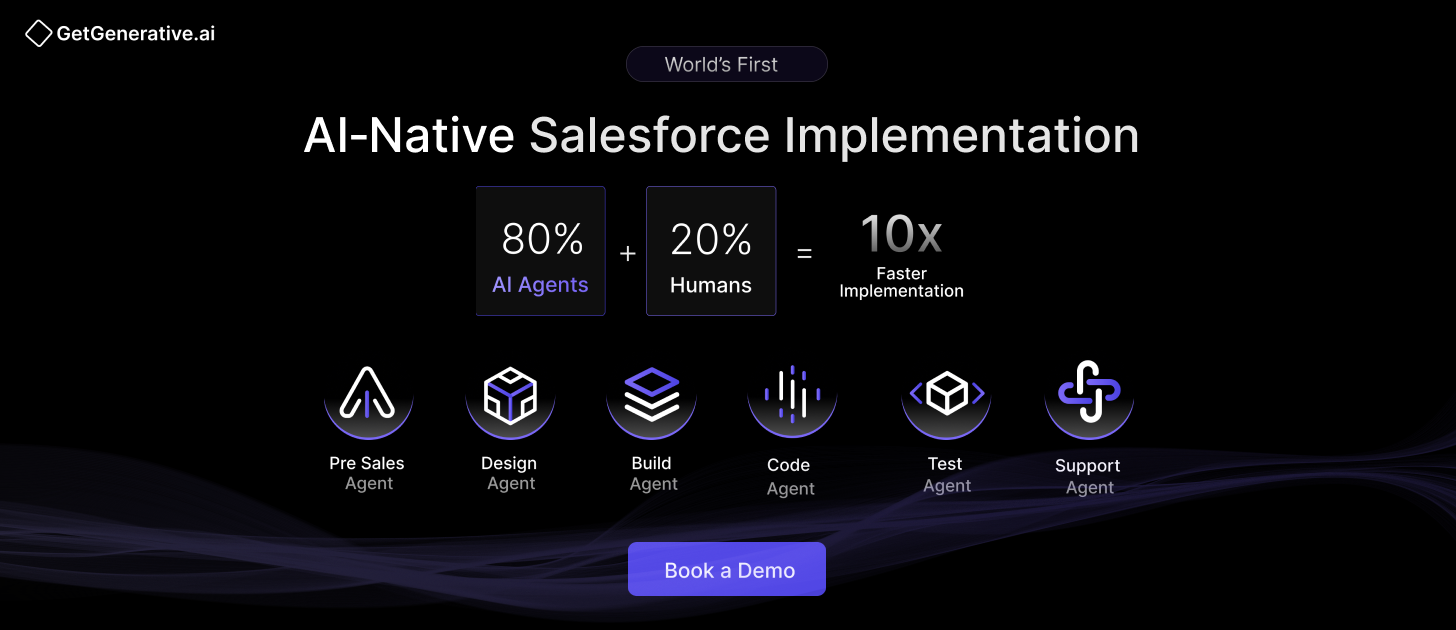
At GetGenerative.ai, we are the world’s first AI-native registered Salesforce Consulting Partner. We combine the precision of expert-led strategy with the speed of intelligent AI agents to deliver Salesforce projects 10x faster and with significantly lower implementation costs.

Traditional consulting models are slow, people-heavy, and fragmented. We’ve reimagined the Salesforce journey by automating 80% of the lifecycle with AI while keeping the critical 20% guided by seasoned consultants

The result? A modern, scalable, and efficient approach to Salesforce that drives measurable business value.

Why Choose GetGenerative.ai?

  • AI-Native Salesforce Partner – First consulting firm built entirely around AI-driven delivery models.


  • Faster Time-to-Value – Deliver Salesforce implementations in weeks, not months.


  • Cost Efficiency – Save up to 80% effort in proposal creation, design, build, and testing.


  • Traceability & Compliance – Every artifact is automatically documented, linked with metadata, and auditable.


  • Scalable for Any Industry – From financial services and healthcare to manufacturing, retail, and nonprofits.


  • Future-Proof Consulting – Deep expertise in Salesforce Data Cloud, Agentforce, and Industry Clouds.


AI Agents Driving Implementation Efficiency

At the heart of our consulting services are specialized AI agents that automate repetitive, time-consuming tasks, freeing our experts to focus on strategy and innovation.

  • Pre-Sales Agent – Auto-generates proposals, effort estimates, and scope plans to shorten sales cycles.


  • Design Agent – Transforms discovery inputs into solution architectures and user stories.


  • Build Agent – Produces detailed implementation workbooks and developer task breakdowns.


  • Code Agent – Generates Salesforce-ready Apex classes, triggers, and Lightning Web Components.


  • Test Agent – Automates test case creation, execution, and defect tracking, fully integrated with JIRA.


  • Support Agent – Resolves issues by reusing historical project context, syncing updates across documentation.

Benefits of Working With Us

  • 10x Faster Implementations – Accelerate deployment timelines dramatically.


  • Enterprise-Grade Quality – Built-in testing and defect resolution minimize risks.


  • Consistent Documentation – AI ensures every step is fully traceable.


  • Reduced Human Error – Automated lifecycle tasks mean fewer gaps and mistakes.


  • Strategic Focus – Consultants spend more time advising on business outcomes instead of administrative work.


  • Lower Costs, Higher ROI – Clients achieve Salesforce transformation without inflated consulting overheads.

How We Are Different

Traditional Consulting Firms

GetGenerative.ai – AI-Native Consulting

Heavy reliance on people, slower delivery

80% automation, 10x faster results

Manual documentation and fragmented tools

AI-driven traceability with metadata linkage

Limited focus on innovation

Built-in AI agents across the entire Salesforce lifecycle

High costs due to inefficiencies

Lower costs with optimized resource allocation

Reactive support models

Proactive AI-powered Support Agent for ongoing success

Industries We Serve

Our consultants and AI agents have proven expertise across a broad range of Salesforce products and industries:

  • Core Clouds: Sales Cloud, Service Cloud, Experience Cloud
  • Industry Clouds: Financial Services, Healthcare & Life Sciences, Manufacturing, Retail, Nonprofit
  • Next-Gen Salesforce: Data Cloud, Agentforce, and AI-driven customer engagement

Let’s Redefine Salesforce Together

Your Salesforce journey doesn’t have to be slow, expensive, or risky. With GetGenerative.ai, you gain a partner that merges AI-powered automation with expert-led consulting delivering projects faster, smarter, and with measurable outcomes.

salesforce consulting services

👉 Talk to our Salesforce Expert Today and see how we can transform your implementation experience.

👉 Explore our Salesforce AI consulting services

Salesforce OmniStudio Use Cases

Salesforce OmniStudio Use Cases


Salesforce OmniStudio is a powerful low-code platform that redefines how businesses build, deploy, and scale customer-facing applications across industries.

In this blog, we will explore various use cases across industries, including healthcare, financial services, telecommunications, and insurance, highlighting how OmniStudio delivers real-world transformation and measurable results.

Industry-Specific Use Cases 

1. Healthcare

  • Member Experience Transformation: OmniStudio enables personalized health journeys, secure chatbots, and dashboards for both patients and providers.
  • Care Coordination: A California home healthcare provider digitized intake processes and automated provider matching, improving caregiver-to-patient connections.
  • Clinical Trial Optimization: A rare-disease pharma company centralized trial management, improving patient engagement while ensuring compliance.
  • Prior Authorization Automation: A Texas-based health plan reduced manual workloads by digitizing utilization management and enabling faster care delivery.

2. Financial Services 

  • Digital Onboarding: OmniScripts guides customers through onboarding, while FlexCards support bank staff with real-time verification.
  • Loan Processing: Automates workflows from application to approval with audit-ready compliance.
  • Wealth Management: Advisors use FlexCards for unified client dashboards, improving decision-making and client satisfaction.
  • Core System Integration: Real-time integration layers bridge legacy banking systems with modern digital channels.

Also Read – Getting Started with Salesforce OmniStudio: A Complete Beginner’s Guide

3. Telecommunications 

  • Quote-to-Order: Guided flows simplify large, complex transactions in Communications Cloud.
  • Service Configuration: Intelligent workflows reduce onboarding times by up to 30%.
  • Customer Self-Service: Portals enable customers to troubleshoot and manage services independently, cutting call center costs.

4. Insurance 

  • Claims Processing: Guided workflows route claims dynamically based on complexity and adjuster expertise.
  • Policy Administration: Dynamic interfaces allow rapid policy updates and product rollouts.
  • Underwriting Automation: Business rule engines reduce manual risk assessments while ensuring accuracy.

5. Government and Public Sector

  • Citizen Self-Service Portals: Governments can use OmniScripts and FlexCards to provide digital services such as license renewals, tax payments, and benefit applications—reducing in-person visits and wait times.
  • Case Management: Agencies can automate intake, eligibility checks, and case resolution processes, ensuring transparency and accountability.

6. Education

  • Student Onboarding & Enrollment: Universities can build guided workflows that help students apply, submit documents, and register for classes, with data integration into SIS (Student Information Systems).
  • Alumni Engagement: FlexCards can consolidate alumni donation history, event participation, and communication preferences, improving engagement strategies.

7. Retail & E-Commerce

  • Personalized Shopping Journeys: OmniScripts guide customers through product configurations (e.g., custom furniture or electronics bundles), while Integration Procedures connect with inventory and pricing systems.
  • Loyalty Program Management: DataRaptors aggregate purchase history and rewards points, presenting real-time balances and redemption options through FlexCards.

8. Energy & Utilities

  • Smart Metering & Billing: Utilities can integrate meter readings into customer dashboards, allowing clients to track usage and pay bills seamlessly.
  • Outage Management: OmniScripts can guide customers through reporting outages, while FlexCards display status updates and restoration timelines.

9. Travel & Hospitality

  • Seamless Booking Experiences: Airlines and hotels can use OmniScripts to build guided flows for booking, upgrades, and loyalty redemption.
  • Personalized Guest Services: FlexCards provide agents with real-time guest preferences, booking history, and service requests to improve customer service.

10. Manufacturing & Supply Chain

  • Dealer and Distributor Portals: FlexCards enable partners to view order status, warranties, and inventory availability.
  • Quality Control & Compliance: DataRaptors can automate reporting of quality metrics and compliance data, ensuring audit readiness.

Also Read – How to Deploy OmniStudio Components in Salesforce: Step-by-Step Guide

Best Practices and Performance Optimization

1. Development Methodology and Governance

The most successful OmniStudio implementations follow structured methodologies that balance speed, scalability, and governance.

A. Component Design Optimization:

  • FlexCards should use child components for reusability and flyouts for detailed data.
  • OmniScripts must offload heavy logic to Integration Procedures and keep flows under 750 elements to ensure performance.

B. Asynchronous Processing:

  • Integration Procedures can be configured with “fire and forget” to run complex tasks without disrupting the user experience.
  • Ideal for processes like external system calls, email triggers, or heavy calculations.

C. Payload Optimization:

  • Minimize API payload sizes by trimming unnecessary fields.
  • Reduce round-trips through well-structured Integration Procedures.
  • Streamline DataRaptor extracts for leaner operations.

2. Deployment Strategies and Risk Management

OmniStudio’s enterprise-grade deployments require disciplined rollout strategies to minimize risk.

A. Multi-Environment Approach:

  • Using dev, integration, UAT, and production environments reduces production issues and accelerates deployment cycles by 73%.

B. Local Compilation Advantage:

  • Cuts deployment times from hours to minutes.
  • Offers 9× faster activation of components, improving development velocity.

C. Change Management Excellence:

  • Implement rollback plans, automated backups, and version control.
  • Leading organizations can restore functionality within 2–4 hours if issues occur.

Also Read – Salesforce OmniStudio Integration Procedures Explained

Conclusion 

OmniStudio represents far more than a low-code tool. It’s a strategic enabler of enterprise agility, customer-centricity, and long-term competitiveness.

salesforce consulting services

At GetGenerative.ai, we’ve reimagined Salesforce implementation—built from the ground up with AI at the core. This isn’t legacy delivery with AI added on. It’s a faster, smarter, AI-native approach powered by our proprietary platform.

👉 Explore our Salesforce AI consulting services

Salesforce Financial Services Cloud: Record Alerts Explained

Salesforce Financial Services Cloud: Record Alerts Explained


Research shows that 73% of customers are more likely to remain loyal to companies that anticipate their needs and act proactively. Delivering the right information at the right moment can turn a routine interaction into a relationship-strengthening opportunity—or stop a minor issue from escalating into a crisis.

This is exactly where Salesforce Financial Services Cloud (FSC) Record Alerts prove invaluable. With the global finance cloud market valued at $32.8 billion in 2024 and forecasted to grow at a CAGR of 22.7% through 2034, intelligent alerting systems are becoming indispensable for financial institutions aiming to stay ahead.

Salesforce FSC, already a market leader in CRM for financial services, takes notifications far beyond simple pop-ups. Record Alerts form a proactive intelligence layer that helps advisors and relationship managers anticipate client needs, strengthen compliance, and create personalized client experiences.

What Are Record Alerts?

Record Alerts are intelligent notifications in Salesforce Financial Services Cloud that highlight significant changes or actions required on client records. Unlike generic system messages, these alerts are tailor-made for the financial services industry, where context, personalization, and timing are vital.

They act as a real-time intelligence layer, pulling data from multiple sources, core banking systems, wealth management platforms, credit bureaus, and Salesforce records to surface actionable insights exactly when they’re needed.

The Architecture of FSC Record Alerts

The sophistication of Record Alerts lies in their design. They are highly configurable and structured for maximum clarity and actionability.

Core components include:

  • Actions – Advisors can dismiss, snooze, or escalate alerts.
  • Active Status – Tracks whether the alert is still relevant.
  • Description – Provides a clear explanation of the alert.
  • Severity Levels – Alerts can be classified as Error, Warning, Info, or even custom-defined.
  • Source Identification – Displays whether the alert originated internally within Salesforce or from an external system.

API-powered integrations further extend this architecture, pulling data seamlessly from third-party financial platforms and creating a unified view of client activities.

Why Intelligent Alerting Matters

Digital Transformation Pressure

The Salesforce FSC market growth highlights a shift toward proactive client engagement rather than reactive problem-solving.

Key drivers include:

  • Rising client expectations for personalized service.
  • Increasing regulatory compliance requirements.
  • The need for competitive differentiation in saturated markets.
  • Pressure to automate routine monitoring and free up advisor bandwidth.

The Cost of Staying Reactive

Without intelligent alerts, institutions risk:

  • Missed revenue opportunities – Overlooking signals for cross-selling or upselling.
  • Compliance gaps – Failing to detect suspicious or high-risk activities quickly.
  • Client churn – Losing customers due to unresolved issues.
  • Advisor inefficiency – Excessive time spent on manual monitoring.

CRM studies show that while Salesforce implementations yield a positive ROI within 12–13 months and an average of 299% ROI over three years, the true differentiator lies in shifting from reactive to proactive client management.

Also Read – The Architecture of Salesforce Financial Services Cloud

The Technology Behind Record Alerts

Salesforce FSC’s Record Alerts use a multi-layered technology stack:

  • OmniStudio Integration – FlexCards provide rich, interactive alert displays with contextual actions.
  • Business Rules Engine – Complex logic can combine multiple conditions (e.g., balance below threshold and recent overdraft fees).
  • Data Consumption Framework – Connects Salesforce with external systems asynchronously, pulling in data from banking cores, credit agencies, or insurance systems.

Alert Categories and Severity Levels

Record Alerts can be configured to suit different use cases:

  • Error Alerts – Critical issues like compliance violations or high-risk transactions, requiring immediate action.
  • Warning Alerts – Cautionary signals such as clients nearing credit limits or overdue payments.
  • Informational Alerts – Non-urgent updates like anniversaries or service notifications.
  • Custom Alerts – Tailored severity values aligned with institutional risk appetite.

This flexibility ensures that alerts are meaningful and aligned to business objectives, avoiding alert fatigue.

Integration and Hierarchical Views

Another powerful capability of FSC Record Alerts is contextual visibility across multiple entity types:

  • Financial Account Alerts – Notify on account-level activities like threshold breaches or unusual transactions.
  • Person Account Alerts – Capture client-specific events such as life milestones or relationship changes.
  • Aggregated Views – Hierarchical groupings allow advisors to see how multiple alerts interrelate for a single client.

This hierarchy ensures that financial advisors don’t just see fragmented notifications—they gain holistic insight into client needs and risks.

Business Impact: From Risk Management to Revenue

Fraud Detection and Risk Control

With cyber threats on the rise—ransomware attacks in banking alone increased by 30% year-over-year—Record Alerts serve as an early warning system. Suspicious transaction patterns can immediately trigger alerts, enabling faster investigations and reducing compliance risk.

Relationship Strengthening

Record Alerts prompt outreach when engagement drops, or surface life events like marriage or career changes, creating opportunities for personalized financial planning.

Revenue Generation

Alerts also fuel cross-selling by highlighting when clients are primed for new products. For example, one mid-sized credit union using FSC saw a 27% increase in satisfaction scores and a 15% productivity boost by leveraging Record Alerts.

Also Read – Salesforce Financial Services Cloud for Mortgage Lending

Implementation Strategy: Best Practices for Success

Phase 1: Planning and Preparation

  • Stakeholder Alignment – Involve senior leadership, advisors, service teams, and IT to define clear objectives.
  • Data Strategy – Map and cleanse data across banking, wealth, and insurance systems for consistency.
  • Compliance Framework – Define retention policies, audit processes, and regulatory alignment upfront.

Phase 2: Technical Configuration

  • Permission Management – Use FSC-specific permission sets to balance accessibility with data security.
  • Alert Criteria – Configure rules in the Business Rules Engine, ensuring relevance without overloading users.
  • System Integration – Connect via the Data Consumption Framework or MuleSoft to pull in external financial data.
  • UI Customization – Add FlexCards strategically on record pages so alerts are visible but not overwhelming.

Phase 3: Testing and Optimization

  • Sandbox Testing – Validate logic and triggers before production rollout.
  • User Acceptance Testing (UAT) – Engage advisors and service reps to confirm alerts support workflows.
  • Performance Monitoring – Track resolution times, response rates, and accuracy.

Phase 4: Deployment and Adoption

  • Phased Rollout – Start with pilot groups before full-scale launch.
  • Training Programs – Educate teams on interpreting and acting on alerts.
  • Change Management – Communicate benefits, address resistance, and share quick wins.

Phase 5: Continuous Improvement

  • Regularly refine alert logic based on user feedback.
  • Add new integrations and advanced alert types as needs evolve.
  • Document and share best practices across teams.

Also Read – Salesforce UAT Best Practices for Smooth Go-Live

Security and Compliance: Safeguarding Client Data

Financial institutions must protect sensitive data while leveraging Record Alerts.

  • GDPR Compliance – Classify sensitive fields, restrict access, maintain audit trails, and support “Right to be Forgotten.”
  • PCI DSS and SOX Requirements – Implement strong internal controls for payments and financial reporting.
  • Encryption and MFA – Secure alert data at rest and in transit, with multi-factor authentication for all users.
  • Regular Reviews – Conduct quarterly security and compliance audits to close gaps.

By embedding compliance into alert configuration, organizations reduce regulatory risk while ensuring client trust.

Competitive Landscape: FSC vs Alternatives

Salesforce FSC Advantages

  • Pre-built financial services data model (accounts, holdings, relationships).
  • Native compliance features and robust audit trails.
  • 2,600+ AppExchange apps for extended capabilities.
  • Advanced analytics with Einstein AI.

Microsoft Dynamics 365 Strengths

  • Seamless integration with Office 365, Teams, and Power BI.
  • Lower costs for organizations fully invested in Microsoft ecosystems.
  • On-premise deployment options.

Emerging Fintech Platforms

  • Agile, cloud-native players like Fin365 bring niche capabilities but lack global scalability and ecosystem maturity.

Bottom line: While Microsoft and fintech competitors have their appeal, Salesforce FSC remains the most industry-specific and scalable choice for complex, relationship-driven financial institutions.

ROI and Success Metrics

Institutions adopting Record Alerts consistently report measurable gains:

  • Operational Efficiency – 25% reduction in IT operational costs and 26% productivity improvement.
  • Customer Engagement – 25–30% higher client satisfaction scores post-implementation.
  • Revenue Growth – 15–27% increase in product adoption and customer engagement.

Key Metrics to Track:

  • Average alert resolution time.
  • % of alerts leading to meaningful client interactions.
  • Compliance incident reductions.
  • Client retention and upsell rates.

Future Trends: Where Record Alerts Are Headed

  1. AI-Powered Proactivity
    • Predictive alerts generated before issues arise.
    • Natural Language Processing for advisor-friendly explanations.
    • Machine learning to refine alerts based on past outcomes.


  2. Omnichannel Reach
    • Mobile-first alerts for on-the-go advisors.
    • Voice-enabled notifications through assistants.
    • Push notifications via SMS, email, and in-app channels.


  3. RegTech Integration
    • Automated compliance reports generated from alerts.
    • Cross-border compliance logic embedded in real time.
    • Continuous monitoring for regulatory changes.

Roadmap for Decision-Makers

  • Months 1–2 – Assess current systems, align stakeholders, and define ROI targets.
  • Months 3–4 – Design data architecture, configure rules, and establish security.
  • Months 5–6 – Test, validate integrations, and optimize for workflows.
  • Months 7–8 – Deploy with training and change management support.
  • Months 9–12 – Monitor KPIs, refine alerts, and expand advanced features.

This phased approach ensures both short-term wins and long-term scalability.

Also Read – Top Use Cases of Salesforce Financial Services Cloud in 2025

Common Challenges and How to Overcome Them

  • Alert Fatigue – Prioritize high-impact alerts, customize by role, and review quarterly.
  • Integration Barriers – Plan ahead for legacy system connections and data quality issues.
  • User Adoption Resistance – Secure executive sponsorship, empower champions, and share success stories.

Conclusion 

The financial services industry is at a crossroads. Institutions that embrace proactive, intelligent client engagement will outpace competitors in retention, compliance, and growth. Salesforce FSC Record Alerts are not just a notification system—they are a strategic enabler of modern relationship management.

salesforce consulting services

At GetGenerative.ai, we’ve reimagined Salesforce implementation—built from the ground up with AI at the core. This isn’t legacy delivery with AI added on. It’s a faster, smarter, AI-native approach powered by our proprietary platform.

👉 Explore our Salesforce AI consulting services

How to Create a Salesforce Technical Implementation Scope of Work

How to Create a Salesforce Technical Implementation Scope of Work


A comprehensive technical scope of work (SOW) is the foundation of project success. It defines project boundaries, deliverables, risks, and expectations, ensuring all stakeholders align on measurable outcomes. Organizations with properly defined project scopes are more than twice as likely to succeed, and well-implemented CRM systems can deliver an average ROI of 245% within three years.

This guide provides a strategic framework and practical tools for creating Salesforce SOWs that maximize ROI, minimize risks, and drive higher adoption.

Why Scope Definition Matters

The High Cost of Failure

The consequences of weak scope planning are significant. Beyond the high implementation failure rate, organizations with poor scope management often face budget overruns of 60–70%. Timelines stretch far beyond the expected 4–10 weeks, sometimes extending into months. These delays often lead to low adoption rates, broken integrations, and diminished customer experiences.

The financial impact is equally alarming. Failed implementations frequently cause revenue losses of 15–25%, driven by poor data quality and disrupted operations. Adding to this, nearly half of employees report experiencing multiple abandoned projects, highlighting how weak project management undermines both financial and organizational performance.

The Business Case for Excellence

On the other hand, organizations that invest in strong scope definition see dramatically different outcomes. Well-planned implementations deliver:

  • 38% faster decision-making
  • 18.4% average revenue increase
  • 35% improvement in customer satisfaction
  • Over two times higher project success rates compared to poorly scoped projects

Companies that consistently document and define scope achieve success rates of 65% or more, compared to just 25% for those that neglect this step.

What Is a Salesforce Technical Implementation Scope?

A Salesforce technical implementation is the process of tailoring Salesforce through configuration, customization, and deployment to meet an organization’s unique requirements. Unlike basic out-of-the-box deployments, these projects often involve advanced integrations, compliance requirements, and custom code to ensure the CRM system aligns perfectly with business goals.

Key components of a technical implementation include:

  • Requirements gathering and stakeholder alignment
  • Solution design and technical architecture
  • Standard configuration and customization
  • Data migration and integration with legacy systems
  • Apex programming and Lightning component development
  • User interface customization
  • Security and role-based access control setup
  • Testing and quality assurance
  • User training and adoption planning
  • Deployment, go-live, and hypercare support
  • Post-implementation maintenance and optimization

The Evolution of Complexity

Modern Salesforce implementations are significantly more complex than in the past. With Salesforce releasing three major platform updates every year, scope documents must balance detail with flexibility.

Key trends driving today’s implementations include:

  • AI-powered functionality with Einstein GPT
  • Multi-cloud deployments spanning Sales Cloud, Service Cloud, and Marketing Cloud
  • Sophisticated integrations with SaaS ecosystems
  • Increasing compliance and data security mandates
  • Mobile-first design requirements for field sales and service teams

Also Read – Best AI Tools for Salesforce Proposal Generation

Core Components of an Effective Scope of Work

Executive Summary and Business Justification

The executive summary is the anchor of your scope document. It should communicate the business case, expected ROI, and strategic alignment in a way executives can quickly understand.

Best practices include:

  • Setting quantified business objectives with measurable outcomes
  • Presenting ROI projections using industry benchmarks
  • Highlighting how the project supports broader business goals
  • Summarizing risks and mitigation strategies
  • Providing a high-level investment and timeline overview

Organizations that provide clear business justifications are far more likely to secure executive sponsorship and funding throughout the implementation lifecycle.

Detailed Scope Definition

The scope definition is the backbone of your SOW. It should carefully outline what is included and, just as importantly, what is excluded.

In-Scope Activities

Configuration and Setup:

  • Salesforce org structure and hierarchy design
  • User profiles, permission sets, and security roles
  • Standard object customization and field creation
  • Workflow rules, process automation, and flows
  • Reports and dashboards
  • Email templates and communication setup

Custom Development:

  • Apex classes and triggers for advanced business logic
  • Lightning components for user experience enhancement
  • Custom objects and applications for unique needs
  • API integrations for third-party systems
  • Advanced reporting and analytics capabilities

Data Management:

  • Data extraction, cleansing, and preparation
  • Mapping and transformation specifications
  • Migration testing and validation
  • Governance frameworks for ongoing data quality

Integration Architecture:

  • System connectivity and middleware design
  • API specifications and security protocols
  • Real-time versus batch integration strategies
  • Error handling and monitoring processes

Out-of-Scope Exclusions

Defining exclusions is equally important to avoid scope creep, which affects nearly half of all Agile projects. Common exclusions include:

  • Enhancements requested beyond the initial 90 days
  • Integrations not identified during discovery
  • Development for undocumented requirements
  • Training for users outside the initial defined group
  • Licenses and subscription fees for third-party apps

Technical Architecture and Requirements

This section sets the technical foundation for a successful project and requires close collaboration between business stakeholders and technical architects.

System architecture considerations include:

  • Choosing the right Salesforce edition
  • Sandbox strategies for development, testing, and staging
  • Security frameworks, including SSO and IP restrictions
  • API patterns, middleware requirements, and synchronization rules
  • Performance metrics such as page load times and concurrent user limits

Additional technical specifications should address:

  • Scalability for growth
  • Disaster recovery and backup protocols
  • Industry-specific compliance requirements
  • Mobile responsiveness and accessibility
  • Expected integration volumes and frequency

Implementation Methodology

The chosen methodology, like Agile, Waterfall, or Hybrid, defines how the project will be delivered.

  • Agile: Provides iterative delivery, faster feedback loops, and adaptability. Projects using Agile show significantly higher success rates.
  • Waterfall: Works best for projects with fixed requirements and regulatory-heavy environments that require detailed upfront documentation.
  • Hybrid: Combines Waterfall’s structured planning with Agile’s flexibility. Many organizations now prefer hybrid models to balance predictability with adaptability.

A recommended Agile framework includes:

  • Two-week sprint cycles
  • Quarterly major releases and monthly minor updates
  • Weekly demos and stakeholder reviews
  • Bi-weekly retrospectives for continuous improvement

Also Read – Salesforce CRM Implementation With AI – The Ultimate Guide

Resource Requirements and Responsibilities

Successful Salesforce implementations require a diverse mix of skills, from executive leadership to technical expertise. Clearly defined roles prevent bottlenecks and ensure accountability.

Internal Resources

Executive Sponsorship

  • Provides budget authority and organizational alignment
  • Removes roadblocks and ensures strategic prioritization
  • Leads steering committees for governance

Project Management

  • Manages timelines, risks, and stakeholder communication
  • Coordinates daily project activities
  • Escalates issues and ensures delivery accountability

Business Analysis

  • Gathers requirements and maps business processes
  • Creates user stories and acceptance criteria
  • Coordinates change management and training

Technical Resources

  • Salesforce administrators for system management
  • Data analysts for migration and testing
  • Integration specialists for connecting third-party apps

External Consulting Support

Organizations often augment internal capabilities with Salesforce consultants. Rates vary significantly:

  • Senior consultants: $150–200/hour for advanced customization
  • Junior consultants: $50–100/hour for standard configurations
  • Offshore consultants: $30–65/hour, offering 60–70% cost savings

Key consulting roles include:

  • Solution architect for overall design
  • Salesforce developers for Apex and Lightning components
  • Data migration specialists
  • Change management consultants for adoption strategies

Investment Planning and Budget Allocation

Budgeting is one of the most scrutinized aspects of Salesforce implementations. Costs typically range from $15,000 for small projects to over $500,000 for enterprise deployments.

Typical Cost Breakdown

  • Consulting & Strategy: 25%
  • Customization & Development: 30%
  • Licensing: 20%
  • Data Migration: 15%
  • Training & Adoption: 7%
  • Post-launch support: 3%

Small to Mid-size Implementations ($25,000–$200,000):

  • 1–50 users
  • Standard processes with moderate customization
  • Limited integrations

Enterprise Implementations ($200,000–$500,000+):

  • 50+ users across multiple business units
  • Complex processes requiring deep customization
  • Multiple integrations and data sources
  • Large-scale training and change management

Hidden Costs to Consider

  • Internal resource time for requirements and testing
  • Change management efforts beyond basic training
  • Data cleansing and quality improvements
  • Extended testing cycles
  • Ongoing optimization requests

Best practice: allocate 15–20% contingency to cover unexpected costs.

Risk Management and Mitigation Strategies

Comprehensive risk planning doubles the chances of success. Risks span both technical and organizational dimensions.

Common Technical Risks

  • Data migration failures due to poor quality or complex transformations
  • Over-customization creates maintenance headaches
  • Integration breakdowns with APIs or third-party apps
  • Performance issues under load

Common Organizational Risks

  • User resistance, leading to poor adoption
  • Lack of executive sponsorship
  • Competing priorities rare educing engagement
  • Resource shortages during critical phases

Mitigation Best Practices

  • Engage stakeholders early and consistently
  • Provide role-specific training and ongoing support
  • Use phased rollouts to reduce complexity
  • Conduct rigorous testing in sandboxes
  • Establish escalation procedures and contingency plans

Success Metrics and Acceptance Criteria

Measurable success criteria provide an objective way to evaluate outcomes and ensure alignment with business goals.

Technical Acceptance Standards

  • Page load times under three seconds
  • 99.9% uptime during business hours
  • Data accuracy rates above 98% post-migration
  • Security and compliance requirements fully validated

Business Impact Metrics

  • User adoption rates (login frequency, feature usage)
  • Improved sales cycle times
  • Higher customer satisfaction scores
  • Revenue per lead improvements
  • Reduced manual processes through automation

Organizations that set clear metrics are twice as likely to achieve desired outcomes.

Also Read – Top AI Tools Every Salesforce Developer Should Know in 2025

Advanced Scope Considerations for 2025

The Salesforce ecosystem is rapidly evolving. SOWs must account for emerging technologies and compliance landscapes.

AI and Automation Integration

  • Data readiness for machine learning models
  • Use case documentation for AI-driven automation
  • Ethical AI considerations and bias monitoring
  • Continuous improvement and retraining protocols

Compliance and Security Requirements

  • Data privacy regulations like GDPR and CCPA
  • Zero-trust security frameworks
  • Audit trail requirements in industries like finance and healthcare
  • Cross-border data transfer safeguards

Platform Evolution

  • Incorporating Salesforce’s quarterly releases into planning
  • Managing feature deprecations
  • Lightning migration for legacy Classic users
  • Multi-cloud integration strategies

Conclusion 

Creating a Salesforce Technical Implementation Scope of Work is the foundation of successful delivery. The difference between failure and success often comes down to how well the scope is defined, communicated, and executed.

salesforce consulting services

At GetGenerative.ai, we’ve reimagined Salesforce implementation—built from the ground up with AI at the core. This isn’t legacy delivery with AI added on. It’s a faster, smarter, AI-native approach powered by our proprietary platform.

👉 Explore our Salesforce AI consulting services

Compliant Data Sharing in Salesforce Financial Services Cloud

Compliant Data Sharing in Salesforce Financial Services Cloud


Salesforce Financial Services Cloud (FSC) has emerged as a strategic solution, providing purpose-built compliance capabilities that balance secure collaboration with regulatory adherence. 

For senior executives, the stakes are high: over 75% of European compliance leaders report a 35% increase in compliance workloads, and nearly half of financial firms plan to increase their compliance technology budgets in 2025.

This blog explores how FSC’s compliant data sharing transforms data governance, ensures regulatory adherence, and improves operational efficiency.

The Escalating Compliance Imperative in Financial Services

Regulatory Complexity at Critical Mass

The financial services industry operates within a constantly expanding web of regulations. The SEC plans to introduce 25 new rules in 2024, while frameworks like the EU’s Digital Operational Resilience Act (DORA) and PCI DSS 4.0 demand more sophisticated technology responses. Institutions must manage compliance across GDPR, CCPA, SOX, GLBA, and now emerging AI governance frameworks.

Jurisdictional differences further complicate compliance. In the UK, 36% of firms faced penalties in 2023, while regulations such as the FCA’s Consumer Duty forced 63% of firms to overhaul customer service models. This patchwork of global and local rules creates a compliance minefield that requires both robust systems and flexible adaptation.

The Real Cost of Compliance Failures

The financial impact of non-compliance is staggering. GDPR fines hit €1.2 billion in 2024, and SOX violations can cost up to $5 million and carry criminal liability for executives. Beyond penalties, 62% of UK consumers say they would lose trust in a provider after a compliance breach, underlining how reputational damage can erode customer loyalty.

Operationally, compliance lapses are equally costly. Organizations with cybersecurity skills shortages suffer 20% higher breach costs, and breaches involving stolen credentials take an average of 292 days to identify and contain—amplifying both regulatory and financial consequences.

Technology Investment as a Strategic Necessity

To address these risks, financial firms are prioritizing technology. Around 40% of compliance budgets are now allocated to technology integration, reflecting a shift toward automation-first compliance frameworks. A 2025 forecast suggests that AI-powered compliance solutions could save US financial institutions $23.4 billion annually.

The global RegTech market, valued at $13 billion in 2023, is projected to surge to $82 billion by 2033. With 90% of financial institutions already using RegTech tools, it’s clear that manual compliance models are no longer viable.

Salesforce FSC: Market Leadership and Strategic Positioning

A Dominant Market Presence

Salesforce commands 21.8% of the global CRM market—more than its four top competitors combined. In 2024, the company reported $34.86 billion in revenue, driven by platforms like Service Cloud ($8.25B) and Sales Cloud ($7.58B)—both integral to FSC.

The adoption is significant: 83% of US financial institutions leverage FSC, reflecting broad market confidence. With more than 150,000 businesses globally using Salesforce, institutions benefit from continuous innovation and strong network effects.

Industry-Specific Architecture

Unlike generic CRM platforms, FSC offers financial-services-specific data models with objects such as Financial Accounts, Relationship Groups, and Households. These accommodate the sector’s unique complexities in client relationships, lending, underwriting, and policy servicing.

Through integrations with legacy platforms using MuleSoft and APIs, FSC allows firms to modernize without abandoning critical systems, a vital advantage for institutions still reliant on decades-old technology.

Compliance-First Design Philosophy

FSC differentiates itself through a compliance-first architecture. With built-in encryption, audit trails, and role-based access controls aligned to GDPR, SOC 2, ISO 27001, and PCI DSS, the platform ensures compliance is baked into operations rather than retrofitted as an afterthought.

Understanding Compliant Data Sharing (CDS) in FSC

Core Functionality

Compliant Data Sharing (CDS), introduced in Salesforce’s Winter ’21 release, enables institutions to enforce advanced data sharing rules without heavy coding. It allows administrators to precisely control what data is shared, with whom, and under what conditions, while maintaining full auditability.

CDS uses a participant-role framework that differs from traditional Salesforce models. Administrators create participant roles defining access levels, and users assign participants to records based on those roles. This enforces consistent compliance policies across the organization.

Technical Implementation Framework

CDS functions through organization-wide sharing defaults and share table entries that activate when participant role access exceeds baseline defaults. Currently, Financial Deal, Account, and Opportunity objects support CDS, with more in development.

Implementation involves five key steps: enabling CDS for objects, creating participant roles, assigning permissions, updating layouts, and configuring audit trails. This requires collaboration between compliance leaders, admins, and end-users.

Participant Role Management

Participant roles are business-aligned rather than purely technical. Institutions might define roles like “Approved Analyst,” “Compliance Officer,” or “External Advisor” with mandatory approval workflows for sensitive data. This ensures that sharing decisions not only meet business needs but also regulatory requirements.

Also Read – What Is a Household in Salesforce Financial Services Cloud?

Advanced Security and Audit Capabilities

Salesforce Shield Integration

Salesforce Shield strengthens FSC with three key features:

  • Platform Encryption: Protects sensitive data such as PII and financial records at rest.
  • Event Monitoring: Tracks user actions, API calls, and data exports in real-time to prevent insider threats.
  • Field Audit Trail: Preserves historical data for up to 10 years, ensuring compliance with long-term recordkeeping requirements.

Comprehensive Audit Trail Framework

FSC automatically logs every interaction, email, call, meeting, and task, linking them to specific households or clients. This eliminates manual gaps while providing regulator-ready documentation.

Audit logs capture transaction changes, authorizations, timestamps, and user identities, creating immutable compliance records essential for both internal and external audits.

Role-Based Access and Data Masking

CDS enables granular permissions—restricting data to specific roles, client groups, or records. Sensitive fields like Social Security numbers or balances can be masked, allowing employees to work efficiently without exposing unnecessary details. This multi-layered security ensures compliance even in complex organizations.

Regulatory Compliance and Risk Management

Multi-Framework Compliance Support

FSC is built to address multiple regulations simultaneously, ensuring coverage for:

  • GDPR: Data subject rights and consent tracking.
  • CCPA: Transparency and customer disclosure requirements.
  • PCI DSS: Cardholder data protection standards.
  • SOX: Financial integrity and internal controls.

The platform provides automated disclosure tracking for regulations like Regulation BI and NAIC suitability standards, while workflow automation ensures compliance with Section 404 SOX requirements.

Risk Assessment and Mitigation

Compliance leaders benefit from supervision dashboards that highlight anomalies in real time, track approval turnaround times, and provide visibility into advisor activities.

FSC’s case management system streamlines compliance investigations by creating a complete digital paper trail for each escalation, supporting both internal audits and external regulators.

Automated Compliance Workflows

With prebuilt approval workflows, FSC automates oversight for disbursements, policy changes, account rollovers, and trades. Workflows can be configured by role, transaction size, or client type, ensuring consistent compliance.

Dynamic forms further reduce errors by collecting the required documentation during client onboarding and product enrollment, lowering the risk of missed disclosures.

Implementation Strategies and Best Practices

Phased Implementation

Firms achieve greater success when they begin with high-value use cases such as Accounts and Opportunities, and then scale toward complex objects like Financial Deals.

Clean, well-structured data is foundational. Institutions should audit and cleanse existing data before deployment to ensure CDS and AI-driven insights deliver accurate outcomes.

Change Management

Employee adoption is as critical as the technology itself. Training programs should highlight how FSC’s automation supports staff rather than replaces them, while ongoing refreshers keep employees aligned with evolving compliance best practices.

Cross-departmental collaboration is another priority—FSC enables wealth managers, loan officers, and service reps to work from a single unified view of client data, reducing silos.

Integration Architecture

Many institutions rely on legacy core banking systems. By using middleware like MuleSoft or Dell Boomi, FSC integrations can be phased in, reducing risk.

Institutions should also review API limitations upfront and engage IT leaders to resolve integration challenges before rollout.

Also Read – The Architecture of Salesforce Financial Services Cloud

Measuring ROI and Business Impact

Quantifiable Benefits

Organizations implementing compliant data sharing frameworks see 25–40% improvements in data quality metrics such as accuracy, completeness, and consistency within the first year.

Firms leveraging automation also report lower breach costs by an average of $2.2 million, alongside better audit readiness scores and fewer compliance violations.

Operational Efficiency Gains

FSC adoption drives clear operational wins:

  • Loan processing times reduced by up to 45%.
  • Customer satisfaction up by 40%.
  • Manual workload reduced by 35% through automation.

These efficiencies translate into faster service delivery, lower costs, and more engaged clients.

Long-Term Strategic Value

Beyond compliance, FSC builds strategic advantages. With its 360-degree customer view, institutions can deliver personalized recommendations, anticipate client needs, and unlock new cross-sell opportunities. Over time, this leads to higher retention rates and stronger revenue growth.

Emerging Trends and Future Outlook

AI and Automation

With Salesforce’s Agentforce capabilities (introduced in 2025), financial institutions can leverage AI agents for compliance monitoring and testing. Features like Einstein Trust Layer field masking automate sensitive data protection across the organization.

RegTech Evolution

The RegTech market is set to grow to $82 billion by 2033, fueled by AI and blockchain. AI is already reshaping fraud detection, transaction monitoring, and compliance reviews, while blockchain-based immutable ledgers are streamlining audit transparency.

Regulatory Shifts

Upcoming changes like Basel III Endgame, open banking mandates, and AI governance frameworks will reshape compliance expectations. FSC’s compliance-first design allows firms to adapt quickly to evolving requirements, minimizing disruption.

Strategic Implementation Roadmap

Phase 1: Assessment and Planning

Start with a compliance assessment to identify gaps and establish governance frameworks. Baseline measures should include data quality scores, compliance costs, and efficiency metrics.

Technology readiness reviews should evaluate current systems, integration capacity, and team skills before deployment.

Phase 2: Pilot Implementation

Pilot use cases should target low-risk, high-impact areas, like Account and Opportunity objects. Early success metrics should combine both technical KPIs (data accuracy, audit readiness) and business KPIs (customer satisfaction, process efficiency).

Phase 3: Scaling and Optimization

Once pilots prove successful, expand across departments and add objects. Ongoing change management and continuous improvement cycles ensure compliance frameworks remain aligned with evolving regulations and business needs.

Conclusion 

With average breach costs topping $6 million and compliance budgets rising 25% annually, manual compliance methods are unsustainable. FSC offers compliant data sharing, role-based access, automated workflows, and audit trails, empowering firms to reduce compliance risks, improve efficiency by 35%, and deliver better customer experiences.

salesforce consulting services

At GetGenerative.ai, we’ve reimagined Salesforce implementation—built from the ground up with AI at the core. This isn’t legacy delivery with AI added on. It’s a faster, smarter, AI-native approach powered by our proprietary platform.

👉 Explore our Salesforce AI consulting services

Do You Need a Salesforce Integration Consultant? Here’s Why

Do You Need a Salesforce Integration Consultant? Here’s Why


When does your organization truly need a Salesforce integration consultant, and what is the cost of getting it wrong?

With Salesforce holding 20.7% of the global CRM market and processing over 7.6 billion integration transactions daily, it has become the digital backbone of enterprises worldwide. Yet, despite its dominance, industry research highlights a sobering reality: 50–90% of CRM projects fail to meet objectives, often due to preventable integration challenges .

This gap between Salesforce’s potential and real-world outcomes has fueled the rapid growth of the consulting ecosystem. Valued at $20.93 billion in 2025, the Salesforce consulting services market is projected to reach $57 billion by 2032, reflecting a remarkable 15.4% CAGR. For executives, the choice to engage an integration consultant is far more than vendor selection—it’s a strategic investment that can mean the difference between achieving 299% ROI over three years or falling into the 90% of underperforming projects.

The Current State of Salesforce Integration Complexity

Market Dynamics Driving Integration Demands

Enterprises today rely on an average of 1,000 separate applications, yet only 28% are properly integrated. This creates “data silos”—isolated pockets of critical information that prevent organizations from delivering on Salesforce’s promise of a unified customer view.

According to industry research, 81% of IT leaders cite data silos as the primary roadblock to digital transformation . For Salesforce customers, this becomes especially challenging when integrating with ERP systems, marketing platforms, and legacy databases not designed for modern API connectivity.

Consider a manufacturing enterprise: Salesforce must connect with SAP for financials, Oracle for inventory, HubSpot for marketing, and custom scheduling apps. Each integration introduces risks—latency issues, error handling, maintenance, and security overhead—that scale exponentially with system complexity.

The Hidden Costs of Poor Integration

Executives often focus on visible consultant fees—typically $100–300 per hour or $10,000–200,000 for projects—but the hidden costs of failed integrations are far higher. Research shows that poor data quality alone costs companies $12.9 million annually, while failed Salesforce rollouts result in $2,500 per employee per year in lost productivity.

The ripple effects are significant:

  • Sales reps waste 70% of their time on non-selling activities due to fragmented systems.
  • Marketing campaigns fail without clean, synchronized customer data.
  • Executives receive inaccurate forecasts from dashboards corrupted by broken integrations.

These inefficiencies accumulate quarter after quarter, dwarfing the initial investment required for expert consulting.

Recognizing the Signs: When You Need Expert Help

Operational Red Flags

Senior leaders should recognize key warning signs that signal the need for integration consulting:

  • System performance issues: Latency, synchronization delays, or recurring integration failures.
  • User adoption decline: If Salesforce usage stagnates while teams fall back on spreadsheets, it’s often due to missing or inconsistent integration data.
  • Data integrity breakdowns: Duplicate records, mismatched financials between Salesforce and ERP, or campaigns misfiring because of stale datasets.

These issues usually indicate that your integration approach cannot handle enterprise-level data volume or complexity.

Strategic Growth Triggers

Beyond red flags, certain growth scenarios demand integration expertise:

  • Mergers & acquisitions: Consolidating disparate systems quickly is critical to realizing deal value.
  • Digital transformation: Migrating from legacy systems to the cloud requires airtight integration to maintain continuity.
  • Compliance-heavy industries: Healthcare, financial services, and manufacturing require integrations that preserve audit trails, data lineage, and strict security protocols .

In each case, expert consultants provide the frameworks and execution needed to avoid costly disruption.

Also Read – Salesforce Integration Consultant: A Complete Guide

The Strategic Value Proposition of Integration Consultants

Faster Implementation, Faster Value

Industry studies show that organizations using experienced integration consultants achieve 78% faster project delivery compared to internal teams. Why? Consultants bring:

  • Pre-built integration frameworks.
  • Proven best practices.
  • Knowledge of recurring integration patterns.

While internal teams may take 12–18 months to build integrations, consultants can often deliver in 4–6 months, unlocking business value much sooner.

Risk Mitigation & Quality Assurance

Equally important is risk management. Consultants anticipate pitfalls such as Salesforce governor limits, API versioning issues, and scalability challenges. They also enforce rigorous quality assurance through:

  • Comprehensive testing frameworks.
  • Data validation and rollback processes.
  • Business continuity safeguards.

This structured risk management greatly reduces the chance of post-implementation failures.

Advanced Technical Capabilities

Modern Salesforce integrations often demand capabilities beyond typical IT teams:

  • AI-driven integration design: Using machine learning to optimize data flows.
  • Event-driven architectures: Enabling real-time synchronization across multiple systems.
  • API governance: Ensuring lifecycle management, performance monitoring, and secure operations at scale.

These are precisely the areas where seasoned consultants deliver transformative impact.

Financial Analysis: The True Cost-Benefit Equation

Looking Beyond Hourly Rates

While consulting fees average $100–300 per hour or $10,000–200,000 per project, executives must look at the total cost of ownership (TCO):

  • Opportunity cost of internal teams: IT staff spending months on integration means fewer resources for other strategic initiatives.
  • Infrastructure/tooling costs: Consultants bring pre-built testing and monitoring frameworks, saving licensing and setup expenses.
  • Training costs: Instead of enrolling staff in costly training, organizations gain immediate expertise and structured knowledge transfer.

When viewed through this lens, external consultants often deliver better financial efficiency than internal-only approaches.

ROI Realization Patterns

Data from successful Salesforce projects shows organizations achieve 299% ROI over three years, with payback in as little as 12–13 months . ROI drivers include:

  • Operational efficiency: Automated data syncs eliminate manual reconciliation.
  • Sales productivity: Unified customer views boost lead management and forecasting accuracy.
  • Customer experience: Real-time access across touchpoints enhances personalization.
  • Failure cost avoidance: Avoiding $ millions in remediation costs from botched integrations.
  • Revenue acceleration: Companies report 21–30% improvements in sales effectiveness after successful Salesforce integrations.

Also Read – Tableau and Salesforce Integration: A Complete Guide

Building the Business Case: Decision Framework for Executives

Complexity Assessment Matrix

To decide whether to engage a consultant, assess integration needs on three dimensions:

  1. Technical complexity – number of systems, real-time data needs, transaction volume, and required custom logic.
  2. Organizational complexity – distributed teams, change management needs, user adoption dependencies, and aggressive timelines.
  3. Risk tolerance – industries with strict compliance (finance, healthcare), limited IT resources, or high competitive stakes should lean toward consultant involvement.

Build vs. Buy vs. Partner

  • Build: Internal development works if requirements are simple and timelines are flexible.
  • Buy: Pre-built integrations fit standard use cases but often lack customization.
  • Partner: Consultants deliver the best balance of customization, speed, and risk management, especially in high-stakes, multi-system environments.

For most enterprises, the partner model is optimal.

Implementation Strategies: Maximizing Consultant Value

Choosing the Right Engagement Model

Executives should align consultant engagement with business priorities:

  • Fixed-scope projects: Best for stable requirements and predictable deliverables.
  • Time-and-materials: Flexible for evolving projects, but require strict oversight to prevent overruns.
  • Retainer models: Provide ongoing access to expertise for continuous optimization, typically at $90–300/hour depending on experience and region.

Governance & Success Metrics

Clear governance ensures that consultant success translates into business value. Key elements include:

  • KPIs: System uptime, data accuracy, user adoption, and efficiency gains.
  • Governance cadence: Weekly reviews, milestone-based deliverables, and structured communication.
  • Knowledge transfer: Documentation, staff training, and phased ownership transition ensure sustainability.

Also Read – Salesforce OmniStudio Integration Procedures Explained

Future-Proofing Integration Investments

Preparing for Emerging Technologies

The integration landscape is rapidly evolving. Consultants help organizations prepare for:

  • AI-powered automation – optimizing workflows through intelligent orchestration.
  • Event-driven architectures – enabling real-time responses to data changes.
  • Composable applications – flexible, modular systems designed for rapid adaptation.
  • Low-code/no-code platforms – empowering citizen developers but requiring architectural oversight to avoid scalability issues.

Expert consultants ensure integrations aren’t just built for today, but also for tomorrow’s technology shifts.

Organizational Readiness & Change Management

Integration success depends on people as much as technology. Consultants often guide:

  • User adoption strategies – workflows, training, and ongoing support.
  • Cultural transformation – moving from siloed to collaborative, data-driven decision-making.
  • Compliance alignment – ensuring security, data lineage, and auditability across all connected systems.

Conclusion

The stakes for Salesforce integrations are higher than ever. While internal teams may be able to handle basic connections, complex, high-value enterprise initiatives demand the expertise of seasoned integration consultants. The risks of failure—lost productivity, compliance penalties, and failed digital transformation—far outweigh consultant fees.

salesforce consulting services

At GetGenerative.ai, we’ve reimagined Salesforce implementation—built from the ground up with AI at the core. This isn’t legacy delivery with AI added on. It’s a faster, smarter, AI-native approach powered by our proprietary platform.

👉 Explore our Salesforce AI consulting services

What Is a Household in Salesforce Financial Services Cloud?

What Is a Household in Salesforce Financial Services Cloud?


In an era where Salesforce implementations have driven 147% ROI and close to $1 million in annual benefits for leading firms, the concept of a household in Salesforce Financial Services Cloud (FSC) has emerged as a critical differentiator for senior professionals aiming to strengthen client engagement, compliance, and sustainable growth.

The household feature in FSC is not just a convenient data grouping tool. It is a sophisticated relationship management system that enables organizations to visualize, analyze, and serve entire family units and their extended financial ecosystems. 

Understanding the Household Foundation in FSC

Defining the Household Concept

In Salesforce Financial Services Cloud, a household is defined as a collection of individuals and related entities whose relationships and shared attributes influence how financial institutions serve them. Unlike traditional CRM systems that treat each customer as an isolated record, FSC households capture the full spectrum of relationships—from spouses and dependents to business entities, trusts, and professional advisors.

A household is built on a specialized account record type, forming the technical backbone of FSC’s data architecture. This allows for both simple and complex relationship structures. For example, a high-net-worth client may belong to their immediate family household while also appearing as a beneficiary in their parents’ estate planning household.

The Technical Architecture Behind Households

At the core of FSC’s household management lies the Party Relationship Group object. This architecture integrates several related components:

  • Business Accounts – represent the household entity itself.
  • Person Accounts – capture individual family members.
  • Account Contact Relationships – link individuals to household accounts.
  • Contact Contact Relationships – map interpersonal connections.
  • Account Account Relationships – define connections between business entities, trusts, and households.

This multi-layered data model ensures that advisors can navigate seamlessly from an individual client record to the entire household’s financial landscape, improving clarity, efficiency, and decision-making.

Strategic Implementation and Business Value

Driving ROI Through Household Management

Real-world examples highlight the measurable business value of FSC households. Trilogy Financial achieved a 147% ROI in just one year, unlocking nearly $972,000 in annual benefits by eliminating data silos and equipping advisors with a consolidated view of client relationships.

According to a Forrester Total Economic Impact study, FSC implementations have delivered:

  • $81.3 million in total benefits over three years
  • 10% revenue growth from cross-selling and client retention
  • Significant improvements in advisor efficiency and compliance visibility

For senior executives, these results provide strong evidence that robust household management capabilities directly translate into financial performance.

Operational Efficiency Gains

Beyond revenue, FSC households dramatically improve efficiency. Institutions report:

  • 25% faster call handling
  • 50% quicker application processing
  • 60% higher campaign efficiency through household-based targeting

These improvements reduce manual effort and empower advisors to dedicate more time to high-value relationship building, succession planning, and multigenerational engagement.

Also Read – The Architecture of Salesforce Financial Services Cloud

Advanced Household Configuration and Customization

Rollup Fields and Data Aggregation

One of FSC’s most powerful features is its automatic rollup functionality, which aggregates financial data across household members. Advisors can instantly view consolidated figures such as:

  • Total household assets under management (AUM)
  • Combined liability exposure
  • Household-wide insurance coverage
  • Aggregate investment performance

Configuring rollups requires defining Record Rollup Definitions that specify the rules for aggregation (e.g., summing balances across only active accounts). Done right, this gives advisors a complete financial picture at the household level.

Relationship Mapping and Visualization

The Actionable Relationship Center (ARC) is FSC’s visualization engine, turning complex data into intuitive maps that display:

  • Family decision-making hierarchies
  • Extended network referral opportunities
  • Concentrations of financial risk
  • Succession planning pathways

ARC empowers advisors to quickly identify opportunities and risks that would otherwise remain buried in spreadsheets or siloed systems.

Customizing Household Roles and Relationships

FSC also supports flexible customization of household roles. Standard roles like spouse, dependent, trustee, and beneficiary can be extended with custom reciprocal roles tailored to an institution’s unique client base.

Best practices include:

  • Governance for role creation to avoid redundant or conflicting roles.
  • Validation rules that maintain consistency across records.
  • Specialized roles for unique segments (e.g., international family offices or blended households).

By enforcing strict data quality measures, organizations ensure that household insights remain reliable and actionable.

Security, Compliance, and Data Governance

Regulatory Considerations

Household management in FSC must align with strict financial services regulations across privacy, security, and data handling. Salesforce provides built-in compliance features that help institutions adhere to frameworks like GLBA, SEC, and state-specific regulations. These include:

  • Comprehensive audit trails for all household modifications
  • Data retention enforcement based on internal policies
  • Consent management to govern communications with household members
  • Granular access controls tied to roles and relationships

By embedding governance directly into the household model, institutions can balance the need for relationship visibility with stringent privacy protections.

Security Model Implications

The FSC security model allows organizations to apply household-specific sharing rules. For example, a senior advisor may be granted full access to a primary client’s data but limited (read-only) access to their spouse’s or dependent’s records, depending on documented consent.

Financial institutions should carefully design permission sets and sharing logic to strike the right balance between accessibility for advisors and compliance with regulatory constraints.

Implementation Best Practices and Challenges

Phased Implementation Strategy

The most successful household implementations follow a phased roadmap to build competency gradually while minimizing disruption. Recommended stages include:

  1. Data model design aligned with current business processes
  2. Pilot deployments with experienced advisory teams
  3. Rollup field configuration for key metrics like AUM and liabilities
  4. Integration with banking/wealth management systems for real-time synchronization
  5. User training programs focused on relationship-driven workflows

This structured rollout ensures both technical stability and user adoption.

Common Pitfalls to Avoid

Research shows that FSC household implementations often falter due to insufficient planning and stakeholder alignment. Frequent challenges include:

  • Vague or unclear business objectives
  • Poor data quality inherited from legacy CRMs
  • Low adoption rates due to limited training
  • Integration complexity with older systems


  • Resistance to change from advisors accustomed to siloed processes

Mitigation strategies include early definition of success metrics, comprehensive data cleansing, and ongoing change management.

Data Migration Considerations

Migrating household data from legacy CRMs is often the most complex task. Best practices include:

  • Conducting comprehensive audits to resolve relationship inconsistencies
  • Establishing naming conventions for household entities
  • Implementing validation rules for consistent mappings
  • Using incremental migration to reduce business disruption

Institutions that invest in data preparation upfront are better positioned to unlock the full value of FSC households.

Also Read – Top Use Cases of Salesforce Financial Services Cloud in 2025

Integration with the Broader Salesforce Ecosystem

Service Cloud Integration

FSC households integrate seamlessly with Service Cloud, providing support agents with a 360-degree view of household interactions. This improves first-call resolution rates and client satisfaction, particularly for high-net-worth households that demand white-glove service.

Agents can see:

  • All household members’ recent cases and interactions
  • Shared service preferences
  • Pending service requests across the family

Marketing Cloud Synergy

With Marketing Cloud, institutions can run household-based campaigns that align with life events and relationship dynamics. Use cases include:

  • Targeting multiple generations within affluent families
  • Coordinating messaging across related members
  • Running referral-based campaigns leveraging extended networks
  • Personalizing outreach based on shared financial goals

This approach boosts marketing ROI while staying aligned with compliance on household communications.

Data Cloud Analytics

Integration with Salesforce Data Cloud enables advanced analytics, helping institutions uncover deeper insights such as:

  • Cross-sell and upsell opportunities across households
  • Risk concentrations across related entities
  • Behavioral signals indicating life events (marriage, retirement, inheritance)
  • Portfolio optimization opportunities

These insights equip advisors to shift from reactive to proactive client engagement.

Future Trends and Strategic Considerations

AI and Machine Learning

The fusion of AI/ML with household data is reshaping financial services. Applications include:

  • Predictive analytics to anticipate life events (e.g., children entering college)
  • AI-driven relationship mapping from emails and interactions
  • Automated cross-sell recommendations tailored to household needs
  • Risk scoring models incorporating interdependencies across family units

Firms that invest early in AI-driven household insights will gain a long-term competitive edge.

Evolving Regulatory Landscape

As privacy laws and compliance standards evolve, institutions must maintain flexibility to adjust household configurations. Key areas include:

  • Enhanced consent frameworks for family data sharing
  • Data portability rights as mandated by new consumer protection laws
  • Cross-border compliance for multinational households
  • Expanded audit trail requirements for regulators

Market Expansion Opportunities

With the finance cloud market projected to hit $217.30 billion by 2034, household mastery will be a market share differentiator. Early adopters of FSC’s household model will be positioned to lead as competition intensifies in wealth management, retail banking, and insurance.

Conclusion

The household model in Salesforce Financial Services Cloud represents a paradigm shift from siloed client management to a relationship-centric approach to engagement. With ROI benchmarks showing 147% improvements and annual benefits approaching $1 million, FSC households are crucial for institutions seeking to thrive in a competitive market.

salesforce consulting services

At GetGenerative.ai, we’ve reimagined Salesforce implementation—built from the ground up with AI at the core. This isn’t legacy delivery with AI added on. It’s a faster, smarter, AI-native approach powered by our proprietary platform.

👉 Explore our Salesforce AI consulting services