Solutions
Implementation Org Review Org Monitoring Managed Services
Agents
Discovery Agent Metadata Agent Design Agent Build Agent Test Agent Governance Agent Support Agent
Industry Solutions
Financial Services
Healthcare & Life Sciences
NDIS & Disability Services
Nonprofit
Not-for-Profit
Other Industries
Recruitment & Staffing Real Estate Cosmetic Procedures
Agentforce Claudeforce Blogs Pricing

How to Use Salesforce’s Prompt Builder to Speed Up Design Work

How to Use Salesforce’s Prompt Builder to Speed Up Design Work

Salesforce’s Prompt Builder, part of the Einstein 1 platform, exemplifies this shift. It empowers admins and designers to embed reusable, AI-powered prompts directly into CRM workflows, reducing manual content creation and dramatically speeding up design work.

With up to 90% productivity gains reported for AI-supported tasks and 93% of marketers using AI to generate content faster, Prompt Builder transforms routine tasks like email drafting, record summarization, and narrative content generation into one-click actions—all while keeping data safe within Salesforce’s secure environment.

What Is Salesforce Prompt Builder?

Prompt Builder is a no-code prompt engineering tool built directly into the Einstein 1 platform. Unlike generic AI chat interfaces, Prompt Builder is tightly integrated with Salesforce data and workflows. It lets admins build reusable AI prompt templates that:

  • Use merge fields from CRM records
  • Pull context from Data Cloud or external systems
  • Operate within Salesforce’s Einstein Trust Layer

Key Capabilities at a Glance

  • No-Code Templates: Write prompts like “Draft a follow-up email for {Lead.Name}…” with click-to-activate templates
  • Data Grounding: Merge real-time CRM values into prompts for factual, personalized outputs.
  • Einstein Trust Layer: Protect sensitive data through encryption and masking before interacting with LLMs.
  • Workflow Integration: Embed prompts into record pages, Flows, Copilot sidebars, or Agentforce actions.

In short, Prompt Builder enables Salesforce admins to act as in-house prompt engineers, creating safe, scalable, and structured AI experiences that are embedded directly into day-to-day design workflows.

How Prompt Builder Accelerates Design Workflows

Prompt Builder accelerates content design by automating time-consuming tasks such as writing, formatting, and summarizing—without compromising control or compliance.

1. Reusable Templates with Guardrails

Admins can create prompt templates using structured instructions and conditional logic. For example, a “Deal Summary” prompt might include:

  • Sections like Summary, Contacts, Risks, and Next Steps—only if relevant data exists
  • HTML formatting rules or bold headings
  • Guardrails to exclude empty fields or avoid filler phrases

This ensures consistent, high-quality output—without requiring each user to write from scratch or worry about formatting.

2. Data-Driven Personalization

By merging live Salesforce fields into prompts, Prompt Builder enables the creation of hyper-personalized content. For example:

A prompt like “Send a follow-up email to {Lead.Name} about {Product.Name}” generates a custom email for every lead, complete with dynamic subject lines and tone-of-voice instructions.

This eliminates repetitive personalization work for reps and content creators.

3. Embedded in the UI

Prompt Builder integrates tightly into the Salesforce experience. You can:

  • Place buttons on record pages to generate summaries or emails
  • Use Lightning App Builder or Flows to fetch data and trigger prompts
  • Embed prompts into Slack, Copilot, or mobile apps for contextual access

For example, admins have created a “Summarize Open Cases” button on the Account page that generates a paragraph summarizing all open issues—ready for review with a single click.

4. One-Click Output and Iteration

Prompt templates offer instant results. Users trigger them manually or via Flow, preview the output, and edit if needed. Admins can:

  • Test prompts with sample data in Preview mode
  • Tweak instructions, tone, and structure
  • Apply updates globally across workflows

This shortens iteration cycles and guarantees accurate AI output—without code.

Also Read – Prompt Engineering for Salesforce Developers

Common Use Cases for Designers and Admins

Prompt Builder’s design impact is most visible in high-volume, repetitive tasks. Key examples include:

1. Email & Document Drafting

Designing marketing or sales emails? Prompt Builder can handle:

  • Outreach, confirmation, or follow-up emails
  • Personalization using CRM fields
  • Tone control (“Avoid clichés like ‘hope this finds you well’”)
  • CTA structuring and formatting rules

A single prompt template can replace dozens of manually written emails per day.

2. Dynamic Content Generation

Prompt Builder’s Field Generation templates convert structured data into polished narratives:

  • Retailers: Auto-generate product descriptions from SKUs
  • Support teams: Summarize open cases with issue counts and key terms
  • Sales: Turn opportunity fields into formatted deal reports

One click replaces hours of writing.

3. Record Summaries & Reports

Need exec-level summaries? Prompt Builder can:

  • Output HTML-rich record summaries
  • Exclude null or empty values
  • Add links, format dates/currency, and structure content for easy reading

Example: A “Lead Summary” includes key info, status, and activities in a neatly formatted block embedded into Lightning pages or PDF exports.

4. Marketing & Creative Work

Prompt Builder supports brainstorming and creative content:

  • Generate campaign taglines, landing page copy, or blog intros
  • Output draft versions for A/B testing or stakeholder review
  • Power content templates for Journey Builder personalization

This frees marketing and design teams to focus on strategy, not filler text.

Also Read – The Ultimate Salesforce Prompt Builder Cheat Sheet

Best Practices: Designing Effective Prompts That Scale

To fully realize the benefits of Prompt Builder, organizations should apply prompt engineering best practices that maximize accuracy, consistency, and ROI.

1. Start with Clear Objectives

Every prompt should serve a measurable purpose. Ask:

  • What task are we automating?
  • What does ideal output look like?
  • What’s the KPI—time saved, output quality, user adoption?

Example: Instead of “Write a sales email,” use:
“You are a sales engineer writing to {Lead.Name} to follow up on {Product.Name}. Keep tone professional, CTA at the end, max 100 words.”

This clarity enables better design outcomes and meaningful performance tracking.

2. Use Role–Task–Format Structure

This 3-part structure improves prompt reliability and comprehension for the LLM:

  • Role: “You are a support agent…”
  • Task: “…summarizing open cases…”
  • Format: “…in a paragraph under 150 words, plain language, no bullets.”

Including example inputs and outputs (few-shot prompting) or step-by-step logic (chain-of-thought) can dramatically improve results, especially for decision-making prompts.

3. Leverage Merge Fields and Flow Variables

To make prompts data-grounded, include tokens like {!Opportunity.Stage} or variables from Flows. This ensures personalization and factual accuracy.

As Gearset notes:

“Grounding the prompt in your Salesforce data is key to getting the most relevant, personalized responses.”

When prompts require aggregated data (like open case summaries), Flows can fetch and pass the necessary context into the template.

4. Define Guardrails Clearly

Avoid hallucinations by explicitly telling the AI how to behave with missing or incomplete data:

  • “Do not include empty fields”
  • “If ‘Next Step’ is unavailable, omit that section”
  • “Stick to US English; no Markdown formatting”

These constraints ensure clean, predictable output and reduce error handling overhead.

5. Iterate Prompt Designs with Testing

Use Prompt Builder’s Preview mode to:

  • Test with real data
  • Review edge cases
  • Refine tone, structure, and word choice

As Salesforce recommends, templates should be:

“Tested, revised, customized before going live.”

Regularly iterate based on user feedback, evolving business needs, or updated regulations.

6. Track Usage and Outcomes

Use reporting tools and Agentforce analytics to answer:

  • Are users adopting the prompt?
  • How much time is it saving?
  • What’s the acceptance rate of AI-generated content?

Example: For a “Case Summary” prompt, measure how often agents accept vs. edit the AI output.

These metrics inform prompt refinement and help justify continued investment.

7. Establish Governance and Ownership

Treat prompt templates like enterprise assets. That means:

  • Version control (e.g., via DevOps Center or metadata APIs)
  • Permission sets for creation and execution
  • Change review and approval workflows

Train admins and designers in prompt engineering, and assign roles for ownership and iteration. For regulated industries, implement formal approval chains and audit logging.

Also Read – Getting Started with Code Builder and Agenforce in Salesforce

Security, Compliance, and Trust

Prompt Builder doesn’t just offer productivity—it’s designed for enterprise-grade trust and governance.

Data Security: The Einstein Trust Layer

Every prompt runs inside the Salesforce Trust Layer, which:

  • Encrypts or masks sensitive data (like names, emails)
  • Ensures LLMs never see raw PII
  • Maintains compliance with frameworks like GDPR, HIPAA, and SOC 2

Accuracy and Bias Control

Generic LLMs risk hallucination. Prompt Builder mitigates this through:

  • Contextual grounding with real CRM values
  • Instructions like: “Only use the data provided”
  • Fallbacks for missing data (e.g., “Say ‘unknown’ if empty”)

This structure significantly reduces factual errors and hallucinated output—top concerns for over 50% of users, according to Salesforce research.

Compliance and Oversight

Especially critical for regulated industries, Prompt Builder includes:

  • Prompt Approval workflows
  • Audit logs of AI interactions
  • Role-based access control
  • Compatibility with Salesforce Shield and Security Center

Templates can be deployed via change sets, unlocked packages, or DevOps pipelines, ensuring AI governance matches your software lifecycle.

Final Thoughts 

Salesforce’s Prompt Builder marks a significant step in integrating AI into core enterprise design work. It doesn’t just speed things up—it enforces best practices, safeguards sensitive data, and enables scale with control.
salesforce consulting services

At GetGenerative.ai, we’ve reimagined Salesforce implementation—built from the ground up with AI at the core. This isn’t legacy delivery with AI added on. It’s a faster, smarter, AI-native approach powered by our proprietary platform.

👉 Explore our Salesforce AI consulting services
English Is the New Apex: How Natural Language Is Changing Salesforce Development

English Is the New Apex: How Natural Language Is Changing Salesforce Development


Salesforce development is evolving rapidly. With the rise of generative AI, a new model of “intent-first” development is emerging, where developers and admins use natural language to generate Apex code, Flows, and Lightning Web Components (LWC). This shift, often referred to as “vibe coding” or “coding by intent,” allows professionals to describe their goals in English and receive structured, ready-to-deploy solutions in seconds.

According to recent industry reports:

  • 76% of developers use or plan to use AI in their daily workflows (StackOverflow 2024).
  • In the Salesforce ecosystem, 61% of admins and developers use AI daily, and 86% are actively exploring new AI use cases.

Salesforce’s own research underscores this evolution. Developers are becoming orchestrators of AI agents, shifting from line-by-line code writing to managing outcomes through natural language prompts.

What is Vibe Coding? 

Coined by OpenAI’s Andrej Karpathy, vibe coding is an approach where developers write what they want, not how to build it. In Salesforce, this might look like:

“Create an Apex trigger to notify the sales manager when an Opportunity is Closed-Won.”

Salesforce’s AI interprets the prompt and generates a complete trigger, with best-practice implementations including bulkification, test classes, and error handling. This fundamentally changes the developer’s role — from code producer to strategic architect and AI collaborator

One architect explained:

“I’m no longer buried in syntax. I’m thinking about systems, integrations, and innovation.”

AI-Powered Salesforce Tools Transforming Development

Salesforce’s AI-native stack is designed to bring natural language to every corner of the development lifecycle. Here’s how:

1. Agentforce for Developers (Einstein for Developers)

This Visual Studio Code extension is at the heart of Salesforce’s AI push. Built on proprietary LLMs like CodeGen2.5 and xGen-Code, it supports:

  • Natural Language Code Generation: Input a prompt and receive production-ready Apex or LWC.
  • Inline Code Completions: Real-time suggestions tailored to your org’s metadata.
  • Test Class Creation: Auto-generates unit tests based on your Apex classes or triggers.
  • Code Explanation: Translate legacy or AI-written code into plain English with one command.
  • Trust Layer Assurance: Salesforce’s Trust Layer ensures customer data stays protected and outputs remain compliant. No customer data is used to train LLMs.

Also Read – Agentforce for Developers: How to Build AI-Powered Solutions

2. Einstein Copilot and Prompt Builder for Flow Automation

Natural language isn’t just for coders. Salesforce now brings it to admins and declarative users via:

  • Einstein for Flow: Converts prompts into Flow logic automatically.
  • Prompt Builder: Helps teams create reusable, governed prompt templates that integrate live CRM data.

Admins can now say:

“Alert the Account Owner when an Invoice is overdue by 30 days.”

And the Flow Builder builds out the full automation — no dragging-and-dropping required.

3. ApexGuru – AI for Code Quality and Performance

Think of ApexGuru as your AI-powered code coach. It scans your Apex for:

  • SOQL inside loops
  • Improper DML patterns
  • Missing bulkification or error handling

…and gives side-by-side comparisons and explanations. This is particularly valuable for junior developers and code reviews.

4. Einstein GPT and Copilot: AI Grounded in CRM Data

Launched in 2023, Einstein GPT connects Salesforce Data Cloud with LLMs for real-time, CRM-aware AI.

Use case:

“Generate an Apex trigger that creates a Contact when an Account is added — but only if the country is USA.”

Einstein GPT will:

  • Check your org’s metadata
  • Respect field-level security
  • Output secure, context-aware code
  • Log the interaction for auditing

Copilot ensures relevance; the Einstein Trust Layer ensures compliance.

Natural Language as a Developer Interface: Key Stats

  • Salesforce’s internal tools like CodeGenie process 7M+ lines of code monthly, saving over 30,000 developer hours.
  • GitHub research shows that AI pair programming can increase developer velocity by 55%.
  • Surveys reveal 72% of Salesforce developers report higher productivity with AI tools.

These tools are not replacing developers — they’re augmenting them. And this productivity gain is reshaping team roles.

Related Read – A Beginner’s Guide to ApexGuru, Code Analyser, and DevOps Centre

AI-Driven Development: Transforming Roles, Teams, and Output

The shift from hand-coded Apex to natural language-driven development is not just about speed — it’s about redefining productivity and team dynamics.

Faster Prototyping, Faster Delivery

Salesforce teams now prototype in hours, not weeks. A recent Salesforce architect summarized:

“What used to take a week to build, test, and document — now happens in a single afternoon with Agentforce.”

Salesforce’s own tool, CodeGenie, has processed over 7 million lines of code, responded to 500,000+ developer queries, and saved an estimated 30,000 developer-hours per month.

From Developers to AI-Orchestrators

This change empowers developers to move up the stack, focusing on architecture, integrations, and business impact. One Gartner analysis calls this “the rise of the AI pilot”: developers who guide AI agents, validate results, and align them to strategic goals.

“The most valuable developers will be those who can collaborate with AI, not compete against it.”

Challenges And Risks: A Balanced View

While the promise is strong, responsible adoption is critical. Below are the primary challenges and how to address them:

1. Trust & Accuracy

AI can “hallucinate.” Salesforce warns that even its own LLMs can produce inaccurate or harmful code. Best practices include:

  • Treat AI output as a first draft
  • Require manual review + automated testing
  • Use tools like Salesforce Code Analyzer and CI/CD validations

2. Data Privacy and Governance

Prompt-based AI can unintentionally expose sensitive fields or make decisions based on biased data.

Recommendations:

  • Sanitize data inputs and prompts
  • Leverage the Einstein Trust Layer to enforce security
  • Use Field-Level Security and Shield Encryption

3. Lack of AI Literacy

AI tools are only as effective as their users. Surveys show that many developers still struggle with:

  • Writing effective prompts
  • Knowing what AI tools can and can’t do
  • Understanding how LLMs interpret context

Solution: Invest in Trailhead modules, internal AI workshops, and cross-team collaboration.

4. DevOps & Metadata Complexity

AI-generated Flows, Apex, and configurations can introduce complex metadata dependencies.

Best practices:

  • Use Git-based version control
  • Treat prompts and agent configs as deployable assets
  • Update your release pipelines to support AI-generated artifacts

5. Quality Assurance and Testing

With AI generating new artifacts quickly, QA becomes even more essential.

  • Agentforce and ApexGuru can auto-generate test classes
  • Run automated regression suites before every deployment
  • Monitor code coverage and defect rates of AI-written components

Case Example: GetGenerative.ai’s AI-Native Model

One standout implementation of natural-language-first Salesforce development is GetGenerative.ai – the world’s first AI-native Salesforce implementation partner.

Key Highlights:

  • 200+ Salesforce projects across 8+ countries
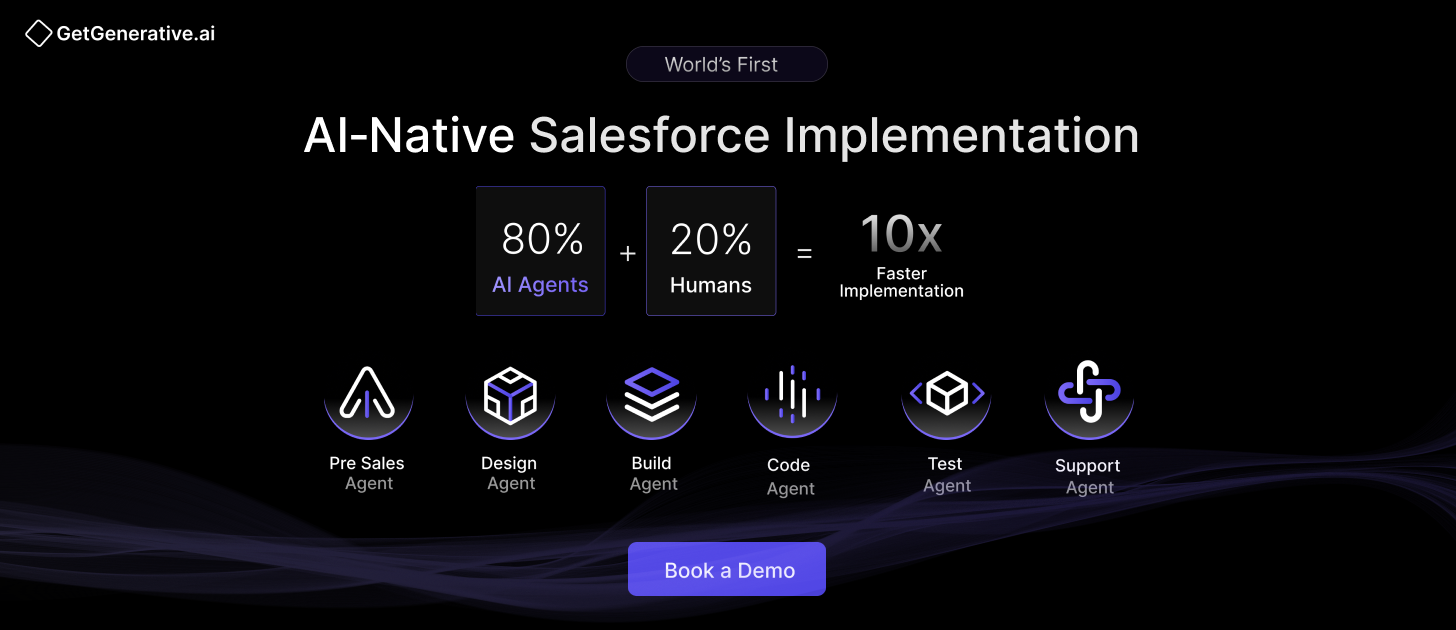
  • 80% AI Agents + 20% Human Experts
  • AI Agents include:
    • Pre-Sales Agent (Proposal automation)
    • Design Agent (User story + LLD generation)
    • Code Agent (Prompt-based Apex, LWC, test generation)
    • Test Agent (Automated test runs + Jira integration)
    • Support Agent (Auto-resolves tickets from metadata history)
  • Delivers 10x faster implementation compared to traditional partners

GetGenerative’s Code Agent works just like Agentforce — developers or BAs write prompts in natural language (e.g. “build a custom Apex batch job for deleting inactive Leads”) and the AI returns tested, deployable code.

Result: Enterprise Salesforce delivery in days instead of months, with deep integration into version control, CI/CD, and metadata governance.

Conclusion 

The rise of natural-language development is not a gimmick — it’s a structural transformation. With tools like Agentforce, Einstein Copilot, ApexGuru, and platforms like GetGenerative.ai, Salesforce professionals are unlocking unprecedented speed, agility, and innovation.

salesforce consulting services

At GetGenerative.ai, we’ve reimagined Salesforce implementation—built from the ground up with AI at the core. This isn’t legacy delivery with AI added on. It’s a faster, smarter, AI-native approach powered by our proprietary platform.

👉 Explore our Salesforce AI consulting services
Prompt Engineering for Salesforce Developers

Prompt Engineering for Salesforce Developers


The rise of generative AI has reshaped software development. Tools like OpenAI’s ChatGPT and Salesforce’s Einstein GPT are no longer fringe experiments — they’re rapidly becoming embedded in the daily workflows of developers and architects across the Salesforce ecosystem.

According to the Stack Overflow Developer Survey,

  • 76% of developers are using or planning to use AI tools.
  • 74% of ChatGPT users intend to continue using it long-term.

Salesforce’s own research confirms this trend:

61% of professionals in Salesforce roles already use or plan to use generative AI in their jobs.

From generating Apex classes and SOQL queries to simulating user interactions and writing test cases, AI has the potential to transform how developers build on Salesforce. But tapping into that power effectively requires more than just clicking a button — it requires a new skillset:

👉 Prompt engineering — the art of crafting natural-language inputs that guide AI to produce precise, usable, and secure outputs.

This blog will explore what prompt engineering means in a Salesforce context, how it can supercharge developer productivity, and how to apply it effectively using tools like Einstein GPT, Prompt Builder, and ChatGPT. Let’s get started! 

What Is Prompt Engineering?

Prompt engineering is the discipline of designing high-quality prompts to steer generative AI models (like GPT-4) toward specific, useful outputs. A prompt is simply the input text you feed into the AI, but its wording, structure, and clarity can significantly impact the outcome.

Effective prompts act like functional specifications — they guide the AI like requirements documents guide developers. 

For example, instead of typing “write Apex code”, you might craft:

“You are a senior Salesforce developer. Write an Apex trigger that updates a Last_Contact__c field when a Case is closed.”

That one sentence provides role context, a clear objective, and data references — helping the AI generate more accurate code.

Key Components of an Effective Prompt:

  • Role declaration: Define the AI’s “persona” (e.g., Salesforce dev, data architect).
  • Contextual grounding: Include relevant CRM data, object names, or business rules.
  • Task specificity: State exactly what you want — a formula, a code snippet, a flow.
  • Format constraints: Specify the desired output format (e.g., JSON, Apex class).
  • Few-shot examples: Provide example inputs/outputs for better learning.

Why Prompt Engineering Matters for Salesforce Developers

In the Salesforce ecosystem, prompt engineering is fast becoming as important as knowing Apex or SOQL.

Why? Because AI tools are now deeply integrated into Salesforce workflows:

  • Einstein GPT and Prompt Builder generate CRM content, metadata, and code.
  • ChatGPT and Copilot assist with testing, optimization, and documentation.
  • Slack, Service Cloud, and Flow now support generative AI chat and logic blocks.

Developers who master this skill can:

  • Cut boilerplate coding time by up to 70%
  • Generate test classes, flows, and documentation in minutes instead of hours
  • Focus on high-level problem-solving instead of repetitive tasks

In addition, a well-designed prompt helps non-developers collaborate more effectively. Admins, product managers, and architects can use structured prompts to:

  • Draft user stories and test cases
  • Translate business requirements into flow logic
  • Generate customer email templates and help content

But for AI to be a reliable co-pilot, it must be guided by someone who understands the platform deeply, and that’s where Salesforce developers play a crucial role.

Inside Salesforce’s AI Ecosystem: Where Prompt Engineering Comes In

Salesforce’s generative AI ecosystem is rapidly expanding. Here’s a snapshot of what developers have access to in 2025:

Einstein GPT

Announced at TrailblazerDX, Einstein GPT blends OpenAI’s LLMs with your live CRM data. It can:

  • Generate Apex, LWC, and SOQL
  • Summarize records and conversations
  • Auto-compose emails, field help, or user guidance

Einstein GPT is made secure via a Trust Layer that strips sensitive data before sending it to external models. Data is not stored, indexed, or remembered by the LLM, solving key enterprise adoption concerns.

Einstein Copilot Studio

A suite of low-code tools for building AI-powered experiences:

  • Prompt Builder: Create structured, reusable prompts tied to CRM data
  • Skills Builder: Design workflows activated by prompt triggers
  • Model Builder: Bring in external or fine-tuned models securely

![Prompt Builder UI]

Visual: Side-by-side layout showing a structured prompt template and AI-generated output preview

Prompt Builder lets you:

  • Insert dynamic record data into prompts (e.g. {$Input:Contact.FirstName})
  • Define expected outputs (e.g. bullet list, JSON, plain text)
  • Preview and test results live

These tools turn prompt engineering into an enterprise-grade process, with testing, versioning, and governance.

Also Read – Getting Started with Code Builder and Agenforce in Salesforce

Core Prompt Engineering Techniques for Salesforce Developers

To get the best from Salesforce AI tools, developers must apply tried-and-true prompt engineering techniques.

Here are the top strategies:

✅ Define the AI’s Role

“You are a Salesforce Apex developer with 10+ years of experience. Respond concisely and in code only.”

This frames the model’s response style and narrows scope.

✅ Use Delimiters for Context

Use ### Instructions: and ### Input: or triple backticks (“`) to separate your instructions from data/code.

Example:

trigger UpdateContactDate on Case (after update) {

  // Trigger logic here

}

Prompt:
“Explain what the Apex trigger does. Code is between triple backticks.”

✅ Few-Shot Prompting

Show 1–2 examples of what you want before your real input.

Example:

Input: “Customer is unhappy with product delay”
Output: “Negative”

Input: [New Review]
Output: ???

This primes the model to follow your logic.

✅ Chain-of-Thought Prompting

For complex tasks, break the solution into steps.

“First, list all Opportunity stages. Then explain which ones are open. Then summarize in a table.”

This improves output structure and reduces hallucinations.

✅ Specify Output Format

“Respond with a JSON array containing fields: Name, Email, AccountID.”

Clear format expectations help automation and API use.

✅ Refine Iteratively

Prompt engineering is not “set it and forget it.” Tweak, test, and evolve your prompts. Start simple, add constraints, and test with different data.

Best Practices from OpenAI, Salesforce, and Google

Prompting Principle

Why It Works

Instructions First

Models prioritize early text

Positive Framing

Don’t say “Don’t do X” – say “Do Y”

Explicit Output Types

Prevents guessing by the model

Avoid Sensitive Data

Use pseudonyms or test data

Use Prompt Templates

Standardize successful prompts for reuse

Also Read – From Prompts to Prototypes: The Rise of AI-Driven Development in Salesforce

Top Use Cases of Prompt Engineering in Salesforce Development

Prompt engineering unlocks a powerful set of AI-driven capabilities across the Salesforce development lifecycle. Here are some of the most impactful applications with real-world examples:

1. Apex and LWC Code Generation

Prompt:

“Generate an Apex trigger that updates the Last_Contact__c field on the Account when a Case is closed.”

Output:

An entire functional Apex trigger with a handler class. Similarly, you can use prompts to:

  • Scaffold Lightning Web Components (LWC)
  • Generate test classes with @isTest
  • Refactor legacy Apex using clean code principles

2. Metadata and Object Configuration

Prompt:

“Based on this PlantUML class diagram, generate the corresponding Salesforce object metadata in XML format.”

Use Cases:

  • Generate object and field XML for Metadata API
  • Create validation rules, formula fields, or Flow JSON
  • Build translation files or picklist mappings

Example:

A data model described in bullet points can become deployable XML.

3. SOQL & Data Queries

Prompt:

“Write a SOQL query to find all Cases closed in the last 30 days, grouped by owner.”

AI responds with a syntactically correct and optimized SOQL query.

Use Cases:

  • Complex joins using parent-child relationships
  • Dynamic filtering based on business logic
  • Script generation for batch processing

4. Test Class and QA Generation

Prompt:

“Create a test class for this Apex controller with at least 90% coverage.”

AI returns:

  • @isTest annotated class
  • Positive/negative test cases
  • Mock data creation logic

Also useful for:

  • Generating data factories
  • Writing negative test paths
  • Simulating edge cases

5. Documentation and Diagrams

Prompt:

“Convert this object relationship into a PlantUML diagram.”

Output:

Ready-to-use diagram code visualizing object models or integration flows. Also used for:

  • Generating Mermaid.js flowcharts
  • Creating ERDs
  • Drafting user manuals and integration docs

6. Formulas, Automation & Validation Rules

Prompt:

“Write a validation rule to prevent Opportunities from being marked Closed–Won without a signed contract.”

Output:

A complete formula with proper syntax, error message, and testable conditions.

Also used for:

  • Building custom formulas for KPIs
  • Flow decision logic generation
  • Suggesting Process Builder automation steps

7. Email, Content & Knowledge Article Generation

Prompt:

“Create a branded HTML email for a customer renewal reminder with placeholders for name, renewal date, and CTA.”

Output:

Complete HTML/CSS email template respecting brand tone.

Use Cases:

  • Marketing Cloud content blocks
  • Knowledge articles
  • Pre-drafted case responses

8. Translations and Localization

Prompt:

“Translate the following 20 field labels and help texts to German for DACH markets.”

Use Cases:

  • Support multilingual deployments
  • Automate Translation Workbench inputs
  • Generate regional-specific help content

9. Chatbots and Guided Help

Prompt:

“You are a Salesforce support bot. Help users reset a password without asking for PII.”

Used in:

  • Einstein Bots
  • Slack chat integrations
  • Service Cloud guided assistance

Prompt design helps control bot tone, flow, and compliance.

Also Read – AI-Generated Code: When to Trust It and When to Intervene

Tools for Prompt Engineering in Salesforce

Here’s a breakdown of the key tools that enable prompt-driven development in Salesforce:

1. Prompt Builder (Beta)

  • Create prompt templates with dynamic field bindings
  • Use special tokens ({$Input:Record.Name}) for context
  • Version prompts, test outputs, enforce formats

2. Einstein for Developers (Pilot)

  • Salesforce-trained GPT model for Apex, LWC, and metadata
  • Generates test classes, documentation, and suggestions in VS Code

3. VS Code Extensions

  • Einstein GPT plugin to prompt directly from code
  • Highlight Apex, right-click → “Generate Unit Test” or “Explain Code”

4. Flow Builder (Text Generation Element)

  • Add “Generate Text” AI blocks to Flows
  • Use prompts as part of decision-making logic

5. External AI (OpenAI, Azure)

  • Connect LLMs to Salesforce via Apex callouts or MuleSoft
  • Ensure secure token management and prompt logging

6. GitHub Copilot & Tabnine

  • AI autocompletion in Apex, JS, HTML within Salesforce projects
  • Complements prompt-driven code generation

Risks and Challenges to Watch Out For

While powerful, generative AI also introduces real risks:

1. Hallucinations

LLMs can generate fake methods or non-existent objects.

Solution:

Always review AI output, especially code or SOQL queries.

2. Data Leakage

Prompts may expose PII if sent to external LLMs.

Solution:

Use the Salesforce Trust Layer or sanitize data manually.

3. Compliance and Bias

Prompts may unintentionally trigger non-inclusive or non-compliant content.

Solution:

Include tone and inclusivity instructions in prompts. Review outputs for bias.

4. Token Limits and Cost

GPT-4 has token caps and API costs. Large prompts = slower + more expensive.

Solution:

Use compact prompts. Avoid verbose context unless needed.

5. Drift and Versioning

A prompt that worked last month may behave differently after a model upgrade.

Solution:

Version prompts. Retest regularly. Lock models when possible.

Conclusion 

Prompt engineering is no longer optional — it’s the gateway to generative productivity in Salesforce. With the rise of Einstein GPT, Prompt Builder, and Copilot Studio, developers can offload repetitive work to AI and focus on designing smarter, safer, and faster solutions.

salesforce consulting services

At GetGenerative.ai, we’ve reimagined Salesforce implementation-built from the ground up with AI at the core. This isn’t legacy delivery with AI added on. It’s a faster, smarter, AI-native approach powered by our proprietary platform.

👉 Explore our Salesforce AI consulting services

From People-First Delivery to the AI Factory in Salesforce Consulting

From People-First Delivery to the AI Factory in Salesforce Consulting

Salesforce implementations have historically relied on large teams of experts—architects, developers, analysts, testers—delivering results through sheer human effort. 

But in today’s AI-driven world, this “people-first” delivery model is reaching a breaking point. With the rise of generative AI, businesses are under pressure to accelerate timelines, reduce costs, and deliver higher-quality CRM solutions faster than ever before.

So, what if we reimagined Salesforce delivery using lean pods of people augmented by intelligent AI agents?

This blog explores how the AI Factory model is revolutionizing Salesforce consulting.

The Traditional Salesforce Delivery Model: Where It Excels and Where It Breaks

For decades, Salesforce projects have been delivered through large, people-heavy teams aligned to a waterfall or phased methodology. Every role—business analysts, architects, developers, testers—plays a crucial part, especially in complex enterprise implementations. 

This model made sense when automation was limited, and human labor was the only path to custom code, configuration, data migration, and end-user training.

But this model is under strain. Why?

  • Scale and Complexity: Salesforce Data Cloud exceeded 50 trillion records in 2025, doubling year-over-year. This sheer scale adds pressure on teams to build, customize, and integrate faster than ever.
  • Customization Overload: Each new feature—be it a custom object or API integration—requires code, configuration, and QA, lengthening timelines and inflating costs.
  • Linear Execution: Traditional project phases—design → build → test → deploy—mean teams operate in sequence, not in parallel.
  • Inefficient Coordination: Larger teams require more communication and hand-offs, often leading to delays and misunderstandings.

Let’s take a closer look at the four major pain points facing the legacy model:

1. Data Migration and Integration Overhead

Moving data from legacy systems and integrating multiple platforms is a massive, manual task. Without automation, teams spend weeks on data cleansing, mapping, and validation, which drives up costs and delays ROI.

2. Testing Bottlenecks

Manual testing can inflate QA budgets and introduce risk. Even with large QA teams, edge cases often go untested. The cost of human testing has become a key bottleneck for many Salesforce projects.

3. Training and Adoption Challenges

People-first change management is time-consuming and inconsistent. In-person training, manuals, and post-launch support are expensive and often ineffective, leading to poor adoption.

4. Coordination and Communication Lag

Every additional person on a team introduces complexity. As Fred Brooks famously noted in The Mythical Man-Month, adding people to a late project only makes it later.

“The old model is reaching a point of diminishing returns, just as businesses are seeking faster, more agile implementation methods.”

The Gap Between the Traditional Model and an AI-Native Future

Can AI simply be “added” to the traditional consulting workflow? Not quite.

The problem isn’t just about plugging AI into legacy workflows—it’s a structural mismatch between how humans work and how AI operates best. Traditional delivery is bespoke, sequential, and siloed. AI thrives on repeatability, automation, and parallelism.

Key Mismatches

Legacy Model

AI-Native Model

Linear phases

Continuous iteration

Custom, project-by-project

Reuse across clients and use cases

High human effort

High automation, low overhead

Role-based execution

AI agent-based orchestration

Most firms still treat AI as a nice-to-have. But early adopters recognize that generative AI can 10x delivery speed and improve project outcomes—if embedded properly.

Also Read – Service-as-Software: The convergence of Software and Services

Reimagining the Delivery Model: Pods of People + AI Agents

Pod-based delivery model—small expert teams (2–5 people) paired with domain-specific AI agents that automate 80% of the repetitive tasks.

What does a Pod Look Like?

  • Salesforce Architect: Oversees solution integrity
  • Business Analyst: Refines requirements and validates outputs
  • AI Agents:
    • Design Agent: Generates user stories, solution designs
    • Code Agent: Writes Apex, LWC, and configurations
    • Testing Agent: Generates and runs test cases
    • Support Agent: Automates post-deployment ticket resolution

Think of it like an AI assembly line, with human experts supervising the output and AI agents doing the repetitive work at lightning speed.

“In the time a traditional team produces one MVP, an AI Factory-enabled team might deliver multiple tested releases.”

Real-World Impact

  • Speed: Salesforce reports that ~20% of its internal code is already written by AI. AI-generated designs, stories, and test cases compress delivery time by 50–80%.
  • Cost: AI-native teams can reduce delivery costs by 30–50% by eliminating human grunt work.
  • Quality: AI-driven outputs follow rules and patterns without fatigue, enhancing consistency and reducing errors.

Introducing the AI Factory Model

The AI Factory isn’t just a metaphor—it’s a systematic, repeatable operating model where AI is embedded into every phase of Salesforce consulting.

Core Principles of the AI Factory

  1. Standardized Pipelines – From proposal to deployment, every step uses AI-driven patterns
  2. Repeatability at Scale – Templates, models, and agents are reused across projects
  3. Lean, Cross-Functional Pods – Agile teams with embedded AI “co-workers”
  4. Outcomes over Effort – Value delivered is measured in business impact, not billable hours

A Look at the Assembly Line

Stage

AI Agent Involved

Pre-Sales

Pre-Sales Agent (proposal generation, estimation)

Design

Design Agent (solution diagrams, user stories)

Build

Code Agent (Apex/LWC generation)

Test

Testing Agent (test cases, execution)

Deploy & Support

Deploy Agent, Support Agent (config fixes, ticket resolution)

Firms like Deloitte and IBM are already building their own AI Factory frameworks. 

For Salesforce consulting, GetGenerative.ai is leading the charge with purpose-built agents that handle each stage of the implementation lifecycle.

Building the AI-Powered Delivery Team: New Roles, New Capabilities

Transitioning to the AI Factory model means more than plugging in tools—it requires redefining roles and upskilling talent. While traditional Salesforce projects relied heavily on task-based human execution, AI-native models shift humans into strategic, supervisory, and orchestration roles.

Key Roles in an AI-Enhanced Pod

AI Delivery Manager (Pod Leader)

  • Aligns AI capabilities with business goals
  • Prioritizes use cases and oversees agent outputs
  • Acts as the factory floor supervisor, ensuring consistent, high-quality throughput

AI-Augmented Business Analyst

  • Structures inputs for AI agents (e.g., workshops → user stories)
  • Reviews and refines AI-generated documentation and designs
  • Bridges client intent with AI outputs

Prompt Engineer / AI Architect

  • Crafts precision prompts to steer AI agents
  • Designs AI flows to generate architecture, code, or test cases
  • Emerging as one of the most in-demand roles in generative AI consulting

AI Platform Engineer / Model Mechanic

  • Tunes AI models for Salesforce-specific terminology
  • Integrates agents with Salesforce APIs and enterprise systems
  • Ensures models are scalable, compliant, and domain-aware

Data Engineer & Data Scientist

  • Prepares data pipelines for training and grounding AI agents
  • Creates embeddings, vector databases, and knowledge repositories
  • Evaluates agent performance using metrics like coverage, accuracy, and velocity

AI-Enhanced Developers and Consultants

  • Prompt AI code generators, then review/refactor outputs
  • Use config agents to auto-generate Flows or schema mappings
  • Shift from manual execution to orchestration and validation

“AI-enhanced developers aren’t replaced—they’re elevated. They work smarter, not harder, delivering more value with less effort.”

By staffing pods with a few of these hybrid roles, a single team can achieve 10x throughput compared to traditional setups.

GetGenerative.ai: Your AI Assembly Line for Salesforce Projects

GetGenerative.ai is one of the few platforms purpose-built to operationalize this AI Factory vision for Salesforce.

Full Lifecycle Agent Suite:

Agent

Function

Pre-Sales Agent

Creates proposals, estimates, and solution design slides

Design Agent

Generates user stories, acceptance criteria, ERDs

Build Agent

Builds configuration tasks, LLDs, and execution plans

Code Agent

Writes Apex code, LWC, Triggers, and SOQL from user stories

Test Agent

Generates test cases, executes them, logs defects

Support Agent

Suggests fixes for support tickets, syncs changes to documentation

Real-World Impact

  • Up to 80% reduction in proposal writing time
  • 50–70% savings in design and documentation efforts
  • 50%+ reduction in Apex/LWC coding time
  • Automated test case coverage across 15+ QA types

GetGenerative integrates with Salesforce, Jira, GitHub, and more, enabling real-time collaboration and traceability. It provides a secure, private, enterprise-grade environment aligned with compliance best practices.

“With GetGenerative.ai, consulting firms don’t need to build an AI Factory from scratch—they can deploy a plug-and-play digital workforce.”

Transforming Processes: From Waterfall to Assembly Line

To unlock the true power of AI, firms must evolve their processes:

  • Automate hand-offs between phases via AI pipelines
  • Introduce AI checkpoints (e.g., Design Review for AI-generated LLDs)
  • Shift from phase-based to continuous delivery, enabled by agent speed
  • Document learnings and reuse: AI-generated assets (like a great CPQ configuration prompt) should be stored and reused across projects

Modern firms are now designing entire project lifecycles around AI velocity, not just human capacity. Internal KPIs are shifting from “hours billed” to “business outcomes delivered.”

Also Read – From SaaS to AI: Overcoming Data and Security Fears in the AI Era

Best Practices for Adopting the AI Factory Model

Start Small: Pilot a Pod

Choose a well-defined project. Use 2–3 AI agents. Show ROI in 30–90 days. Build internal excitement.

Redesign Processes

Rethink your delivery workflow. Where can AI replace repetition? Where does it need human oversight? Codify this.

Upskill Continuously

Train your staff in prompt engineering, AI supervision, and design review. Celebrate wins and AI successes.

Govern Responsibly

Implement Responsible AI frameworks. Monitor for bias. Enforce ethical guardrails. Secure sensitive inputs.

Track & Evangelize Results

Measure time saved, quality improved, and cost reduced. Share stories internally and with clients to build trust.

The Strategic Advantage

In an increasingly competitive consulting market, AI-native delivery can be your core differentiator:

  • Win More Deals: Offer fixed-price, fast-track delivery packages
  • Expand Margins: Do more with fewer people
  • Attract Talent: Top talent wants to work with cutting-edge AI tooling
  • Earn Trust: Clients ask: How will you use AI to save us time and money?

The AI Factory approach helps you answer confidently and deliver convincingly.

Final Thoughts 

The AI Factory isn’t science fiction—it’s Salesforce Consulting’s future. By rethinking roles, adopting purpose-built tools like GetGenerative.ai, and aligning your processes to favor automation and reuse, your organization can lead this transformation.

“The future isn’t AI versus humans—it’s humans plus AI.”

With people driving strategy and AI handling scale, you unlock new levels of velocity, quality, and innovation. Whether you’re an individual consultant or a global Salesforce partner, embracing the AI Factory model now will position you to win tomorrow.

Getting Started with Code Builder and Agenforce in Salesforce

Getting Started with Code Builder and Agenforce in Salesforce


Modern Salesforce development is undergoing a profound transformation. As organizations embrace AI, cloud-native tooling, and DevOps, developers and IT leaders alike are under pressure to deliver faster, with greater accuracy, and at scale. 

According to Salesforce research, organizations using top-tier development tools report 65% higher innovation and 47% greater developer satisfaction and retention1.

In response to this shift, Salesforce has introduced two groundbreaking tools:

  • Salesforce Code Builder – a browser-based, full-featured IDE built on Visual Studio Code, designed to streamline development with zero local setup.
  • Agentforce – Salesforce’s AI agent-building platform (formerly Einstein Copilot), enabling developers to build and manage intelligent, autonomous agents that execute tasks and generate code.

Together, these platforms redefine how development teams build, test, and deploy on Salesforce. 

This blog offers a comprehensive guide to getting started with Code Builder and Agentforce, exploring their capabilities, technical setup, and strategic advantages for enterprise teams. Let’s get started!

Understanding Salesforce Code Builder

What Is Code Builder?

Salesforce Code Builder is a cloud-based integrated development environment (IDE) that brings the power of Salesforce Extensions for VS Code directly into your browser. With no local installations or setup needed, developers can launch, configure, and start building Salesforce apps in minutes.

It includes:

  • Salesforce CLI pre-installed
  • Full Apex, LWC, SOQL support
  • GitHub integration
  • Built-in analyzers, linters, and debugging tools

This makes it an ideal solution for organizations prioritizing rapid onboarding, security compliance, and distributed team collaboration.

Key Features of Code Builder

Feature

Description

Instant Setup

Launch a fully configured Salesforce DX environment from your browser – no downloads or installs.

Apex, LWC & SOQL Support

Code Builder supports all Salesforce languages: Apex, Visualforce, SOQL, Lightning Web Components, and Aura.

Integrated CLI & Git

Out-of-the-box support for Salesforce CLI and GitHub streamlines deployment and collaboration.

Einstein for Developers

Leverage Salesforce’s generative AI (in beta) to generate or refactor code from natural language prompts.

VS Code Marketplace Access

Extend your IDE using the Open VSX marketplace – add CI/CD, testing, syntax tools, and more.

Org-Level Security

Runs in Salesforce’s secure cloud infrastructure and adheres to enterprise governance policies.

How Code Builder Accelerates Development

Code Builder is designed to eliminate the time and complexity involved in setting up local environments. With pre-installed tools, automatic configuration, and persistent cloud containers, teams avoid “environment drift” and focus entirely on building features.

  • Reduced Onboarding Time: New developers can start contributing immediately. No setup tutorials or dependency issues.
  • Consistent Dev Experience: All team members share identical tools, versions, and extensions.
  • Secure by Default: Cloud-hosted containers enforce org-level controls, avoiding risky local storage or code access.

These capabilities are particularly impactful in regulated industries like healthcare, banking, and the public sector, where compliance and tooling consistency are paramount.

How to Get Started with Code Builder

Here’s a step-by-step guide to launching your first Code Builder environment:

1. Enable Code Builder in Your Salesforce Org

  • Go to Setup → Installed Packages
  • Install the Code Builder managed package
  • Available in Professional Edition (with API access), Enterprise, and Unlimited Editions

2. Launch a Dev Environment

  • Navigate to Setup → Code Builder
  • Connect to a Dev Hub and spin up a new environment
  • Your browser will open the full IDE pre-loaded with your Salesforce DX project

3. Authenticate and Connect to Orgs

  • Authorize your Scratch Org, Sandbox, or Production environment
  • Use the built-in terminal to execute SFDX commands (sfdx force:auth:web:login, etc.)

4. Customize the Dev Environment

  • Create a .devcontainer.json file to add additional libraries or tools (e.g., Node.js, Prettier, Jest)
  • Share configurations across teams to maintain consistency

5. Start Building

  • Begin writing Apex, Lightning Web Components, SOQL queries, or test classes
  • Use the SOQL Builder to visually query Salesforce data
  • Integrate Git for version control and team collaboration

Where Code Builder Fits in the Modern DevOps Lifecycle

Salesforce Code Builder is ideal for:

  • Agile Sprints: Developers spin up feature-specific orgs and environments instantly
  • Remote Collaboration: Distributed teams avoid local setup issues or version mismatches
  • Continuous Integration/Deployment: Use GitHub or Bitbucket pipelines with sfdx CLI tools directly from the IDE
  • Onboarding & Contracting: Quickly equip new developers or external vendors with secure, compliant dev environments

Strategic Advantages of Code Builder

Benefit

Impact

Developer Efficiency

Start coding in minutes, not days. Reduce non-coding overhead.

Compliance-Ready

Cloud-based IDE ensures no data leaves approved environments.

Governance

Centralized control over tools, extensions, and access.

Talent Enablement

Lower barriers for junior devs or new hires. Align everyone on the same tooling.

Introduction: From Code to Intelligence — The Rise of AI Agents

While Code Builder revolutionizes how developers build on Salesforce, Agentforce reimagines who is doing the building.

Agentforce, Salesforce’s AI agent platform (formerly part of Einstein Copilot), lets teams create and deploy autonomous agents that understand natural language, take action using Salesforce data, and even generate code inside your IDE. For developers, it’s more than a smart assistant — it’s an AI-powered colleague.

With Agentforce, you can:

  • Build custom AI agents (sales, service, support)
  • Auto-generate Apex and Lightning Web Component code
  • Accelerate test case development
  • Simulate and preview agent behavior
  • Use YAML-based agent specs aligned with GitOps workflows

What Is Agentforce? And Why Should Developers Care?

Agentforce is Salesforce’s next-gen framework for building AI-powered, task-specific agents using enterprise data. These agents go beyond simple chatbots. They understand your business context, interact with Salesforce objects, and execute workflows via natural language.

There are two ways to build with Agentforce:

  1. Low-Code Agent Builder: Ideal for admins and business users — configure agents visually using prebuilt templates and guided flows.
  2. Agentforce for Developers: A CLI and IDE-based toolkit that lets you generate agents, code, and tests directly from VS Code or Code Builder.

Also Read – Agentforce for Developers: How to Build AI-Powered Solutions

Key Capabilities of Agentforce

Feature

Description

Custom AI Agents

Build agents for support, sales, marketing, or internal workflows. Configure topics, instructions, and actions.

Code Generation

Use natural language to generate Apex classes, triggers, LWC components, and test methods.

Dev Assistant Chat

Chat with your IDE. Ask it to explain code, fix bugs, or scaffold new logic.

Inline Completions

As you type, Agentforce suggests context-aware completions in Apex, HTML, JS, and more.

Unit Test Generation

Auto-generate test boilerplate for new classes or components.

YAML Agent Specs

Define agents declaratively using human-readable YAML files.

Simulation & Preview

Preview how your agent would respond to requests directly inside VS Code or Code Builder.

Installing Agentforce in Your Salesforce Dev Environment

To get started, follow these steps:

1. Update Salesforce CLI

sf update

2. Install the Agentforce Plugin

Run your first command (e.g. sf agent generate agent-spec) and the CLI will install the plugin automatically.

3. Install the IDE Extension

Add Agentforce for Developers to your Code Builder or VS Code environment. It’s available in:

4. Enable Developer Telemetry

In Code Builder, ensure telemetry is enabled to activate Agentforce features. Salesforce uses this for secure model access and behavior tracking.

5. Try Sample Commands

Generate a new agent spec using:

sf agent generate agent-spec

Then simulate:

sf agent preview

Developer Workflow: Using Agentforce in Code Builder

Once installed, here’s how developers can integrate Agentforce into daily workflows:

Dev Assistant Chat

  • Open the chat pane (slash command or sidebar)
  • Ask:
    • “Explain this Apex trigger”
    • “Generate a test method for this class”
    • “Refactor this loop using best practices”

Code Generation

  • Use the Command Palette: Agentforce: Generate Code
  • Type: “Create a REST API in Apex for inserting Contacts”
  • Output: Full Apex class with proper annotations and DML

Inline Code Suggestions

  • As you code, Agentforce autocompletes statements based on context
  • Works in .cls, .js, .html, .css — just like IntelliSense, but smarter

Test Case Generation

  • Highlight a class
  • Run Agentforce: Generate Unit Test
  • Agentforce scaffolds @isTest methods, mocks, and assertions

Agent Previews

  • Edit your YAML agent spec
  • Preview conversations in a sandboxed window
  • Adjust tone, behavior, and data access in real-time

Also Read – Everything You Need to Know to Implement Salesforce Agentforce in 2025

Strategic Benefits for Engineering Teams

Outcome

Benefit

16× Faster AI Agent Delivery

Use templates and YAML specs to stand up working AI agents in days

Boosted Dev Velocity

Generate boilerplate code, get inline help, and accelerate test coverage

Stronger Governance

All agent logic lives in YAML + Git, enabling versioning and CI/CD integration

Better Security

Use Salesforce’s Einstein Trust Layer to audit prompts and restrict data access

Higher Quality

Combine static analysis with AI assistance to catch bugs and improve standards

Best Practices for Agentforce Adoption

Establish Coding Guardrails

AI-generated code still requires validation. Use PMD, ESLint, or Salesforce Code Analyzer alongside Agentforce for safer deployment.

Train Teams on Responsible AI

While 96% of developers believe AI agents will improve productivity, only 45% say they’re confident using them responsibly[^3]. Invest in workshops or Trailhead modules.

Start with Pilots

Use a limited scope — like a service agent or unit test generator — to prove value and measure impact.

Measure ROI

Track metrics like:

  • Time saved per code change
  • Test coverage delta
  • Time-to-onboard new devs
  • Agent deployment speed

Keep It Iterative

AI tooling evolves quickly. Update your Agentforce CLI, extensions, and prompts regularly to keep pace with Salesforce’s improvements.

Also Read – How Agenforce Is Reshaping Developer Workflows in Salesforce

Conclusion 

With Code Builder, developers gain an enterprise-grade IDE that runs in the cloud — no installs, no drift, and full Salesforce support. With Agentforce, they add an AI teammate to accelerate coding, automate agent creation, and streamline development.

salesforce consulting services

At GetGenerative.ai, we’ve reimagined Salesforce implementation—built from the ground up with AI at the core. This isn’t legacy delivery with AI added on. It’s a faster, smarter, AI-native approach powered by our proprietary platform.

👉 Explore our Salesforce AI consulting services

How Agenforce Is Reshaping Developer Workflows in Salesforce

How Agenforce Is Reshaping Developer Workflows in Salesforce


According to Salesforce, 96% of developers believe AI agents will improve the development experience, and 92% expect agentic AI to advance their careers. 

In this blog, we explore how Agentforce is shaping modern development workflows, starting with the underlying platform, the tooling available for developers, and the real-world productivity gains. Let’s get started!

What is Agentforce?  

Agentforce is Salesforce’s native AI agent framework that enables the creation of intelligent, autonomous agents directly within the CRM ecosystem. These agents are powered by generative AI and real-time data, allowing them to perform tasks, interact with systems, and make decisions with minimal human input. 

Unlike traditional rule-based automation, Agentforce agents are grounded in context through Salesforce Data Cloud and can take complex actions using Apex, Flows, and APIs.

Why Developers Should Care

Agentforce isn’t a standalone product—it’s embedded into the Salesforce stack. Developers don’t need to learn a new language or adopt a separate toolchain. Instead, Agentforce allows the reuse of existing metadata, Apex code, flows, and APIs to define agent behavior. This tight integration means developers can focus on orchestrating logic rather than writing it from scratch.

Salesforce’s FY2025 report highlights Agentforce’s strategic importance, attributing $900 million in ARR and 3,000 net-new Agentforce deals in Q4 2024 to its adoption. Moreover, companies like Wiley Education reported 40% higher case resolution rates when switching from bots to Agentforce-powered agents.  

Marc Benioff called Agentforce the enabler of an “on-demand digital workforce.” For Salesforce developers, it’s a leap toward automation without sacrificing the control and governance required in enterprise-grade environments.

Agentforce for Developers 

To bring AI directly to developers’ fingertips, Salesforce released Agentforce for Developers, a set of intelligent coding tools embedded within VS Code and Code Builder. At the heart of this suite is a generative AI model (CodeGen2.5 and SFR Code model) that can interpret natural language, understand Apex syntax, and offer context-aware assistance in real time.

Key Features:

Natural Language Code Generation

With Agentforce’s Dev Extension, you can describe the functionality you want in plain English, and the system will generate Apex classes, triggers, or LWC code. For example:

“Generate an Apex trigger that updates an Account field when a related Contact is changed.”

Inline Auto-Completion

Agentforce surfaces intelligent auto-completions as you type Apex or JavaScript. These suggestions reduce errors, save keystrokes, and standardize coding patterns across your team. It’s like GitHub Copilot, but fine-tuned for Salesforce’s ecosystem.

Interactive Dev Assistant

A conversational panel allows developers to:

  • Ask questions about unfamiliar code
  • Generate unit tests with slash commands like /test
  • Produce inline documentation
  • Refactor and explain complex logic

All outputs are based on anonymized Salesforce code patterns. Importantly, your proprietary code is not used to train Salesforce’s AI models, preserving IP and confidentiality.

Why It Matters

Salesforce emphasizes that this tooling “boosts productivity and simplifies complex tasks.” For senior developers, it shortens iteration cycles. For junior developers, it’s a built-in mentor.

In developer research presented at Dreamforce, respondents listed the following as the most valuable AI use cases:

  • Test generation (84%)
  • Code review assistance (76%)
  • Debugging support (69%)

Agentforce for Developers delivers on all three.

Also Read – Agentforce for Developers: How to Build AI-Powered Solutions

Agentforce DX: Building Agents with Pro-Code Workflows

While Agentforce started with a low-code visual builder, pro developers now have Agentforce DX—a CLI- and YAML-based framework that embeds agent creation directly into developer workflows.

Key Capabilities

CLI Integration  

A new plugin for Salesforce CLI lets you:

  • Generate agent specs via sf agent generate agent-spec
  • Preview agent interactions
  • Deploy agents across environments

This allows agent configurations to be stored in Git, version-controlled, peer-reviewed, and CI-tested, just like Apex classes or Lightning Web Components.

YAML-Based Metadata

Agent definitions are now expressed in human-readable YAML, including:

  • Agent topics and intents
  • Guardrails and constraints
  • API and Flow references
  • Test cases and expected responses

This shift from XML to YAML makes it easy to read, diff, and merge changes. It also supports GitOps and Infrastructure-as-Code models for AI agents.

Conversation Simulation

Developers can write and execute agent tests using YAML, similar to unit tests. This ensures agents respond correctly under various conditions and edge cases, without requiring them to be deployed first.

DevOps Alignment: CI/CD for Agents

Agentforce DX was designed with DevOps in mind. Developers can now:

  • Include agent specs in their Git repos
  • Add agent tests to CI pipelines
  • Auto-deploy agents to sandboxes or production with release branches

This means no more switching back and forth between browser builders and local environments. Teams can manage agents with the same maturity and discipline as any other application artifact.

Developer Productivity Gains: Real-World Impact

So what’s the bottom-line benefit?

Accelerated Build Cycles

Customers like Secret Escapes reduced AI agent build time from 6 months to 2 weeks using Agentforce—an 85% time savings.

Reduced Repetition

Tasks like:

  • Generating Apex tests
  • Writing boilerplate triggers
  • Drafting user prompts and flows

…are now handled automatically, allowing developers to focus on architectural design and optimization.

Enhanced Developer Experience

Agentforce removes friction in daily dev work. As one Salesforce product lead noted:

“Developers spend less time configuring and more time creating.”

This shift unlocks more engaging work and aligns technical tasks with strategic outcomes. In developer surveys, 92% said Agentforce would help them advance in their careers.

Also Read – Everything You Need to Know to Implement Salesforce Agentforce in 2025

Deep Integration with Salesforce Data Cloud

A key advantage of Agentforce is its native integration with the Salesforce platform, particularly with Data Cloud, formerly known as Customer 360 Audiences. This gives Agentforce agents deep contextual awareness grounded in real customer and enterprise data.

Reuse Existing Assets

Agentforce doesn’t require developers to reinvent the wheel. You can:

  • Trigger existing Apex classes or Flows as agent actions.
  • Call external APIs defined in your org.
  • Use Salesforce prompt templates and metadata directly within agents.

Data Cloud as Agent Brain

Behind Agentforce is Data Cloud, Salesforce’s hyper-scalable data engine that unifies structured and unstructured data across the enterprise. This allows agents to:

  • Ground responses in live customer profiles
  • Avoid hallucinations by referencing past case histories
  • Connect to external data sources like Snowflake, Databricks, or MuleSoft APIs

By tapping into Data Cloud, agents become smarter and more reliable—no generic answers, just context-rich, accurate assistance.

Developer Responsibility

Because Agentforce relies heavily on enterprise data, developers play a key role in:

  • Defining which Data Cloud datasets an agent can access
  • Setting up grounding rules and filters
  • Auditing what information agents use to reason and act

In most organizations, this requires close collaboration with data engineers, architects, and security teams to ensure data accuracy, access control, and compliance.

Governance, Security, and the Einstein Trust Layer

With AI agents acting on behalf of users, governance is critical. Salesforce has implemented robust protections via its Einstein Trust Layer, designed to enforce security, privacy, and compliance.

Key Trust Layer Features

  • Zero data retention: Customer prompts and agent responses aren’t stored or used to train Salesforce’s models.
  • Grounding filters: Limit what an agent can “see” to reduce risk of hallucinations or data leaks.
  • Toxic content filtering: Prevent agents from generating inappropriate or biased content.
  • Audit trails and logs: Every action taken by an agent is logged and reviewable.

These features let developers build with confidence. As emphasized in Salesforce’s Trust Center, Agentforce aligns with enterprise-grade data policies, including SOC 2, ISO 27001, and GDPR.

Dev Role in Trust & Compliance

Developers must:

  • Configure security guardrails (e.g., which actions are allowed)
  • Validate agent outputs with test simulations
  • Participate in reviews for AI-driven features

This governance-first approach helps ensure Agentforce agents are safe, ethical, and audit-ready from the start.

Post-Deployment Monitoring & Analytics

Agentforce provides tools to track agent behavior and enhance performance over time, transforming agent deployment into a continuous learning loop.

Interaction Explorer

This dashboard lets teams:

  • Review real-time agent conversations
  • Identify bottlenecks or logic errors
  • Spot trends in agent usage and outcomes

If an agent frequently provides incorrect info or fails to complete tasks, developers can trace the issue to flawed logic, missing data, or unclear instructions and fix it directly in YAML or Flow.

Continuous Feedback Loop

Best practice:

  1. Build: Define agent topics, actions, and guardrails
  2. Test: Use simulation tools or scripted conversations
  3. Deploy: Push to sandbox, UAT, or production
  4. Monitor: Use built-in analytics to assess performance
  5. Refine: Iterate quickly based on real-world results

By treating agents like living software components, teams maintain quality and relevance over time.

Final Thoughts

Agentforce doesn’t just offer faster development—it redefines the role of a Salesforce developer. Engineers are no longer just coders; they’re architects of intelligent systems. 

salesforce consulting services

At GetGenerative.ai, we’ve reimagined Salesforce implementation—built from the ground up with AI at the core. This isn’t legacy delivery with AI added on. It’s a faster, smarter, AI-native approach powered by our proprietary platform.

👉 Explore our Salesforce AI consulting services

From Prompts to Prototypes: The Rise of AI-Driven Development in Salesforce

From Prompts to Prototypes: The Rise of AI-Driven Development in Salesforce


With the rise of tools like Einstein GPT, Agentforce, and GetGenerative.AI, Salesforce has moved from being a platform for declarative and programmatic development to one that supports natural-language-driven application design.

As Salesforce itself puts it, generative AI allows organizations to “expedite development, swiftly prototype new ideas, and build applications that cater to unique business needs.” 

In this blog, we explore the rapid evolution of AI-driven development within the Salesforce ecosystem, analyze adoption trends, and unpack the core AI technologies shaping the future. Let’s dive in!

AI in Salesforce Today: Adoption Is Already Mainstream

Rapid Uptake Across the Salesforce Community

In the Salesforce ecosystem, AI is not a luxury—it’s becoming a standard tool. A 2025 survey of Salesforce developers and admins revealed:

  • 61% of professionals use AI in daily tasks
  • 41% report AI is adopted across their entire team
  • 86% are exploring new AI use cases

These trends align with broader industry data. According to the Stack Overflow Developer Survey, 76% of developers now use or plan to use AI tools in their workflow, up from 70% in 2023.

More importantly, these tools are proving effective:

  • 80% of employees using AI report increased productivity
  • 72% of developers feel positive about AI’s role in their workflow
  • 76% of developers use AI to write, refactor, or debug code (Google DORA)

Crucially, much of this momentum is driven from the bottom up. Developers and admins are independently experimenting with ChatGPT-like tools and integrating AI into their workflows, well before it appears on formal roadmaps. 

As one analysis explains, “Salesforce professionals feel they’re ahead of their teams in using AI, pushing adoption from the ground up.”

Caution Persists at the Executive Level

Despite this enthusiasm, executive leadership remains cautious. According to Salesforce’s internal research:

  • 77% of executives express concern over data trust, security, and ethics
  • Only 10% of workers fully trust AI decisions
  • Just 21% of companies have clear AI governance policies

This gap between adoption and oversight highlights the importance of clear strategy, data governance, and compliance frameworks. As Clara Shih, CEO of Salesforce AI, emphasizes, successful AI deployment requires:

“Trusted data, user access control, vector search, audit trails and citations, data masking, low-code builders, and seamless UI integration.”

In other words, while AI is democratizing development, enterprises must invest in secure infrastructure to scale it safely.

Salesforce’s Core AI Stack: Tools That Are Redefining Development

Salesforce is embedding generative AI across its entire platform, enabling developers and admins to move from idea to execution with fewer technical hurdles. Here are the cornerstone technologies:

1. Einstein GPT (2023)

Einstein GPT merges Salesforce CRM data with large language models (LLMs) to automate:

  • Email generation
  • Product descriptions
  • Apex code from plain English

Unlike standalone tools, Einstein GPT grounds responses in real-time CRM data, ensuring contextual accuracy and security.

2. Einstein Copilot & Data Cloud (2024)

Copilot enhances GPT with live customer data integration, enabled by Salesforce Data Cloud and protected by the Einstein Trust Layer. Developers can:

  • Generate context-aware responses
  • Build prompt templates that auto-populate data
  • Guarantee output security via trust layer filters

3. Agentforce (2024)

Agentforce introduces autonomous AI agents built on the Atlas reasoning engine. These agents:

  • Handle multi-step workflows
  • Manage support cases or customer queries
  • Automate Salesforce operations

Over 5,000 businesses (including OpenTable and Heathrow) have already adopted Agentforce agents to reduce manual overhead and improve customer service responsiveness.

4. Einstein for Developers (Beta)

An IDE-based AI assistant integrated with Visual Studio Code and Code Builder, Einstein for Developers enables:

  • Code generation from prompts
  • Inline Apex and JavaScript suggestions
  • Bug, runtime, and security scans
  • Automatic unit test generation

Salesforce’s CodeGen model powers the assistant, ensuring that it produces code aligned with Apex and LWC best practices, without relying on customer data.

5. Einstein for Flow

For non-developers, this tool enables prompt-based automation. Admins can write:

“Create a flow to alert account owners when invoices are overdue by 30 days”

Einstein builds the automation with elements, conditions, and audit trail logging—all within minutes.

6. Prompt Builder

Prompt Builder brings low-code governance to AI by enabling teams to:

  • Craft enterprise-grade prompts
  • Link prompts to real-time CRM fields (e.g., account names, product SKUs)
  • Standardize AI interactions across users and teams

One Salesforce architect noted that Prompt Builder allows them to “bring CRM data into prompts easily with no code”, helping streamline their content generation and business logic.

Also Read – Fragmented AI Tooling in Salesforce: The Hidden Cost of Context Switching

Real-World Gains: Speed, Quality, and Innovation

Why are organizations so eager to adopt AI tools in Salesforce? The benefits are measurable:

Faster Time-to-Prototype

Instead of weeks spent on hand-coded UI, logic, and tests, developers can build working versions of apps in hours using natural-language prompts. Example:

“Generate Apex code for account status escalation based on SLA breach” → returns functional code ready for refinement.

Boosted Developer Productivity

  • Code completion reduces typing time
  • Unit tests are autogenerated
  • Bugs and security flaws are flagged early
  • Admins can build Flows with zero code

Higher Quality Outputs

  • Prompt Builder ensures consistency across generative outputs
  • Einstein Copilot’s trust layer filters for data governance
  • Test automation and code scanning catch errors pre-deployment

These quality controls reduce bugs, security incidents, and compliance risks.

Democratized Development

AI tools enable non-technical stakeholders—like business analysts or marketing teams—to contribute directly to solution design, without waiting for IT bandwidth. Paired with developer oversight, this enables faster experimentation.

Challenges of AI-Driven Salesforce Development

1. Data Quality and Governance

AI is only as smart as the data it’s trained on. Inaccurate, incomplete, or outdated Salesforce records can result in faulty AI-generated outputs, whether that’s a misdirected email campaign or a flawed Apex class.

A successful AI implementation must start with:

  • Clean and complete CRM data
  • Metadata enrichment
  • Reliable data pipelines
  • Integration with Data Cloud

By investing in data accuracy and architecture, companies ensure that AI interactions are relevant, reliable, and compliant.

2. Security and Compliance

Generative AI introduces risk vectors related to:

  • Data leakage: LLMs trained on sensitive customer data
  • Model drift: AI behaviors changing unpredictably over time
  • Audit failures: Untraceable logic in generated code or automations

To mitigate this, Salesforce introduced the Einstein Trust Layer, which filters outputs, enforces user-level permissions, and blocks sensitive content.

Additional best practices include:

  • Using sandbox environments for testing AI configurations
  • Masking or encrypting PII before using it in prompts
  • Monitoring AI interactions via audit trails and logs
  • Complying with GDPR, HIPAA, and industry-specific standards

3. Governance and Change Management

AI tools are evolving faster than most organizations can keep up. A key concern: only 21% of companies have formal AI policies, even as adoption explodes.

This governance gap can result in:

  • Unauthorized AI usage
  • Fragmented standards across departments
  • Misaligned expectations between business and IT

IT leaders must take the initiative to:

  • Define AI use cases and boundaries
  • Approve vetted tools (e.g. Einstein GPT vs. third-party LLMs)
  • Create prompt libraries and approval flows
  • Train teams on responsible usage

As noted in Gearset’s 2025 report, “Improving productivity with AI isn’t a plug-and-play fix—it’s a governance project.”

4. Technical Complexity and Overreliance

AI-generated artifacts—such as prompt templates, agent definitions, and Flow logic—often span multiple formats (Apex, JSON, XML, Flow metadata). This can break traditional CI/CD pipelines if teams aren’t prepared.

Furthermore, early research shows that:

  • Excessive AI reliance may reduce team throughput
  • Trust in AI decisions remains low (only ~10% of workers fully trust AI outputs)
  • Inexperienced users may accept flawed code or workflows without validation

Thus, human oversight remains essential, especially for business-critical logic or compliance-sensitive automations.

Also Read – AI-Generated Code: When to Trust It and When to Intervene

Conclusion 

AI-driven development is not replacing Salesforce professionals—it’s augmenting their capabilities. From smarter autocomplete in Apex to auto-generated Flows and AI agents managing customer journeys, the new model of Salesforce dev is conversational, iterative, and deeply collaborative.

salesforce consulting services

At GetGenerative.ai, we’ve reimagined Salesforce implementation—built from the ground up with AI at the core. This isn’t legacy delivery with AI added on. It’s a faster, smarter, AI-native approach powered by our proprietary platform.

👉 Explore our Salesforce AI consulting services

Salesforce Implementation for the Automotive Industry

Salesforce Implementation for the Automotive Industry


Today’s car buyers and service customers demand personalized, seamless, omnichannel experiences across every touchpoint.

To meet these demands, original equipment manufacturers (OEMs), dealerships, captive finance arms, and auto service networks are embracing cloud-based platforms like Salesforce. These platforms unify data, enable intelligent engagement, and drive operational agility. 

According to recent data, the global auto dealership CRM market is expected to grow from $6.13 billion in 2024 to $9.58 billion by 2029, reflecting the increasing pressure to modernize operations and personalize customer experiences.

Let’s explore what’s driving this transformation.

Why Salesforce for the Automotive Industry?

The automotive landscape is defined by complexity—OEMs, dealer networks, third-party service providers, finance companies, and insurance partners all need to collaborate to serve a single customer. Salesforce’s Automotive Cloud was designed to address these challenges by:

  • Unifying driver and vehicle data
  • Connecting siloed systems (DMS, ERP, telematics)
  • Enabling real-time marketing and service engagement
  • Powering personalized omnichannel journeys
AD 4nXcnEXKaOaVrMfv6sVnLOpTusOfWJuz394y ZY9YwlTjwikROnthz1KY0BKptHXhP zWt70Qo2kQDLn0VOz jy60wEZUX6QgpFeS3L6afx8OhoDfnT rp bQTSFCV0fd5XJ8sIZK?key=QlBcqhyTgRkaKwKZ89kh4g

Salesforce Automotive Cloud: Key Capabilities

Salesforce Automotive Cloud builds upon its core CRM engine to offer auto-specific features. Below are the most impactful capabilities tailored to automotive players:

1. Driver 360 and Vehicle 360 Consoles

These views provide a comprehensive, unified profile of each customer and vehicle.

  • Driver 360: Tracks all interactions—sales, service, marketing, call logs, and support cases—across channels. It helps teams identify high-value customers, predict needs, and drive proactive engagement.
  • Vehicle 360: Stores warranty details, build information, service history, and recall data for each vehicle. Enables seamless recall tracking, service support, and upsell targeting.
  • Household View: Links multiple drivers and vehicles in a family. Useful for marketing cross-sells (e.g., second vehicle offers or loyalty service campaigns).

2. Lead Management and Digital Retailing

  • Smart lead routing ensures incoming leads from digital campaigns or portals are scored and automatically assigned to appropriate dealers or reps.
  • Quote-to-order processes powered by Revenue Cloud handle vehicle configuration, pricing, financing, and delivery workflows.
  • Dashboards track conversion rates, inventory movement, and performance by dealership, region, or salesperson.

3. After-Sales Service and Field Operations

Salesforce Service Cloud centralizes all post-sale engagement:

  • Warranty claims, recall notices, and maintenance appointments are auto-logged and triggered by mileage or diagnostic data.
  • Field service mobile apps enable on-site repairs and technician routing.
  • Smart workflows ensure timely service reminders, driving repeat business and customer loyalty.

4. Marketing Automation and Personalization

Using Salesforce Marketing Cloud:

  • Auto marketers can segment by vehicle type, service history, lease cycle, and location.
  • Campaigns are automated for upsells, trade-ins, lease ends, and service reminders.
  • AI-driven personalization ensures that messages are relevant to customer behavior and preferences.

5. Analytics and Einstein AI

Salesforce’s native AI—Einstein—brings intelligence to every workflow:

  • Predictive Lead Scoring: Prioritize leads based on behavior and past engagement.
  • Churn Prediction: Identify customers likely to leave or lapse in service and target them with retention offers.
  • Dealer Network Analysis: OEMs use Einstein to monitor dealer sales, identify high performers, and optimize incentive programs.

Also Read – Salesforce CRM Implementation With AI – The Ultimate Guide

Salesforce Integration in Automotive Environments

No CRM transformation is complete without deep integration across the auto tech stack. Salesforce excels in this area thanks to its open API architecture and tools like MuleSoft.

Common Integrations:

System

Integration Benefit

DMS (Dealer Mgmt. System)

Syncs vehicle orders, parts inventory, service records

Telematics (IoT/Connected Car)

Real-time maintenance alerts, personalized marketing triggers

Finance & Insurance (F&I)

Cross-sell loan options, track F&I performance per dealer

CMS & Digital Retail

Connects online vehicle configuration tools to CRM for lead capture

Partner Portals

Tracks dealer incentives, sales performance, and compliance

Implementation Strategy: Best Practices for Success

Based on extensive case research, here are 7 key best practices for Salesforce implementation in the automotive industry:

1. Start with a Clear Business Case

Define KPIs early: lead conversion rate, time-to-quote, service retention, etc. This ensures alignment with executive sponsors and budget approvals.

2. Create a Cross-Functional Steering Team

Involve marketing, sales, IT, finance, and dealership leads. Appoint internal champions and executive sponsors for ownership.

3. Prioritize Data Quality and Governance

Cleanse, normalize, and deduplicate records. Implement strong data validation rules and monitoring dashboards to avoid future issues.

4. Roll Out in Phases

Start with one region or business unit. Use agile sprints and MVPs (minimum viable products). Focus on getting quick wins and validating assumptions.

5. Integrate Strategically

Use MuleSoft or AppExchange partners to integrate DMS, ERP, CMS, and telematics platforms. Avoid over-customization early on.

6. Train and Incentivize End Users

Provide training based on user role (sales, service, marketing). Use gamification and real-time feedback loops to increase CRM usage.

7. Measure, Optimize, Iterate

Use Salesforce dashboards and Tableau to continuously monitor usage, performance, and adoption. Run A/B tests for campaigns and improve workflows based on insights.

Leveraging AI and Analytics for Competitive Advantage

AI-Powered Sales Assistants

Salesforce Einstein enables dealerships and OEMs to deploy intelligent chatbots and voice assistants that:

  • Automatically respond to common inquiries
  • Pre-qualify leads using real-time data
  • Schedule test drives or service appointments
  • Route high-intent leads to live agents

Predictive Maintenance & Service Intelligence

By integrating vehicle telematics, Salesforce can predict service needs before a failure occurs. Einstein AI can:

  • Trigger service reminders based on mileage
  • Auto-generate recall alerts and work orders
  • Score customers most likely to respond to outreach

Churn Prediction and Upsell Optimization

Einstein AI identifies at-risk customers (e.g., reduced service frequency, expiring warranties) and recommends targeted retention offers.

  • Generate tailored email campaigns to win back customers
  • Identify upsell-ready segments (e.g., new accessories, extended warranties)
  • Use historical service data to recommend next-best actions

Dealer Network Performance Benchmarking

OEMs managing national or global dealer networks use Tableau to:

  • Benchmark performance across KPIs (leads, conversions, NPS, inventory turnover)
  • Identify underperforming regions
  • Optimize incentive programs and training investments

Also Read – Salesforce Proposal Creation With AI: Streamline & Win Deals

ROI from Salesforce in Automotive

A well-implemented Salesforce CRM brings measurable improvements across marketing, sales, service, and operations. Let’s break down the ROI based on real-world outcomes and research.

Revenue Growth

  • Forrester TEI Study found a 354% ROI over three years from Salesforce adoption in manufacturing, closely aligned with auto workflows.
  • A global OEM using Salesforce Marketing Cloud saw:
    • 160% increase in email CTR
    • 62% boost in campaign efficiency
    • Reduced ad spend per acquisition by 30%

Operational Efficiency

  • Ford integrated 20+ legacy systems using MuleSoft into Salesforce, achieving:
    • 95% data accuracy
    • 60% faster marketing campaign deployment
    • Fewer manual handoffs and errors
  • Einstein bots reduced agent workload by automating 20% of customer interactions, cutting service costs by up to 50%

Enhanced Customer Experience

  • Salesforce CRM enables timely follow-ups, personalized offers, and consistent service—all of which drive satisfaction.
  • Global NPS scores improved significantly post-Salesforce adoption in multiple case studies, including Ford, which reported a “notable uplift” in loyalty and engagement.

Common Challenges and How to Overcome Them

Even the best tools can falter if implementation is not managed strategically. Here are typical pitfalls in automotive CRM rollouts—and how to address them.

Challenge

Mitigation Strategy

Fragmented Data

Cleanse and normalize data pre-migration. Use Salesforce validation rules and deduplication logic.

Integration Complexity

Invest in MuleSoft or similar middleware. Start with high-impact systems (e.g. DMS, telematics).

Resistance to Adoption

Focus on user-centric design. Offer training, internal champions, and communicate “what’s in it for me” clearly.

Scope Creep

Start with an MVP. Use agile sprints. Defer low-priority customizations.

Lack of Measurable KPIs

Define success metrics from Day 1 (lead-to-sale %, CSAT, ROI, etc.). Use dashboards to track progress.

Conclusion 

From increasing sales and marketing ROI to building long-term customer loyalty, Salesforce unlocks immense value for automotive manufacturers, finance providers, and dealer networks. It offers more than just CRM—it’s a digital transformation engine, ready for the future of mobility.

salesforce consulting services

At GetGenerative.ai, we’ve reimagined Salesforce implementation—built from the ground up with AI at the core. This isn’t legacy delivery with AI added on. It’s a faster, smarter, AI-native approach powered by our proprietary platform.

👉 Explore our Salesforce AI consulting services

Service-as-Software: The convergence of Software and Services

In a brilliant article by Ashwin Venkatesan and team at HFS, they articulate how services and software are converging, “where services are being codified as software and software is absorbing services,” leading to a collision between traditional service providers and software firms.

The Rise of Service as Software (SaS) in IT Services

Let’s unpack the concept of Service as Software (or “Services as Software” as HFS calls it). Traditionally, we think of Software as a Service (SaaS) as cloud software delivered by subscription.

Now flip that idea: Service as Software means taking what used to be delivered by human consultants or service teams and turning it into scalable software products.

It’s a convergence of two worlds.

As HFS Research observes, enterprise buyers can no longer treat services and software as separate categories. The lines have blurred. Both software companies and service providers are racing to embed intelligence, codify their IP, and deliver business outcomes through scalable, subscription models.

In other words, everyone is trying to productize services and smarten up products.

Why is this happening now? A few catalysts stand out.

First, advances in AI and automation are enabling us to codify expertise into algorithms. What a consultant does over weeks of analysis, an AI can do in minutes.

Second, businesses are under pressure to be more agile, efficient, and resilient, especially after years of volatile markets and rapid tech changes.

In fact, about two thirds of enterprises plan to replace significant human led services and processes with AI led solutions within the next three years.

That’s an astounding shift on the horizon, fueled by the need for speed and cost effectiveness.

Simply put, CEOs and CIOs are tired of paying for bloated software they don’t fully use, and tired of paying armies of consultants to make that software work.

The old models of IT, paying for shelfware and paying for manpower, are breaking down.

HFS Research founder Phil Fersht captured this frustration bluntly: “SaaS is a bloated, overpriced mess … IT services are a glorified human labor business masquerading as innovation.”

Enterprises have been “spending more and more every year on the same old software licenses and hiring more services people to make them work”, a cycle that simply cannot continue.

The answer, emerging now, is to blend software and services into something better.

Enter Services as Software, an AI first, automated service layer that’s coming to obliterate everything in its path.

No more billable hours. No more clunky SaaS.

Instead of static tech plus expensive human help, companies want AI powered, outcome driven solutions that continuously adapt to their needs.

This isn’t a minor tweak; it’s “a full scale re invention of enterprise technology”.

So, what does Service as Software actually mean in practice? HFS defines it elegantly.

Services as Software “eliminates [the] BS, blending automation, AI driven decision making, and outcome based pricing to deliver what enterprises need finally.”

It’s an approach that is:

  • Like services: it delivers expertise and decision making.
  • Like software: it’s automated, scalable, and subscription based.
  • Unlike traditional SaaS or consulting, it continuously learns from data and optimizes processes in real time.

In other words, Service as Software offers the best of both worlds, the knowledge and tailored solutions you’d expect from a consulting service, delivered with the scalability and efficiency of software.

And because it’s AI driven, it keeps getting better on its own.

No wonder HFS found that 6 out of 10 enterprises expect to replace at least some of their professional services with AI driven solutions in the near term.

The market potential is enormous: HFS projects this new category will grow into a $1.5 trillion opportunity by 2035, siphoning off revenue from traditional IT services and even today’s SaaS vendors.

In essence, whoever masters this model stands to reshape a trillion dollar industry.

GetGenerative.ai: Filling a Gap in Salesforce Implementation

In early 2024, when we embarked on creating GetGenerative.ai, the category of Service as Software did not exist.

We were Salesforce consultants who had seen the glorified human labor side of the business firsthand.

Implementing or customizing Salesforce often felt like a slog of repetitive tasks: scoping requirements, writing user stories, configuring settings, writing code, testing, migrating changes, training users…

If you’ve been through an enterprise software project, you know the drill.

It could take months of effort, with countless billable hours spent on things that, to me, seemed ripe for automation.

Why did we accept that an “8 week discovery phase” was normal, or that writing yet another set of test scripts was the best use of a smart consultant’s time?

We believed we could do better.

We envisioned AI Agents that would streamline every stage of a Salesforce project, essentially, a digital consultant that works side by side with the human team.

That vision gave birth to GetGenerative.ai.

We began building it as an AI productivity tool specifically designed for Salesforce users and consultants.

The idea was simple: augment human Salesforce experts with an intelligent layer that handles the heavy lifting.

For example, instead of a consultant manually drafting a project plan or data model, our AI Agents can generate a first pass in minutes.

We trained AI models on the best practices of Salesforce implementation, essentially capturing the knowledge of many senior architects and embedding it into our software.

We ended up with a suite of AI “Agents” for each phase of the implementation lifecycle (Pre Sales, Design, Build, Testing, Deploy, Support).

These agents can analyze inputs (like business requirements or existing system configurations), and then generate outputs like solution designs, user stories, configuration code, test cases, deployment plans, you name it.

Suddenly, tasks that used to take days of human effort could be done in an afternoon or automatically overnight.

Our goal was bold: to implement Salesforce 10 times faster than the old way, without compromising quality.

Claiming “10× faster” sounded audacious. However, we had early reasons to support it.

We ran a survey with our initial users, around 200 Salesforce professionals and project managers, to quantify the impact.

The results floored us: on average, each user reported saving about 10 hours per week on routine tasks by using GetGenerative.ai, effectively freeing up 25% of their work time.

Moreover, across their projects, they achieved a roughly 45% reduction in overall effort (measured in person hours) to achieve the same outcomes.

In practice, this meant that what used to be a 6 month project could be completed in 3–4 months, or a team of 10 could do the work of 18.

These are internal survey figures, not a scientific study, but they gave us confidence that we were on to something real.

One user told me that using our AI was like having an extra team member “who works lightning fast and never sleeps.”

It didn’t replace the need for human judgment on critical design decisions, but it took care of the grunt work and ensured best practices were followed.

Humans could focus on higher level problems or simply go home earlier at night.

This productivity boost is exactly what the Service as Software model promises: automation of the tedious stuff, so experts can spend time on what really matters (or so businesses don’t need to hire as many consultants in the first place).

From Product to GetGen Labs: An AI Native Services Arm

Here’s an irony we didn’t anticipate: by creating a product to minimize the need for human professional services, we ended up launching our own services team.

Let me explain.

As more users adopted GetGenerative.ai, a pattern emerged. They loved the tool’s potential, but many companies still wanted help implementing Salesforce, even with the AI.

Some clients said, “This platform is amazing, but we don’t have the in house experts to use it optimally. Can your team just do the project for us, using your AI?”

Initially, we hesitated.

We built this to empower others, not to become another consulting firm.

However, the demand was loud and clear: our customers wanted hands on guidance, essentially “AI powered consulting”, because we knew our product best and could combine it with our deep Salesforce expertise.

We realized that to ensure our users’ success, we had to offer more than software; we had to offer service.

That’s how GetGen Labs was born.

It’s our in house consulting and implementation arm, but with a twist: everything we do in GetGen Labs is infused with our AI Tool and AI driven methodology.

We don’t show up with a blank slate and start billing hours to figure things out.

We show up with playbooks and AI tools in hand, ready to deliver results faster and more predictably.

Our team is relatively small and highly skilled; the AI handles repetitive tasks, allowing our experts to focus on high level design, complex problem solving, and client communication.

In practice, this means that when a client engages with GetGen Labs, they can complete a project in half the calendar time with a lean team, and they’re not paying for a large team’s worth of billable hours.

Our business model is more outcome based, with pricing and engagement similar to a subscription model during the project, rather than the traditional “hourly rate” approach.

This is very much in line with the Service as Software ethos: outcomes over effort, subscriptions over one off deals, technology over manpower.

As a founder, this was a big mindset shift, essentially blending a software startup with a services firm, but it felt like the right move to truly deliver value.

The market appears to be rewarding this approach; clients who would never buy just a tool are happy to purchase a complete solution, where we take responsibility for the outcome.

Looking back, it’s almost funny: we set out to productize Salesforce services (to make it software), and ended up also servitizing our product (adding a service layer).

But this dual approach is our competitive edge.

We learn by doing. The projects GetGen Labs delivers feed back improvements into the software.

And the software gives us a unique efficiency in delivering projects.

It’s a flywheel.

More importantly, it’s the model I believe many forward thinking companies will follow: a tight integration of product and service, centered around AI.

It’s exactly the “collision” HFS described between software firms and service providers. We became a bit of both.

In the past, people would ask me, “So are you a SaaS company or a consulting company?” and I’d have struggled to answer.

Today, I confidently say: we’re pioneering a new kind of company that does Service as Software.

We deliver outcomes through a combination of software and expertise, powered by AI.

And that is simply what the market is beginning to demand.

In Conclusion

In conclusion, the transformation of the IT consulting industry is underway, and it’s accelerating.

Service as Software isn’t just a buzzword; it’s a fundamental reimagining of how technology expertise is delivered.

It’s about AI native services, continuous improvement, and aligning costs with value.

GetGenerative.ai was born in this revolution, almost by accident at first, but now we carry the flag intentionally.

Our story, from an AI productivity tool to a full fledged AI powered services lab, showcases how the consulting game can be changed.

And we’re not alone.

I believe we’ll soon see more startups and even large vendors blurring the lines, just as we did, all converging on the same endgame: delivering faster, better outcomes with fewer humans.

This doesn’t mean humans become irrelevant; rather, our work becomes more strategic, creative, and impactful, while machines handle the drudgery.

To any fellow consultants, software builders, or enterprise leaders reading this: don’t fear this change. Lead it.

Embrace automation and AI in your operating model.

Experiment with productizing your services or adding service value to your products.

Focus on measurable outcomes for your customers.

If you do, you’ll ride the wave of this $1.5T Services as Software revolution instead of being swept aside by it.

As for us, we are incredibly excited to be on this journey.

At GetGenerative.ai, we’ve reimagined Salesforce implementation, built from the ground up with AI at the core.

This isn’t legacy delivery with AI added on.

It’s a faster, smarter, AI native approach powered by our proprietary platform 👉 Explore our AI-First Salesforce Implementation Services

Sources: HFS Research’s “$1.5 trillion Services as Software market takes off” analysis; Horses for Sources blog by HFS (Phil Fersht et al.) on Services as Software; GetGenerative.ai internal survey data.

Fragmented AI Tooling in Salesforce: The Hidden Cost of Context Switching

Fragmented AI Tooling in Salesforce: The Hidden Cost of Context Switching


Salesforce environments in 2025 are brimming with AI tools. From Einstein GPT in Sales and Service Cloud to Slack-based copilots and third-party AI assistants, the average enterprise has more AI firepower than ever. In theory, this explosion of AI capability should supercharge productivity. In reality, the opposite often occurs.

Why? Because each tool tends to live in its own silo.

Rather than creating seamless workflows, fragmented AI systems force workers to constantly context-switch, jumping between clouds, apps, and assistants. And the cost of this friction is staggering. According to the Harvard Business Review, knowledge workers switch applications over 1,200 times a day, wasting around 4 hours each week on reorientation alone. Multiply this across thousands of employees, and you’re looking at millions of dollars lost annually—a hidden tax on enterprise productivity.

This blog examines the true cost of fragmented AI tooling and how organizations can regain productivity by consolidating their AI experience, beginning with Salesforce.

What Is Context Switching and Why Does It Hurt?

Context switching refers to the mental shift required to move from one task, tool, or conversation to another. Imagine you’re drafting a customer proposal in Salesforce, then replying to a Slack message, then digging through Google Docs for a case study, only to jump back into Salesforce to check pipeline metrics.

AD 4nXfKtKuV8IKPGFQVf8HzAYSZ9aieIMn8Nic9CaY4Z7uUGo4m7yXfGWQ0RN ApckVyE4iv0UEa2SE

Each switch may take seconds, but studies show the brain needs up to 9.5 minutes to regain full focus afterward. 

The cumulative effect? 

Massive time loss, reduced work quality, and mental fatigue.

Top Context Switching Costs: 

Cost Type

Data / Impact

Toggle Overhead

~1,200 app toggles/day per user (Qatalog/Cornell)

Time Lost

4 hours/week per user reorienting between tools

Productivity Drain

Up to 40% of effective work time lost to task switching (HBR, 2021)

Cognitive Lag

9.5 mins to regain focus after each switch

Info Scavenging

59 mins/day searching for data across siloed apps (RingCentral)

App Overload

Avg. employee uses 9–10 apps/day (Salesforce, 2023)

Burnout Risk

Nearly 50% of workers say toggling tools makes them feel less productive (Asana)

IQ Depletion

Task switching can reduce IQ by up to 10 points (University of London)

These stats reflect more than inefficiency—they reflect real cost. If a Salesforce user making $100K/year loses even 5% of work time, that’s a $5,000 productivity hit. Across a 1,000-person organization, that’s $5M annually—without a single line-item in the budget.

Salesforce’s Fragmented AI Ecosystem: The Core Problem

Despite its “Customer 360” promise, Salesforce still relies on a sprawling architecture. Sales Cloud, Service Cloud, Marketing Cloud, Slack, Experience Cloud, and countless partner tools rarely share unified workflows. As a result, users constantly toggle—even within the Salesforce platform.

For example, a rep might:

  • Use Einstein GPT in Sales Cloud to draft an email
  • Jump to Slack for internal collaboration
  • Access Service Cloud to view customer cases
  • Reference a Google Doc or Notion database for context

Each jump fragments focus and worsens the AI experience. It’s no surprise that 45% of users say they’d use generative AI more if it were integrated into their current tools, But 60% of IT leaders say it still isn’t. 

This disconnect makes AI feel like a bolt-on, not a built-in.

“Every context switch can knock off 20–80% of productivity.”

 — Paraphrased from psychologist Gerald Weinberg

AI Sprawl and Redundant Tooling: Paying Twice for the Same Job

Many companies are layering multiple AI tools onto Salesforce without a unifying framework. Einstein GPT may be in play for predictions, while separate GPT copilots draft content, and analytics tools run on standalone LLMs. It’s no surprise then that:

  • The average enterprise uses 991 apps
  • 80% of businesses run multiple AI models
  • Vendors often charge for similar AI functionality under different SKUs

This leads to what one Gartner analyst called “AI sprawl”—where disconnected models do overlapping work, and pricing becomes opaque.

How Salesforce Cut Context Switching with Embedded AI

Salesforce isn’t just selling AI—it’s using it. In a major internal push called “Customer Zero,” Salesforce deployed Slack-native Einstein bots for HR and IT support. In just three months, the Slack AI assistant:

  • Handled 370,000 queries
  • Saved 50,000 employee hours
  • Reduced system switches by consolidating answers inside Slack

Also Read – AI-Generated Code: When to Trust It and When to Intervene

Smart Integration in Action: The Einstein Copilot Example

Salesforce’s latest AI embeds are designed to tackle fragmentation head-on. One standout: the Einstein Copilot integrated directly into the V2MOM strategy tool.

Instead of bouncing to ChatGPT or another external assistant, users can generate strategy drafts in place with the cartoon Einstein assistant on the same screen.

  • No context switch
  • No separate tool
  • Just in-flow assistance

Strategies to Reduce AI Fragmentation and Context Switching

To tackle the rising cost of fragmented AI, leading organizations are shifting focus from feature adoption to workflow integration. Below are five strategic recommendations backed by data, internal Salesforce results, and industry best practices.

1. Embed AI in Core Workflows (Where the Work Happens)

Rather than forcing users to toggle between apps, embed AI directly inside daily tools like:

  • Salesforce Lightning Experience
  • Slack workspaces
  • Service Cloud console
  • Email clients (e.g., Einstein for Outlook)

“The closer AI is to where work is already happening, the greater its ROI.”

 — Brent Leary, CRM Industry Analyst

2. Consolidate Redundant Tools to Shrink the Toggle Tax

Start by auditing your tech stack. MuleSoft found the average enterprise runs 991 applications—a massive source of unnecessary context switching.

Steps to take:

  • Map all AI tools by function and overlap
  • Eliminate redundant copilots, bots, and add-ons
  • Standardize AI use across Salesforce, Slack, and approved LLMs

3. Unify Data and Integrate Systems (Zero-Copy, Federated Access)

Even great AI fails if it’s fed with fragmented, siloed data. 81% of IT leaders say data fragmentation is the biggest barrier to AI effectiveness.  

Key tactics:

  • Use MuleSoft Anypoint or similar API middleware for real-time integrations
  • Adopt Salesforce Data Cloud to connect marketing, service, and sales data
  • Add unified search tools (e.g., Coveo, Algolia) to reduce knowledge hunt time

4. Explore Agentic AI (Orchestration Over Siloed Automation)

The next phase of AI is not more tools—it’s AI that works across tools. Enter: agentic AI.

These smart systems can execute tasks across multiple platforms, such as:

  • Pulling CRM data from Salesforce
  • Cross-referencing documents in Google Drive
  • Drafting emails based on meeting notes from Slack

5. Governance, Training, and Change Management

Even the best tools fail without usage guidelines.

Recommendations:

  • Create clear AI usage policies (when to use Slack bots vs. CRM tools)
  • Offer training on embedded features (Einstein GPT, Slack Copilot)
  • Monitor adoption and context switching rates with UX analytics

Real-World ROI  

Embedded AI Tool

Use Case

Time Saved

Equivalent Productivity

Einstein for Slack (Eng)

Internal Q&A (18K queries)

275,000 hours/year

130 FTE engineers

Concierge (IT support)

Ticket resolution

88,000 cases

66,000 hours/year

Einstein Copilot (Sales)

Strategy generation, case drafting

Context-free inputs

Higher adoption (45%+)

These internal benchmarks prove that when AI is built into workflows, organizations can unlock productivity at scale. Conversely, siloed tooling—even if powerful—can become a bottleneck.

Also Read – The Case for a Unified Orchestration Engine in Salesforce AI Development

Conclusion 

The future of Salesforce AI is not in more assistants, but in fewer, smarter, more integrated ones.

Fragmented AI tooling and context switching are stealth productivity killers. They don’t show up on financial statements—but they erode performance, morale, and decision-making across the enterprise.

salesforce consulting services

At GetGenerative.ai, we’ve reimagined Salesforce implementation—built from the ground up with AI at the core. This isn’t legacy delivery with AI added on. It’s a faster, smarter, AI-native approach powered by our proprietary platform.

👉 Explore our Salesforce AI consulting services