
How Much Can You Earn as an AI Consultant in 2025?
The demand for AI consultants is skyrocketing as businesses across industries invest heavily in AI-driven transformation. AI is no longer a futuristic concept—it’s a necessity for organizations seeking to enhance efficiency, automate processes, and gain a competitive edge. This surge in AI adoption is fueling a high-paying career path for AI consultants, making 2025 an ideal time to enter or advance in this field.
With AI expected to contribute $15.7 trillion to the global economy by 2030, as per the data mentioned in PwC, companies are actively hiring AI consultants to navigate complex AI implementations, develop tailored AI strategies, and ensure responsible AI deployment. As a result, AI consulting salaries have soared, reflecting the high demand for expertise in AI model development, machine learning integration, and AI ethics.
Understanding the Role of an AI Consultant
AI consultants play a pivotal role in helping businesses harness the power of artificial intelligence to improve efficiency, drive innovation, and maintain a competitive edge. With AI becoming a mainstream necessity across industries, organizations require specialized expertise to integrate AI-driven solutions effectively. AI consultants bridge the gap between cutting-edge AI technology and real-world business applications, ensuring that companies implement AI in a way that aligns with their strategic goals.
Unlike traditional IT consultants, AI consultants focus on leveraging machine learning, automation, and data science to optimize business processes. They don’t just develop AI models—they assess company needs, design custom AI strategies, and oversee seamless deployment. Whether it’s automating workflows, optimizing supply chains, enhancing customer personalization, or detecting fraud, AI consultants help organizations maximize AI’s potential while mitigating risks.
Core Responsibilities of AI Consultants
AI consultants wear multiple hats, balancing technical, strategic, and advisory roles. Their responsibilities go far beyond just coding AI models—they ensure AI implementation delivers tangible business value.
- Strategic Planning: AI consultants work closely with stakeholders to identify opportunities where AI can streamline operations, reduce costs, and boost efficiency. They develop custom AI roadmaps tailored to the company’s needs.
- Implementation: AI consultants oversee the deployment of AI models and algorithms, integrating them into existing business systems like CRM, ERP, or cloud platforms.
- Training Teams: Employee adoption is critical to AI success. Consultants train teams on AI tools, ensuring smooth transitions and maximizing AI’s effectiveness.
- Data Analysis: AI thrives on high-quality data. Consultants help businesses clean, structure, and analyze data to extract valuable insights and improve decision-making.
- Custom Solutions: Different industries have unique AI needs. AI consultants develop tailored AI applications for healthcare, finance, cybersecurity, and more—ensuring AI solutions align with industry-specific challenges.
Also Read – What Is An AI Consultant?
Key Skills Required to Succeed as an AI Consultant
Becoming a successful AI consultant requires a unique combination of technical expertise, business acumen, and strategic thinking. AI consultants must not only build AI models but also ensure that these solutions align with business goals, drive efficiency, and solve real-world challenges.
1. Technical Proficiency
A solid foundation in AI technologies is essential for AI consultants, enabling them to design and implement solutions that provide measurable business value. Key technical skills include:
Machine Learning (ML): AI consultants must understand supervised, unsupervised, and reinforcement learning techniques to develop predictive models that automate decision-making. Experience with ML frameworks like TensorFlow, PyTorch, and Scikit-learn is crucial.
Natural Language Processing (NLP): Many AI solutions involve language-based AI, such as chatbots, sentiment analysis, and speech recognition. AI consultants must be skilled in tokenization, named entity recognition (NER), and text classification, along with tools like spaCy, Hugging Face, and BERT.
Data Science & Analytics: AI models rely on clean, structured, and relevant data. AI consultants must be proficient in data preprocessing, feature engineering, exploratory data analysis (EDA), and statistical modeling to extract actionable insights.
Programming & Software Development: AI consultants should be skilled in Python, R, SQL, or TensorFlow, as these languages are widely used for AI model development. Knowledge of GitHub, Docker, and CI/CD pipelines helps in deploying AI solutions efficiently.
Cloud Computing & AI Infrastructure: Since most AI solutions are cloud-based, consultants must be familiar with AWS AI, Google Cloud AI, and Microsoft Azure AI to build, deploy, and manage scalable AI solutions.
2. Project Management
AI consultants don’t just develop AI models—they also lead projects, manage teams, and ensure AI solutions align with business objectives. Strong project management skills are essential to ensure smooth execution.
Time Management & Deadlines: AI projects often have tight deadlines, and consultants must efficiently allocate resources to deliver solutions on time. Poor time management can lead to project overruns and increased costs.
Cross-Functional Team Coordination: AI projects involve collaboration between data scientists, software engineers, business analysts, and executives. AI consultants must act as bridges between technical and non-technical teams, ensuring alignment between AI solutions and business goals.
Agile & Adaptive Thinking: AI implementations often require iterations and refinements as business needs evolve. AI consultants must be comfortable with Agile project management methodologies, ensuring continuous improvement without disrupting workflows.
Risk & Compliance Management: AI consultants must proactively identify potential risks related to data privacy, ethical AI, and regulatory compliance. Developing AI governance frameworks ensures that AI adoption is ethical, unbiased, and legally compliant.
Stakeholder Communication: Explaining complex AI concepts to non-technical stakeholders is critical. AI consultants must simplify technical jargon, demonstrate ROI, and align AI strategies with business objectives to secure buy-in from executives.
3. Business & Consulting Skills
AI consultants must balance technical knowledge with business acumen to drive measurable outcomes. The best consultants understand both technology and strategy, allowing them to deliver AI solutions that create business value.
AI Strategy & Business Process Improvement: AI isn’t just about building models—it’s about transforming business operations. Consultants must assess where AI can be integrated into an organization’s workflow to improve efficiency and competitiveness.
AI Project Implementation: AI solutions must be seamlessly integrated into existing business processes. AI consultants oversee deployment, monitoring, and fine-tuning to ensure optimal performance.
Communication & Stakeholder Management: AI consultants must be able to sell AI-driven solutions to leadership teams and key stakeholders. Their ability to clearly articulate AI’s business value ensures successful AI adoption.
AI Ethics & Responsible AI Practices: AI consultants must address bias, transparency, and regulatory compliance to build trustworthy AI systems. Understanding frameworks like GDPR, CCPA, and AI governance models is crucial in ensuring AI is deployed ethically and responsibly.
Fact: AI consultants don’t just build AI models—they ensure these models deliver real-world business value while adhering to industry regulations and ethical guidelines.
By mastering these skills, AI consultants position themselves as indispensable assets in the AI revolution, helping businesses navigate the complexities of AI adoption and gain a competitive edge in an AI-driven world.
Factors Influencing AI Consultant Salaries
The AI consulting industry is booming, with businesses across every sector investing in AI-driven solutions to enhance productivity, improve decision-making, and gain a competitive edge. However, AI consultant salaries vary significantly based on several factors, including experience level, specialization, geographic location, and industry demand. Understanding these factors can help professionals and aspiring AI consultants maximize their earning potential in 2025 and beyond.
Experience Level: The Biggest Salary Driver
Experience plays a crucial role in determining how much an AI consultant can earn. Just like in any other field, the more experience an AI consultant has, the higher their earning potential. Let’s break it down:
📌 Entry-Level AI Consultants (0–3 years of experience)
- Salary Range: $70,000 – $100,000 annually
- Typical Roles: AI Associate Consultant, AI Analyst, Junior Data Scientist
- Key Responsibilities:
- Assisting in AI model development
- Supporting senior consultants with data analysis
- Learning industry-specific AI applications
How to Increase Earnings: Entry-level consultants should focus on earning AI certifications, developing expertise in high-demand AI tools (e.g., TensorFlow, PyTorch), and working on real-world AI projects to build a strong portfolio.
📌 Mid-Level AI Consultants (3–5 years of experience)
- Salary Range: $120,000 – $160,000 annually
- Typical Roles: AI Consultant, Data Science Consultant, AI Solution Architect
- Key Responsibilities:
- Leading AI project implementations
- Developing AI models tailored to business problems
- Integrating AI into business processes
How to Increase Earnings: Mid-level consultants should specialize in a high-demand AI niche, such as NLP, AI in healthcare, or AI-driven cybersecurity, to stand out. They can also develop consulting skills like project management and stakeholder communication to lead larger AI initiatives.
📌 Senior AI Strategy Consultants (10+ years of experience)
- Salary Range: $180,000 – $250,000+ annually
- Typical Roles: AI Strategy Consultant, AI Director, Chief AI Officer (CAIO)
- Key Responsibilities:
- Developing enterprise-wide AI strategies
- Leading AI governance and ethical AI practices
- Advising C-suite executives on AI adoption
How to Increase Earnings: Senior AI consultants often earn the highest salaries by taking on strategic leadership roles or transitioning into AI consulting firms’ executive positions. Many also start their own AI consulting businesses to maximize earnings.
Specialization in High-Demand AI Fields
One of the most effective ways to boost earning potential as an AI consultant is to specialize in niche AI sectors. AI is not a one-size-fits-all solution—different industries have unique challenges that require custom AI solutions.
✔ AI in Healthcare
- Why It Pays Well: AI-driven diagnostics, robotic surgery, and predictive analytics are revolutionizing healthcare. Hospitals and pharmaceutical companies need AI consultants to develop AI-powered medical tools.
- Salary Potential: $150,000+ annually
- Examples of AI Use Cases:
- AI-assisted radiology for faster disease detection
- Predictive analytics for personalized treatment plans
- AI-powered robotic surgery
✔ AI in Finance
- Why It Pays Well: AI-driven algorithmic trading, fraud detection, and automated risk assessment are transforming the finance sector. Banks and hedge funds rely on AI consultants to maximize profits while minimizing risks.
- Salary Potential: $140,000+ annually
- Examples of AI Use Cases:
- AI-powered fraud detection systems
- Predictive financial modeling for investment decisions
- Chatbot-based customer support for banking services
✔ AI in Retail
- Why It Pays Well: Retailers leverage AI for personalized recommendations, demand forecasting, and AI-powered customer service chatbots. AI consultants in retail focus on enhancing customer experiences and optimizing supply chain efficiency.
- Salary Potential: $130,000+ annually
- Examples of AI Use Cases:
- AI-powered recommendation engines like Amazon’s product suggestions
- Automated inventory management to prevent stock shortages
- AI-driven virtual shopping assistants
✔ AI in Cybersecurity
- Why It Pays Well: Cybersecurity threats are increasing, and companies need AI consultants to implement AI-driven threat detection and anomaly detection solutions.
- Salary Potential: $160,000+ annually
- Examples of AI Use Cases:
- AI-powered fraud prevention systems for financial institutions
- AI-driven encryption algorithms for data protection
- Real-time threat detection using AI models
Industry Insight: AI-driven automation is projected to contribute up to $15.7 trillion to the global economy by 2030, as per the data from PwC.
Also Read, https://www.getgenerative.ai/top-ai-consulting-companies/
Earnings Breakdown: What Do AI Consultants Charge?
AI consultants typically charge clients based on the scope and complexity of their services. Here’s an overview of potential earnings:
Hourly Rates
- AI consultants teaching non-technical teams often charge $500 or more per hour. For example, Heather Murray, who runs AI workshops, earns $530 per hour guiding government agencies and businesses in adopting AI solutions.
Project-Based Fees
- Consultants handling complex business challenges, like streamlining operations or automating processes, often charge $50,000 to $175,000 per project.
Monthly Retainers
- Some consultants work on retainer, offering ongoing support to businesses. For instance, Rachel Woods, who implements AI for marketing agencies, charges $8,000 to $10,000 per month, providing strategic advice and hands-on implementation.
One-Day Intensives
- One-day workshops or hackathons, such as those offered by Jared Bonilla, start at $7,999. These sessions help businesses identify quick wins and implement AI solutions rapidly.
Fact: AI certifications can boost salaries by 20% – 30% in the coming years, as per the LinkedIn Jobs Report 2024
Also Read – How To Become an AI Consultant: A Complete Guide 2025
Geographic Trends in AI Consultant Salaries
North America
In Silicon Valley, AI consultants can earn between $150,000 and $250,000 annually, depending on experience and specialization. Cities like Toronto, Boston, and Seattle are also emerging as AI hubs, offering competitive compensation packages.
Europe
European cities like London, Berlin, and Amsterdam are hotbeds for AI innovation. In the UK, AI consultants can expect salaries ranging from £70,000 to £120,000, with senior roles exceeding £150,000. Germany’s tech industry is also growing rapidly, creating opportunities for consultants skilled in automation and AI integration.
Asia-Pacific
Countries like India, Singapore, and China are investing heavily in AI. While salaries in these regions may be lower compared to North America and Europe, the demand for AI expertise is soaring. In India, AI consultants earn between ₹10,00,000 and ₹25,00,000 annually, while Singapore offers higher salaries, often exceeding $100,000 per year.
Also Read – Top Certifications for AI Consultants in 2025
Freelancing Opportunities for AI Consultants
Freelancing is becoming an attractive option for AI consultants who want flexibility and high earnings. Many AI freelancers charge premium rates due to high demand and limited AI expertise in the market.
Freelance AI Consultant Earnings:
- Junior freelancers: $100 – $150 per hour
- Mid-level freelancers: $150 – $250 per hour
- Senior AI consultants: $300+ per hour
Freelancers who specialize in high-demand AI fields like NLP, generative AI, or AI ethics often command the highest rates.
Also Read – Top AI Tools for Consultants in 2025
The Importance of Certifications and Education
AI consultants who invest in certifications and advanced education can increase their earning potential significantly.
AI Certifications That Boost Earnings
✔ Google Cloud Professional Machine Learning Engineer – Validates ML design and deployment skills
✔ Microsoft Azure AI Engineer Associate – Demonstrates Azure AI expertise
✔ IBM AI Engineering Professional Certificate – Covers AI foundations
Advanced Degrees in AI
✔ Master’s in AI/Data Science – Opens doors to specialized AI roles
✔ Ph.D. in AI/ML – Required for cutting-edge AI research and innovation
Conclusion
AI consultants are at the forefront of digital transformation. They help businesses unlock AI’s full potential by:
✔ Developing AI-driven strategies
✔ Ensuring ethical AI adoption
✔ Integrating AI into existing workflows
✔ Enhancing business decision-making through AI insights
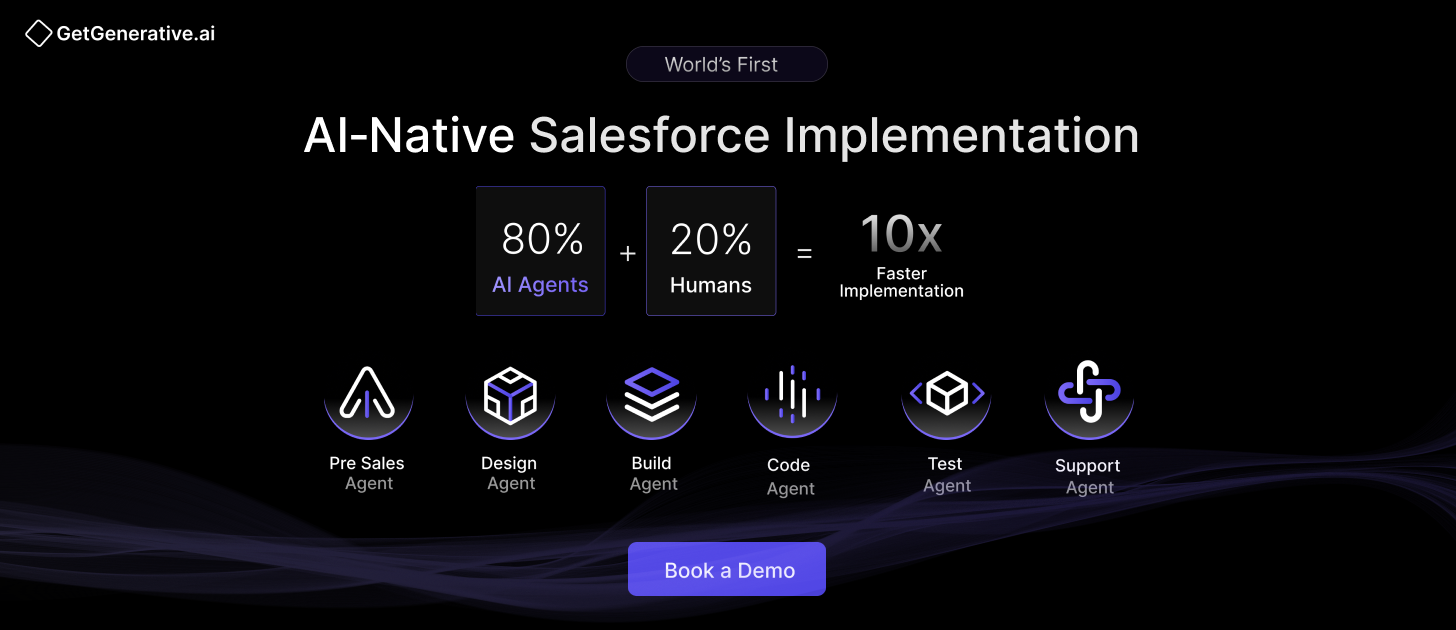
At GetGenerative.ai, we’ve reimagined Salesforce implementation—built from the ground up with AI at the core. This isn’t legacy delivery with AI added on. It’s a faster, smarter, AI-native approach powered by our proprietary platform.
👉 Explore our Salesforce AI consulting services