Solutions
Implementation Org Review Org Monitoring Managed Services
Agents
Discovery Agent Metadata Agent Design Agent Build Agent Test Agent Governance Agent Support Agent
Industry Solutions
Financial Services
Healthcare & Life Sciences
NDIS & Disability Services
Nonprofit
Not-for-Profit
Other Industries
Recruitment & Staffing Real Estate Cosmetic Procedures
Agentforce Claudeforce Blogs Pricing

Salesforce Testing Tools: Categories and How to Choose

Salesforce Testing Tools: Categories and How to Choose

Salesforce testing tools split into six categories by what they test, and the choice between them is decided by maintenance cost rather than by how quickly tests can be created. That distinction sounds academic until the third seasonal release of the year breaks a suite of UI tests nobody has time to repair.

Before evaluating anything commercial, know what the platform already gives you, because four native capabilities cover more ground than most tool comparisons acknowledge.

Salesforce ships four testing capabilities before you buy anything

The Apex test framework runs unit tests against your code and is not optional. Salesforce requires at least 75 percent of your Apex to be covered by unit tests before you can deploy to production, measured across the org rather than per class, which makes this the one testing tool every org already uses whether deliberately or not.

UTAM, the UI Test Automation Model, is Salesforce’s open-source page object framework for UI testing. It is the native answer to browser automation and it understands Lightning components in a way generic frameworks have to be taught.

Agentforce Testing Center validates agent behaviour, scoring responses across quality dimensions rather than returning a pass. If agents are in scope, no third-party tool replaces this.

Code Analyzer performs static analysis, catching security and performance problems before a test ever runs.

Starting here costs nothing and narrows what you actually need to buy.

Salesforce testing tools divide by what they test

Category

What it covers

Tools you will encounter

Unit and code

Apex classes, triggers, coverage

Apex test framework, Code Analyzer

UI and functional

Clicks, screens, end-to-end user journeys

UTAM, Provar, Selenium, ACCELQ, Testsigma, Katalon, Tosca

API and integration

Service calls, payloads, error handling

Postman-style clients, most UI tools’ API modules

Data validation

Record-level comparison against source systems

Dedicated data validation platforms

Agent behaviour

Subagent routing, action selection, response quality

Agentforce Testing Center

Orchestration and DevOps

Running suites inside a release pipeline

Copado, Gearset, and the CI platform you already use

Naming tools here places them in a category rather than endorsing them. Most commercial platforms cover two or three of these rows, which is why teams end up with more than one and why the integration between them matters as much as either.

Maintenance cost decides the testing tool, not creation speed

Every vendor competes on how fast tests can be built. That is the wrong number to optimise.

UI tests break when the interface changes, and on Salesforce the interface changes three times a year without you touching anything. A suite of two hundred UI tests carries a recurring repair bill that arrives on the platform’s schedule rather than yours. API-level tests are far more stable, because the contract underneath changes much less often than the screen above it.

The practical rule that follows: push testing down the stack wherever the assertion allows it. Test business logic through Apex tests and API calls. Reserve UI automation for the journeys where the interface itself is the thing being validated, which is usually a much shorter list than teams first assume.

Two questions expose a tool’s real maintenance profile. How does it handle a Lightning component whose internal structure changed but whose behaviour did not? And what happens to your suite the week after a seasonal release lands? Vendors with strong answers volunteer them; vendors without change the subject to creation speed.

Five criteria matter for Salesforce specifically

  1. Release resilience. How the tool copes with three platform upgrades a year, including whether it can run against a preview sandbox before production changes.
  2. Lightning and metadata awareness. Whether it understands components and org configuration or treats the page as generic HTML.
  3. API testing depth. Because the stable tests live at this layer, a tool weak here pushes you toward the fragile layer.
  4. Environment handling. Whether it can run against multiple sandboxes with different data and different configuration without rewriting the suite.
  5. Licence model against team shape. Per-user pricing suits a small dedicated QA function; execution-based pricing suits a team where many people run tests occasionally.

Everything else on a vendor comparison matrix matters less than these five in a Salesforce context.

AI changes test creation more than test maintenance

AI is now standard in this category, generating cases from requirements and repairing selectors when elements move. The honest read is that it compresses creation substantially and helps with maintenance without eliminating it, because a test that breaks for a genuine reason still needs a human to decide whether the test or the application is wrong. The detail of what AI can and cannot test is worked through separately.

Salesforce testing tool selection goes wrong in six ways

Mistake

Consequence

Correction

Buying before using native capability

Paying for coverage you already have

Start with Apex tests, UTAM and Code Analyzer

Optimising for creation speed

A large suite nobody can maintain

Ask about post-release repair effort

Everything tested through the UI

The suite breaks three times a year

Push assertions down to API and Apex

Agent testing folded into a UI tool

Behaviour scored with no criteria

Use Testing Center for agents

One tool expected to cover six categories

Gaps discovered during a release

Accept a small stack, chosen deliberately

No environment strategy behind the suite

Tests pass in one sandbox and fail in another

Decide which sandbox each suite runs against

The first row is the expensive one. Teams routinely buy a UI automation platform while their Apex coverage sits at the 75 percent floor, which means they are paying for new tests while the mandatory ones remain the weakest part of the estate.

Tool choice sits downstream of a Salesforce testing strategy

A tool decision made before the test strategy exists produces a stack that covers whatever the vendor demonstrated well. The order that works is the opposite: decide what must be tested, at which layer, in which environment, and how often, then buy the smallest set of tools that covers it. That sequence is set out in the strategy behind the tools.

Salesforce testing tool categories, condensed

Item

Detail

Native capabilities

Apex test framework, UTAM, Agentforce Testing Center, Code Analyzer

Mandatory floor

75 percent Apex coverage to deploy to production

Six categories

Unit, UI and functional, API, data validation, agent behaviour, orchestration

The deciding factor

Maintenance cost after each seasonal release

The stability rule

Push assertions down the stack wherever possible

Selection criteria

Release resilience, Lightning awareness, API depth, environments, licence model

Typical outcome

Two or three tools, not one

Most common error

Buying before using what the platform already provides

The Support Agent keeps regression suites alive after go-live

Test suites decay for the same reason documentation does: maintaining them is nobody’s named job once the project team leaves. A suite that is not repaired after the first release stops being run after the second.

GetGenerative.ai handles that as part of ongoing support, where the Support Agent for BAU work generates test cases and validation steps for every change, so the regression pack grows with the org rather than aging against it.

Questions teams ask about Salesforce testing tools

What are the best Salesforce testing tools?

There is no single answer, because the six categories test different things and most commercial platforms cover two or three. Start with the native capabilities you already own, identify which categories they leave uncovered, then buy the smallest set that closes the gap.

Does Salesforce have built-in testing tools?

Yes, four. The Apex test framework for unit tests, UTAM for UI automation, Agentforce Testing Center for agent behaviour, and Code Analyzer for static analysis. Together they cover more ground than most tool comparisons acknowledge.

What is the Salesforce code coverage requirement?

At least 75 percent of your Apex must be covered by unit tests to deploy to production, calculated across the org rather than per class. Individual classes can sit below that provided the overall figure holds and existing production classes are covered.

Are there free Salesforce testing tools?

The native capabilities are included with the platform, and Selenium and UTAM are open source. What costs money is the low-code layer that lets non-developers build and maintain tests, which is what most commercial platforms are actually selling.

How many testing tools does a Salesforce team need?

Usually two or three. One for unit and static analysis, which is native, one for functional and UI coverage, and Testing Center if agents are in scope. A single tool covering all six categories tends to be weak in several of them.

Should we automate every test?

No. Automate what runs repeatedly and changes rarely. Exploratory testing, one-off validation and anything where the expected result is a judgement call stay manual, and automating them costs more in maintenance than the manual runs would have cost.
Nonprofit Salesforce Consultants: A Complete Guide 2024

Nonprofit Salesforce Consultants: A Complete Guide 2024

In the dynamic world of nonprofit organizations, managing donor relationships, volunteer coordination, and tracking programs is crucial. Salesforce offers tailored solutions to meet these needs. Nonprofit Salesforce consultants are pivotal in helping organizations leverage this powerful tool. 

This blog explores the role of Salesforce consultants in the nonprofit sector, their services, best practices, and more.

What are Salesforce consultants for nonprofits?

Salesforce consultants for nonprofits are specialized professionals who assist organizations in implementing, customizing, and optimizing Salesforce solutions. They understand nonprofits’ unique challenges and tailor Salesforce to enhance operational efficiency, improve donor engagement, and drive mission success.

How do Salesforce consultants assist nonprofit organizations?

Salesforce consultants provide services that help nonprofit organizations optimize their operations and achieve their missions more effectively. Here’s a closer look at the specific ways they assist:

Implementation

  1. Needs Assessment: Consultants begin by conducting a thorough needs assessment to understand the unique requirements of the nonprofit. This includes evaluating current processes, challenges, and goals.
  2. Custom Setup: Based on the assessment, consultants configure Salesforce to align with the nonprofit’s specific workflows and objectives. This might involve setting up objects, fields, and workflows tailored to the organization’s needs.
  3. Data Structuring: They ensure that Salesforce’s data structure supports the nonprofit’s reporting and operational requirements, making it easier to track donations, manage volunteers, and measure program impact.

Customization

  1. Tailored Solutions: Consultants customize Salesforce features to better suit the nonprofit’s processes. This can include custom objects, fields, and page layouts that reflect the organization’s unique data and operational requirements.
  2. Automation: By creating automated workflows and processes, consultants help streamline repetitive tasks. For example, automating thank-you emails to donors, scheduling volunteer shifts, or tracking grant deadlines.
  3. App Integration: Consultants integrate Salesforce with other tools and applications the nonprofit uses, such as email marketing platforms, event management software, and accounting systems, to create a seamless operational ecosystem.

Also Read – Salesforce CPQ Consultant: A Complete Guide

Data Migration

  1. Data Cleaning and Preparation: Before migrating data from legacy systems to Salesforce, consultants clean and prepare the data to ensure accuracy and consistency. This involves removing duplicates, correcting errors, and standardizing formats.
  2. Migration Strategy: They develop a detailed migration strategy that minimizes downtime and ensures data integrity. This plan covers mapping old data fields to new ones in Salesforce and performing test migrations.
  3. Execution and Validation: Consultants execute the data migration and validate the results to ensure that all data has been accurately transferred and is functioning correctly within Salesforce.

Integration

  1. Third-Party Apps: Salesforce consultants help nonprofits integrate third-party applications to extend Salesforce’s functionality. This might include integrating email marketing tools like Mailchimp, payment processors like Stripe, or social media platforms.
  2. Custom APIs: For more complex needs, consultants can develop custom APIs that allow Salesforce to communicate with other software solutions the nonprofit uses, ensuring seamless data flow across platforms.
  3. Real-Time Syncing: Ensuring real-time data synchronization between Salesforce and other systems, consultants help maintain up-to-date information across all platforms, enhancing decision-making and reporting accuracy.
 

getgenerativeai

Training

  1. User Training: Consultants provide comprehensive training sessions for staff, ensuring they are comfortable and proficient in using Salesforce. Training can be tailored for different user roles, such as administrators, fundraisers, and program managers.
  2. Training Materials: They create and provide customized training materials, including user manuals, video tutorials, and FAQs, to support ongoing learning and reference.
  3. Ongoing Education: Consultants often offer ongoing training sessions and workshops to help staff stay updated on new Salesforce features and best practices.

Support

  1. Technical Support: Consultants provide technical support to address any issues that arise when using Salesforce. This includes troubleshooting, bug fixes, and performance optimizations.
  2. System Audits: Regular system audits are conducted to ensure that Salesforce is running efficiently and continues to meet the nonprofit’s evolving needs. This involves reviewing system performance, data integrity, and user satisfaction.
  3. Continuous Improvement: Consultants work with nonprofits to improve their Salesforce setup, suggesting and implementing enhancements based on user feedback and new organizational needs.

Salesforce consulting services for small nonprofits

Small nonprofits often have limited resources and distinct needs. Salesforce consultants offer services tailored to these organizations, such as:

  • Affordable Implementation: Cost-effective setup solutions.
  • Basic Customizations: Adjusting Salesforce for essential operations without unnecessary complexity.
  • Scalable Solutions: Implementing a scalable setup that can grow with the organization.
  • Grant Management: Simplifying the tracking and management of grants and donations.
  • Volunteer Management: Streamlining volunteer tracking and coordination.

Also Read – Salesforce Data Cloud Consultant: The Role and Importance

Best CRM practices for nonprofits using Salesforce

To maximize the benefits of Salesforce, nonprofits should follow these best practices:

  1. Define Clear Objectives: Establish goals for what you want to achieve with Salesforce.
  2. Clean Data: Ensure data accuracy and consistency before migrating to Salesforce.
  3. Regular Training: Train staff to stay updated on new features and best practices.
  4. Leverage Reports and Dashboards: Use Salesforce’s reporting tools to gain insights and make data-driven decisions.
  5. Engage with the Community: Participate in Salesforce user groups and communities to share experiences and learn from others.

How much does it cost to hire a Salesforce consultant for a nonprofit?

The cost of hiring a Salesforce consultant for a nonprofit can vary widely based on several factors:

  • Scope of Work: The complexity and extent of the project.
  • Consultant’s Experience: More experienced consultants may charge higher rates.
  • Location: Costs may vary based on geographic location.
  • Ongoing Support: The need for continuous support and training can affect pricing.

On average, consulting fees can range from $100 to $250 per hour, with full projects costing from a few thousand to tens of thousands of dollars.

What are the best Salesforce products for nonprofits?

Salesforce offers several products tailored for nonprofits, including:

  • Nonprofit Cloud: A comprehensive solution designed specifically for nonprofits.
  • Salesforce.org Philanthropy Cloud: A platform for managing donations and volunteerism.
  • Salesforce Pardot: For marketing automation and donor engagement.
  • Einstein Analytics: Advanced analytics for deeper insights into data.

Is Salesforce a suitable CRM for all types of nonprofit organizations?

Salesforce is highly versatile and can be customized for various nonprofit organizations, from small local charities to large international NGOs. However, suitability depends on the organization’s specific needs and resources. Simpler CRM solutions might be more appropriate for some smaller nonprofits with very basic needs.

Related Read – Becoming a Salesforce Consultant – The Ultimate Guide

Do all Salesforce consultants provide training and ongoing support?

Not all Salesforce consultants offer training and ongoing support as part of their services. It’s essential to clarify the scope of services when hiring a consultant. Some consultants specialize only in implementation, while others provide comprehensive services, including training, support, and regular system audits.

Conclusion

Nonprofit Salesforce consultants are invaluable partners in helping organizations harness Salesforce’s full potential. They provide tailored solutions that enhance operational efficiency, improve donor and volunteer engagement, and support the nonprofit’s overall mission. By understanding their services, costs, and best practices for using Salesforce, nonprofits can make informed decisions and achieve greater impact.

Enhance your Salesforce consulting with GetGenerative.ai. Effortlessly craft outstanding proposals, enabling you to dedicate more time to providing exceptional client service. 

Start today!

Frequently Asked Questions (FAQs)

1. What is a Salesforce consultant for nonprofits? 

A professional who helps nonprofits implement, customize, and optimize Salesforce.

2. How can Salesforce consultants benefit my nonprofit? 

They improve donor management, streamline operations, and provide training and support.

3. What are the costs associated with hiring a Salesforce consultant? 

Costs vary based on the project scope, consultant experience, and the level of support needed.

4. Are there specific Salesforce products for nonprofits? 

Yes, including Nonprofit Cloud, Philanthropy Cloud, Pardot, and Einstein Analytics.

5. Do all consultants provide ongoing support? 

Not all; it’s crucial to discuss and clarify the services included with the consultant.

Top Salesforce Sales Cloud Implementation Partners 2025

Top Salesforce Sales Cloud Implementation Partners 2025


Salesforce, the world’s leading CRM platform, continues to empower sales teams globally with its robust Sales Cloud solution. As businesses strive to enhance their productivity and customer relationships, Salesforce Sales Cloud provides the tools to sell smarter and faster, from lead generation to customer loyalty. 

According to recent research, companies utilizing Salesforce Sales Cloud have reported a 44% increase in productivity. The key to leveraging these benefits often lies in choosing the right implementation partner. Here, we present the top Salesforce Sales Cloud implementation partners for 2025.

1. GetGenerative.ai

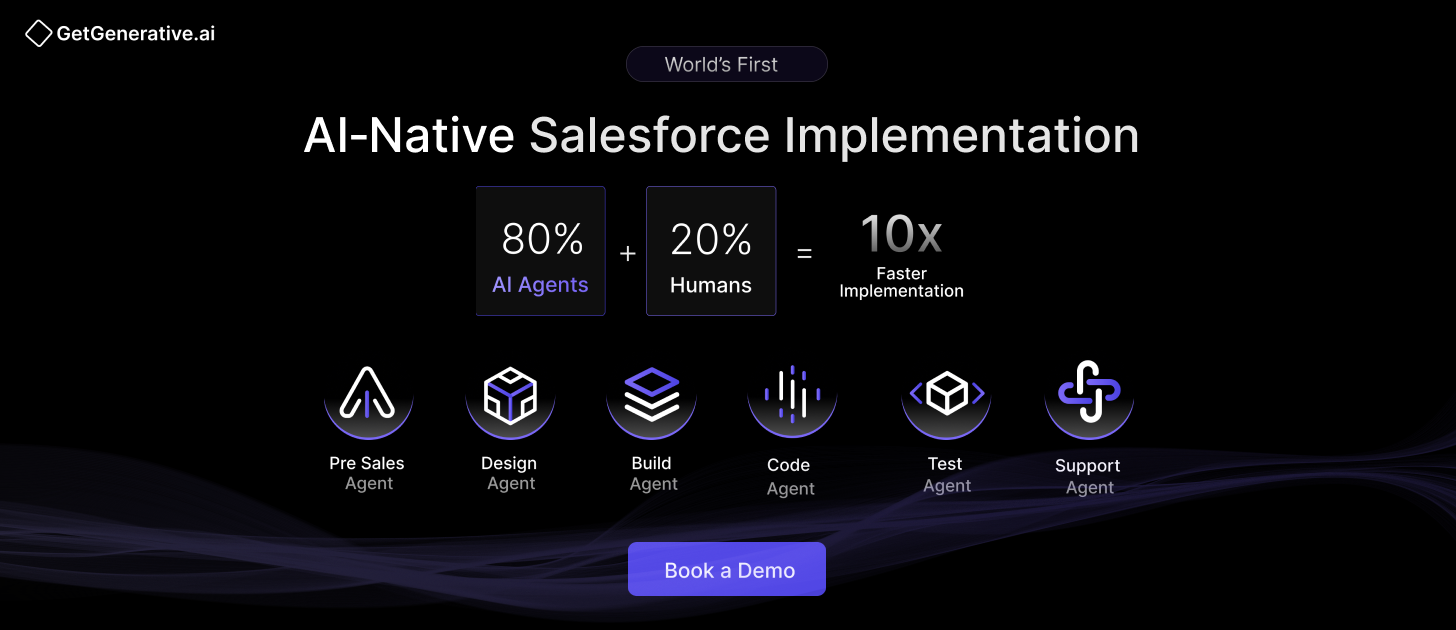
GetGenerative.ai is the world’s first AI-native Salesforce consulting partner, leading the charge in modernizing CRM implementations with intelligent automation. Instead of traditional timelines and resource-heavy approaches, GetGenerative.ai uses a suite of specialized AI Agents to plan, design, build, test, and support Salesforce Sales Cloud solutions—delivering projects up to 10x faster.

Their innovative model includes:

  • Pre-Sales Agent – Instantly generates proposals, estimates, and solution blueprints based on business goals.
  • Design Agent – Translates business requirements into user stories and low-level designs.
  • Build & Code Agents – Auto-generate Apex code, configuration workbooks, and integrations.
  • Test Agent – Creates test cases, executes test runs, and logs bugs.
  • Support Agent – Diagnoses and resolves issues across Salesforce environments using AI.

With over 200 successful projects across 8+ countries, and ISO 27001 & SOC 2 compliance, GetGenerative.ai offers unmatched speed, precision, and scalability for Sales Cloud implementations.  

2. TechForce Services

TechForce Services is renowned for its comprehensive Salesforce services, including migrations, integrations, and analytics. With over 150 Salesforce certifications and multiple awards, this Australian-based company excels in providing end-to-end digital transformation solutions. Clients commend their self-reliant and motivated team, which ensures timely and efficient project delivery.

3. Manras Technologies

Manras Technologies specializes in advanced Salesforce customizations and implementations. Their experienced team focuses on building long-term client relationships and delivering high-quality services. Clients highlight their extensive Salesforce knowledge and ability to think through requirements, making the implementation process seamless.

Also Read – Salesforce Sales Cloud Consultant: The Ultimate Guide

4. Stratiform Business Solutions

Stratiform Business Solutions prides itself on providing personal, long-term partnerships focused on growth and adaptability. Clients value its flexible, personable approach and genuine feedback, which ensures tailored solutions to business challenges. Its hands-on support and expertise make it a preferred partner for many.

5. CloudKettle

As a Salesforce Summit Partner, CloudKettle secures and optimizes Revenue Operations. Its SOC 2 Type II compliance underscores its commitment to security. Clients benefit from CloudKettle’s comprehensive understanding of Salesforce technology and ability to deliver robust, secure solutions across North America.

6. Ksolves

Ksolves offers a decade of experience in software solutions and product development, including Salesforce CRM Development and Lightning Development. Their expertise extends to Big Data, AI, and Machine Learning services, providing a holistic approach to digital transformation for businesses of all sizes.

7. Comnexa Limited

Specializing in Financial and Professional Services, Comnexa Limited excels in Salesforce Financial Services Cloud implementations. Clients appreciate their engaged, communicative approach, ensuring tailored solutions that meet specific industry needs. Their expertise spans multiple Salesforce products, making them a versatile partner.

8. Technology Mindz

Technology Mindz focuses on delivering efficient and cost-effective Salesforce consulting and implementation services. Their iterative methodology and strong domain knowledge in Finance, Real Estate, and E-commerce ensure that clients achieve their business objectives with exceptional service.

9. Zon Projects Ltd

Region: United Kingdom

Zon Projects Ltd specializes in helping SMEs and charities navigate their digital transformation journey. As an independent Salesforce specialist, they offer trusted and personalized support, making them a reliable partner for smaller organizations seeking to leverage Salesforce.

10. Arka Softwares

With over a decade of experience and 600+ successful app launches, Arka Softwares provides innovative Salesforce and digital transformation solutions. Their expertise in product engineering helps businesses penetrate the global market and enhance customer experiences.

Also Read – Salesforce Sales Cloud Implementation Template

Key Criteria for Evaluating Salesforce Implementation Partners

To select the best-fit partner for your Sales Cloud deployment, prioritize the following attributes:

1. Salesforce Certifications & Expertise

The number and type of Salesforce-certified professionals are a strong indicator of capability.

Ensure that the partner has consultants with specific badges like Sales Cloud Consultant, Application Architect, and Integration Architect to manage your technical stack.

2. Industry-Specific Knowledge

CRM requirements vary across verticals. A healthcare provider will need HIPAA-compliant processes, while a fintech company might need integrations with regulatory systems. Top partners like:

  • Silverline focus on Financial Services and Healthcare

  • Coastal Cloud has deep experience in nonprofits, healthcare, and aerospace

Look for documented case studies and client references in your specific industry.

3. Proven Delivery Track Record

Check public data from AppExchange or partner websites. Key indicators:

  • Number of Salesforce projects completed

  • Client retention and satisfaction (e.g., CSAT scores)

  • Analyst recognition or awards (e.g., Partner Innovation Awards)

4. AI and Data Innovation Capabilities

With Salesforce’s rapid rollout of Einstein AI, Agentforce, and Data Cloud, your partner should be ahead of the curve, not catching up.

  • Deloitte and Accenture are Agentforce global rollout integrators

  • Atrium specializes in CRM Analytics, AI, and predictive modeling

  • Coastal Cloud helps align Sales Cloud with Data Cloud and Tableau CRM

AI-infused CRMs are no longer a “nice to have”—they are a competitive differentiator.

5. Full Lifecycle Services

Top partners offer more than just deployment:

  • Change management and training

  • Post-go-live managed services

  • Release management and governance frameworks

  • Ongoing optimization aligned to business goals

This helps ensure long-term Salesforce ROI, not just a one-time go-live.

6. Culture Fit and Delivery Methodology

Finally, assess whether a partner’s agility, communication, and delivery style aligns with your organization. Boutique firms often offer faster turnaround and tailored service, while global SIs bring scalability and global reach.

Ask:

  • Do they follow Agile or Waterfall?

  • How responsive is their team?

  • What are their escalation processes?

Also Read – The Ultimate Salesforce Sales Cloud Features Cheat Sheet

Conclusion

Choosing the right Salesforce Sales Cloud implementation partner can significantly impact your business’s efficiency and growth. The companies listed above are among the best in the industry, each offering unique strengths and expertise to help you maximize your Salesforce investment. For further assistance selecting a partner based on your specific needs, use our Partner Search Tool or contact us for personalized recommendations.

salesforce consulting services

At GetGenerative.ai, we’ve reimagined Salesforce implementation—built from the ground up with AI at the core. This isn’t legacy delivery with AI added on. It’s a faster, smarter, AI-native approach powered by our proprietary platform.

👉 Explore our Salesforce AI consulting services

Frequently Asked Questions (FAQs)

1. What is Salesforce Sales Cloud? 

Salesforce Sales Cloud is a CRM platform that enhances sales productivity and customer engagement.

2. Why choose a Salesforce implementation partner? 

Implementation partners provide expertise, customization, and support for effective Salesforce deployment.

3. How can a Salesforce partner improve my business? 

They offer tailored solutions, streamline processes, and ensure you get the most out of Salesforce.

4. What factors should I consider when choosing a Salesforce partner? 

Consider their experience, client reviews, industry expertise, and certification levels.

5. Are these partners suitable for small businesses? 

Yes, many partners specialize in solutions for SMEs and provide scalable services.

6. How do I get started with a Salesforce partner? 

Contact the partner directly through their website or use the Salesforce Partner Search Tool for recommendations.

Salesforce Technical Consultant: A Complete Guide 2024

Salesforce Technical Consultant: A Complete Guide 2024

Salesforce has emerged as a leading customer relationship management (CRM) platform, transforming how businesses interact with customers. 

Amidst this transformation, the role of a Salesforce Technical Consultant has gained significant prominence. If you’re considering a career as a Salesforce Technical Consultant, this guide will provide you with everything you need.

What is a Salesforce Technical Consultant?

A Salesforce Technical Consultant is a professional who specializes in the technical aspects of Salesforce implementation and customization. They work closely with businesses to understand their needs, design solutions, and ensure the Salesforce platform is effectively integrated into their operations.

How to Become a Salesforce Technical Consultant?

Becoming a Salesforce Technical Consultant typically involves a combination of education, experience, and certification. Here’s a step-by-step guide:

  1. Education: A bachelor’s degree in computer science, information technology, or a related field is often preferred.
  2. Experience: Gaining hands-on experience with Salesforce through internships, projects, or entry-level positions is crucial.
  3. Certification: Obtaining Salesforce certifications, such as Salesforce Certified Technical Architect or Platform Developer, can significantly boost your credibility.

Roles and Responsibilities of a Salesforce Technical Consultant

The roles and responsibilities of a Salesforce Technical Consultant can vary, but typically include:

  • Analyzing business requirements and translating them into technical specifications.
  • Designing and implementing customized Salesforce solutions.
  • Integrating Salesforce with other systems.
  • Conducting data migration and ensuring data integrity.
  • Providing technical support and troubleshooting.
  • Training end-users on Salesforce functionalities.

Best Practices for Salesforce Technical Consultants

To excel as a Salesforce Technical Consultant, follow these best practices:

  • Stay Updated: Salesforce regularly updates its platform. Stay informed about the latest features and best practices.
  • Effective Communication: Communicate technical concepts to non-technical stakeholders.
  • Customization and Configuration: Balance customization with configuration to ensure scalability and maintainability.
  • Documentation: Maintain comprehensive documentation for all implementations and customizations.
  • Continuous Learning: Engage in continuous learning and professional development to stay in the field.

Also Read – Salesforce CPQ Consultant: A Complete Guide

Advanced Skills for Salesforce Technical Consultants

Beyond foundational knowledge, Salesforce Technical Consultants should acquire advanced skills to excel in their roles. These skills not only enhance their technical capabilities but also enable them to provide more value to their clients and organizations. Here’s a detailed look at the advanced skills necessary for a Salesforce Technical Consultant:

Apex and Visualforce

Apex: Apex is Salesforce’s proprietary programming language, similar to Java. Mastery of Apex is crucial for developing custom business logic and complex functionalities that cannot be achieved through standard configuration alone. Specific skills include:

  • Writing Apex triggers to automate tasks and enforce complex business processes.
  • Creating custom Apex classes and methods to encapsulate business logic.
  • Using SOQL (Salesforce Object Query Language) and SOSL (Salesforce Object Search Language) for efficient data retrieval.

Visualforce: Visualforce is a markup language that creates custom user interfaces in Salesforce. Advanced skills include:

  • Designing custom Visualforce pages to provide unique user experiences.
  • Implementing Visualforce controllers to handle page logic.
  • Integrating Visualforce with standard and custom Salesforce objects.

Lightning Framework

The Lightning Component Framework is essential for building modern, dynamic web applications on the Salesforce platform. Key skills include:

  • Lightning Web Components (LWC): Developing reusable and efficient web components using standard JavaScript and HTML.
  • Aura Components: Although LWC is preferred, understanding Aura Components is still valuable for maintaining and upgrading legacy components.
  • Lightning App Builder: Using the builder to create custom applications with Lightning components, integrating them seamlessly with the Salesforce ecosystem.

Integration

Integrating Salesforce with other systems is a critical capability. This involves:

  • APIs: Proficiency in REST and SOAP APIs for data exchange between Salesforce and external systems.
  • Middleware: Knowledge of middleware platforms like MuleSoft, Dell Boomi, or Informatica for complex integrations.
  • OAuth and Single Sign-On (SSO): Implementing secure authentication mechanisms to streamline user access across multiple systems.

Data Management

Effective data management ensures that Salesforce operates smoothly and provides accurate insights. Important skills include:

  • Data Migration: Expertise in tools like Data Loader, Salesforce Data Import Wizard, and third-party ETL (Extract, Transform, Load) tools to migrate data efficiently and accurately.
  • Data Quality: Implementing data quality practices, such as data validation rules, duplicate management, and regular data cleansing.
  • Data Governance: Establishing frameworks to maintain data integrity, security, and compliance with regulations like GDPR and CCPA.

Problem-Solving

Advanced problem-solving skills are essential for addressing complex technical challenges. This includes:

  • Root Cause Analysis: Identifying and diagnosing the root causes of system issues or performance bottlenecks.
  • Performance Tuning: Optimizing Salesforce performance through efficient coding practices, query optimization, and proper use of indexes.
  • Troubleshooting: Using tools like Salesforce Debug Logs, Event Monitoring, and Health Check to diagnose and resolve issues promptly.

Project Management and Collaboration

While technical expertise is vital, managing projects and collaborating effectively is equally important. Key skills include:

  • Agile Methodologies: Applying Agile principles to manage Salesforce projects, ensuring iterative development and continuous feedback.
  • Stakeholder Communication: Communicating effectively with stakeholders to gather requirements, provide updates, and manage expectations.
  • Team Collaboration: Working collaboratively with cross-functional teams, including business analysts, developers, and end-users to deliver successful projects.

Security and Compliance

Ensuring the security and compliance of Salesforce implementations is critical, particularly for industries with stringent regulatory requirements. Advanced skills include:

  • Security Configuration: Implementing robust security measures, such as field-level security, role hierarchies, and sharing rules.
  • Compliance: Ensuring Salesforce implementations comply with industry-specific regulations, conducting regular security audits, and implementing data encryption where necessary.
  • Identity Management: Configuring and managing Salesforce identity features, such as Multi-Factor Authentication (MFA), Single Sign-On (SSO), and identity verification.

Business Acumen

Understanding the business context in which Salesforce operates allows technical consultants to provide more strategic value. This involves:

  • Industry Knowledge: Gaining insights into specific industries, such as finance, healthcare, or retail, to tailor Salesforce solutions to industry-specific needs.
  • Business Process Optimization: Identifying opportunities to streamline and automate business processes using Salesforce, enhancing operational efficiency and effectiveness.

Also Read – Salesforce Data Cloud Consultant: The Role and Importance

Career Path for Salesforce Technical Consultants

The career path for a Salesforce Technical Consultant can be quite rewarding, with opportunities for advancement into roles such as:

  • Senior Salesforce Consultant
  • Salesforce Technical Architect
  • Salesforce Project Manager
  • Director of Salesforce Solutions
  • VP of CRM Solutions

What are the Common Challenges Faced by Salesforce Technical Consultants?

Like any career, being a Salesforce Technical Consultant comes with its challenges:

  • Complex Implementations: Managing complex Salesforce implementations can be challenging and require meticulous planning.
  • Change Management: Ensuring user adoption and managing resistance to change.
  • Data Security: Maintaining data security and compliance with regulations.
  • Continuous Learning: Keeping up with the frequent updates and new features of the Salesforce platform.

Is a Certification Necessary to Become a Salesforce Technical Consultant?

While it’s possible to become a Salesforce Technical Consultant without certification, having certifications can significantly enhance your job prospects and credibility. Certifications demonstrate your expertise and commitment to the field, making you a more attractive candidate to employers.

Do Salesforce Technical Consultants Need Coding Skills?

Yes, coding skills are essential for Salesforce Technical Consultants. Proficiency in Apex, Visualforce, and Lightning Components is often required to design and implement customized solutions. However, combining coding and declarative (clicks, not code) solutions is also valuable.

Related ReadBecoming a Salesforce Consultant – The Ultimate Guide

Conclusion

A career as a Salesforce Technical Consultant is both challenging and rewarding. You can excel in this dynamic field with the right combination of education, experience, and certification. Whether you’re just starting or looking to advance your career, the role of a Salesforce Technical Consultant offers numerous opportunities for growth and development.

salesforce consulting services

👉 Talk to our Salesforce Expert Today and see how we can transform your implementation experience.

👉 Explore our Salesforce AI consulting services

Start today!

Frequently Asked Questions (FAQs)

1. What is the primary role of a Salesforce Technical Consultant? 

A Salesforce Technical Consultant specializes in the technical implementation and customization of the Salesforce platform to meet business needs.

2. How long does it take to become a Salesforce Technical Consultant? 

It can take several years, including obtaining a degree, gaining experience, and achieving certification.

3. Are there different types of Salesforce certifications? 

Yes, Salesforce offers various certifications for different roles and expertise levels, including Technical Architect, Developer, and Administrator.

4. What industries hire Salesforce Technical Consultants? 

Salesforce Technical Consultants are in demand across various industries, including finance, healthcare, retail, and technology.

5. Can you work remotely as a Salesforce Technical Consultant? 

Many Salesforce Technical Consultants work remotely, providing flexibility and opportunities to work with clients globally.

Salesforce CPQ Consultant: A Complete Guide 2024

Salesforce CPQ Consultant: A Complete Guide 2024

Salesforce CPQ (Configure, Price, Quote) is a powerful tool to streamline the sales process. It makes it easier for sales teams to configure products, price them accurately, and generate professional quotes quickly. As businesses grow and their product offerings become more complex, efficient sales processes become paramount. Salesforce CPQ addresses this need by automating and optimizing the sales cycle, ensuring accuracy, reducing errors, and enhancing customer satisfaction.

With the increasing adoption of Salesforce CPQ, there’s a growing demand for specialists who can effectively implement and manage this tool. Salesforce CPQ consultants are becoming indispensable for businesses looking to leverage the full potential of this platform. Their expertise ensures that the CPQ system is tailored to the specific needs of the business, integrated seamlessly with existing systems, and maintained for optimal performance.

What Does a Salesforce CPQ Consultant Do?

A Salesforce CPQ consultant specializes in implementing, customizing, and optimizing Salesforce CPQ solutions. They work closely with businesses to understand their unique requirements and configure the CPQ system accordingly. Their responsibilities include system setup, integration with other Salesforce modules, user training, and ongoing support and maintenance.

Role of a Salesforce CPQ Consultant

A Salesforce CPQ consultant is pivotal in transforming an organization’s sales process. Their responsibilities span various critical areas to ensure the successful implementation and ongoing optimization of the CPQ system. Here’s a deeper dive into their role:

  • Needs Analysis and Planning: The consultant begins by thoroughly assessing the business’s current sales processes. This includes understanding the product catalog, pricing strategies, and sales workflows. Based on this analysis, they develop a comprehensive plan outlining the CPQ implementation scope, timelines, and key milestones.
  • System Configuration: This involves setting up the CPQ tool to align with the company’s unique product offerings and pricing models. The consultant configures product bundles, pricing rules, discount schedules, and approval processes. They ensure the system can handle various scenarios, from simple product configurations to complex multi-level product bundles.
  • Integration Management: Seamless integration with other systems is crucial for CPQ’s success. The consultant ensures that Salesforce CPQ integrates smoothly with existing CRM systems, ERP systems, and other relevant applications. This integration facilitates data flow and maintains consistency across different platforms.
  • Customization and Development: Out-of-the-box solutions often don’t meet all a business’s specific needs. The consultant customizes the CPQ system by creating custom fields, developing tailored workflows, and setting up approval processes that match the business’s unique requirements. They might also develop custom scripts or code to extend the functionality of the CPQ tool.
  • User Training and Support: The consultant’s role is to train the sales team to use the CPQ system effectively. They conduct workshops, create training materials, and provide hands-on training sessions. Post-implementation, they offer ongoing support to troubleshoot issues, answer queries, and provide additional training as needed.
  • Performance Monitoring and Optimization: The consultant continuously monitors the system’s performance after the system goes live. They analyze key metrics to identify areas for improvement, ensure the system is functioning optimally, and make necessary adjustments to enhance efficiency and accuracy.

Also Read – Salesforce Data Cloud Consultant: The Role and Importance

Best Practices for Salesforce CPQ Consulting

Implementing Salesforce CPQ successfully requires adherence to several best practices. These practices help in managing the complexity of the implementation process and ensuring that the system delivers maximum value to the business:

  • Detailed Requirement Gathering: Start with an in-depth analysis of the business’s needs. Conduct interviews with key stakeholders, document current processes, and identify pain points and areas for improvement. This ensures that the CPQ system is designed to address specific business challenges.
  • Agile Implementation Approach: Use an agile methodology to implement the CPQ system. Break the project into smaller phases and deliver incremental updates. This approach allows continuous feedback, reduces risks, and ensures the system evolves based on real user inputs.
  • Robust Training Programs: Develop comprehensive training programs tailored to different user groups. Ensure that the sales team, administrators, and other relevant users understand how to use the CPQ tool effectively. Use various training methods, including hands-on sessions, online tutorials, and detailed user guides.
  • Continuous Improvement: Post-implementation, establish a feedback loop to gather user inputs regularly. Use this feedback to make iterative improvements to the system. Keep an eye on new features and updates from Salesforce and integrate them into the CPQ system to enhance functionality.
  • Data Integrity and Management: Ensure that the data used in the CPQ system is accurate and up-to-date. Implement robust data management practices, including regular data audits and validation checks. Clean and migrate existing data carefully to avoid errors and inconsistencies.
  • Effective Change Management: Implementing a new CPQ system often requires changes in existing processes and user behaviors. Develop a change management strategy with clear communication, training, and support to help users adapt to the new system. Address resistance proactively and highlight the new tool’s benefits.
  • Regular System Audits: Conduct regular audits of the CPQ system to ensure it aligns with evolving business needs. Check for compliance with internal policies and industry standards. Use these audits to identify potential issues and areas for enhancement.

By following these best practices, Salesforce CPQ consultants can ensure that the implementation process is smooth, the system is effective, and the business realizes the full benefits of its investment in Salesforce CPQ.

getgenerativeai

What to Expect During a Salesforce CPQ Consultation?

When engaging with a Salesforce CPQ consultant, businesses can expect a comprehensive and structured approach to ensure a successful implementation. Here’s a detailed breakdown of what typically occurs during a consultation:

  • Initial Assessment: The consultant starts with a discovery phase, which includes understanding the business’s current sales processes, product catalog, pricing strategies, and pain points. This might involve interviewing key stakeholders, reviewing existing documentation, and analyzing current sales data.
  • Requirements Gathering: Detailed requirements are gathered to create a clear picture of what the business needs from the CPQ system. This includes specifics about product configurations, pricing rules, discount structures, approval workflows, and integration points with other systems.
  • Solution Design: The consultant designs a tailored CPQ solution based on the gathered requirements. This design phase includes creating a blueprint for system configuration, customizations, integrations, and user roles. The consultant will provide a detailed plan that outlines the implementation strategy, timelines, and key deliverables.
  • Configuration and Customization: The consultant will configure the CPQ system according to the design specifications. This involves setting up product rules, pricing models, and workflows. Custom fields, scripts, and extensions will be developed to meet specific business needs if necessary.
  • Integration Setup: It is critical to ensure seamless integration with existing systems. The consultant will configure integrations with the CRM, ERP, and other relevant applications to ensure data flows smoothly across platforms. This step is crucial for maintaining consistency and accuracy in sales data.
  • Testing and Validation: The consultant thoroughly tests the CPQ system before going live. This includes unit testing, integration testing, and user acceptance testing (UAT). The goal is to identify and fix any issues to ensure the system works as expected.
  • User Training: Comprehensive training ensures all users are comfortable with the new system. This includes hands-on training sessions, the creation of training materials, and ongoing support to address any questions or concerns.
  • Go-Live Support: The consultant provides on-site or remote support during the initial rollout to ensure a smooth transition. They help address any immediate issues and make necessary adjustments based on user feedback.
  • Post-Implementation Review: After the system has been live for a period, the consultant conducts a review to assess its performance, gather user feedback, and identify areas for improvement. This review helps fine-tune the system for optimal performance.

Also Read – Becoming a Salesforce Consultant – The Ultimate Guide

How to Optimize Salesforce CPQ?

Optimizing Salesforce CPQ is crucial for maintaining efficiency and maximizing the system’s benefits. Here are specific strategies to achieve optimization:

  • Regular Performance Audits: Conduct periodic audits to evaluate the performance of the CPQ system. This includes checking system speed, accuracy of configurations and pricing, and user satisfaction. Audits help identify bottlenecks and areas that need improvement.
  • User Feedback Mechanism: Establish a robust feedback mechanism where users can report issues and suggest improvements. Regularly review this feedback to make iterative enhancements to the system. Engaging users in this process ensures the system evolves to meet their needs effectively.
  • Leverage Advanced Features: Salesforce CPQ has advanced features such as guided selling, AI-powered recommendations, and advanced approval workflows. Ensure that these features are fully utilized to enhance the efficiency and accuracy of the sales process.
  • Continuous Training: Provide ongoing training sessions to update users on new features and best practices. This helps maintain high user proficiency and encourages the adoption of new functionalities that can improve sales efficiency.
  • Data Quality Management: Ensure that the data within the CPQ system is accurate and up-to-date. Implement regular data cleansing practices to remove duplicates, correct errors, and update outdated information. High-quality data is crucial for accurate configurations, pricing, and quotes.
  • Integration Optimization: Regularly review and optimize integrations with other systems such as CRM, ERP, and inventory management. Ensure that data flows seamlessly and that any changes in one system are reflected accurately in the CPQ system. This helps maintain consistency and reduces manual data entry.
  • Automate Workflows: Look for opportunities to automate repetitive tasks and workflows within the CPQ system. This includes automating approvals, discount calculations, and quote generation. Automation reduces manual effort, minimizes errors, and speeds up sales.
  • Monitor and Analyze Key Metrics: Use Salesforce CPQ’s reporting and analytics capabilities to monitor key metrics such as quote turnaround time, approval cycle time, and win rates. Analyzing these metrics helps identify trends and areas for improvement.
  • Stay Updated with Salesforce Releases: Salesforce regularly updates its products with new features and enhancements. Stay informed about these updates and assess how they can be leveraged to improve your CPQ system. Implement relevant updates to keep the system current and efficient.
  • Custom Enhancements: If out-of-the-box features do not fully meet your needs, consider developing custom enhancements. This could involve creating custom scripts, developing new integrations, or extending existing functionalities to better align with your business processes.

By following these strategies, businesses can optimize their Salesforce CPQ system, ensuring it remains a powerful tool for driving sales efficiency and accuracy.

Salesforce CPQ Training Resources

To get the most out of Salesforce CPQ, consider the following training resources:

  • Salesforce Trailhead: A comprehensive platform offering free, self-paced training modules.
  • Official Documentation: Detailed guides and manuals provided by Salesforce.
  • Online Courses: Platform platforms like Udemy, Coursera, and LinkedIn Learning offer professional courses.
  • Consultant-Led Training: Customized training sessions conducted by experienced Salesforce CPQ consultants.

Conclusion

Salesforce CPQ is a game-changer for businesses to streamline their sales processes and improve efficiency. A skilled Salesforce CPQ consultant can make a significant difference in ensuring a successful implementation and maximizing the benefits of this powerful tool. By following best practices and leveraging the right training resources, businesses can optimize their CPQ systems and drive greater sales success.

Enhance your Salesforce consulting with GetGenerative.ai. Effortlessly craft outstanding proposals, enabling you to dedicate more time to providing exceptional client service. 

Start today!

Frequently Asked Questions (FAQs)

1. What is Salesforce CPQ? 

Salesforce CPQ is a tool that helps businesses configure products, set pricing, and generate quotes efficiently.

2. Why do I need a Salesforce CPQ consultant? 

A consultant ensures that the CPQ system is implemented correctly, tailored to your business needs, and integrated seamlessly with other systems.

3. How long does it take to implement Salesforce CPQ? 

Implementation time varies depending on the complexity of your requirements but typically ranges from a few weeks to several months.

4. What are the benefits of using Salesforce CPQ? 

Benefits include increased quote accuracy, faster sales cycles, improved customer satisfaction, and reduced errors.

5. Where can I get training for Salesforce CPQ? 

Training is available through Salesforce Trailhead, official documentation, online courses, and consultant-led sessions.

Salesforce Deployment Tools: An Ultimate Guide 2024

Salesforce Deployment Tools: An Ultimate Guide 2024

Salesforce is a powerful CRM platform that centralizes a company’s interactions with customers, encompassing data, sales, and marketing efforts. Salesforce deployment tools are continuously evolving, becoming more sophisticated and efficient with each passing year. In 2024, these tools will be better equipped to handle the complexities of growing businesses and multiple environments, such as production and testing.

This guide delves into the main Salesforce deployment tools available in 2024, highlighting their features, benefits, and drawbacks. We also explore third-party deployment tools like Copado and Gearset.

Popular Salesforce Deployment Tools in 2024

With technology advancing rapidly, the tools for deploying Salesforce are also improving. Here’s a look at some of the most popular Salesforce deployment mechanisms in 2024:

  1. Salesforce Change Sets
  2. Salesforce Packages
  3. Salesforce DX
  4. Salesforce Metadata API
  5. Salesforce ANT Migration Tool
  6. Salesforce Data Loader
  7. Salesforce AppExchange
  8. Salesforce CLI

1. Salesforce Change Sets

Salesforce Change Sets remain a popular choice for deploying changes between Salesforce environments. They are particularly useful for moving changes from production to sandbox environments. Key benefits include ease of use, minimal setup, and the ability to track changes and monitor deployment progress. However, they do not support the deployment of certain components like Apex classes and Visualforce pages.

2. Salesforce Packages

Salesforce Packages allow for the deployment of code and metadata changes across different orgs. There are two types: Unmanaged and Managed Packages. Unmanaged packages are free and open for anyone to install. In contrast, Managed Packages, which can be free or paid, offer additional perks such as tracking changes and rollback capabilities. Challenges include difficulty in transferring ownership and restricted installation privileges for managed packages.

3. Salesforce DX

Salesforce DX is a cloud-based development platform streamlines building, testing, and deploying applications. It supports version control, automated tests, and collaboration on real-time projects. Its scalability and adaptability make it a powerful tool, though it requires some technical knowledge to leverage effectively.

getgenerativeai

4. Salesforce Metadata API

The Metadata API is a robust tool for managing Salesforce org metadata, including customizations and configurations. It allows for deploying changes between multiple orgs and automating common tasks. While powerful, learning can be challenging and unavailable in all Salesforce editions.

5. Salesforce ANT Migration Tool

The ANT Migration Tool is designed to deploy Salesforce code and metadata between organizations. It uses the Metadata API and is suitable for both on-premises and cloud-based environments. Users should be familiar with the command line to operate this tool effectively.

6. Salesforce Data Loader

Salesforce Data Loader is a desktop application ideal for handling large volumes of data. It supports operations like loading, updating, deleting, and extracting data using CSV files. It’s a free tool that excels at managing extensive data operations.

7. Salesforce AppExchange

AppExchange is a marketplace for pre-built Salesforce applications and add-ons. It allows businesses to find solutions tailored to their needs, reducing the time to market. Applications on AppExchange cater to a wide range of business requirements.

8. Salesforce CLI

Salesforce CLI is a command line interface that automates various development processes, including data retrieval, code deployment, and unit tests. It integrates seamlessly with IDE tools like VSCode, enhancing its utility for developers.

Best Practices for Salesforce Deployment

Effective Salesforce deployment requires careful planning, testing, and execution. Here are some best practices to enhance efficiency and minimize disruptions:

  1. Develop a Deployment Plan: Outline the scope of changes, schedule, roles, and rollback plans.
  2. Use Version Control: Track changes and facilitate collaboration with a version control system.
  3. Leverage Sandboxes: Test changes in a sandbox environment to avoid affecting live data.
  4. Automate Deployments: Use tools like Salesforce DX and Jenkins to automate deployment stages.
  5. Perform Incremental Deployments: Deploy changes incrementally to monitor impacts closely.
  6. Use Metadata API for Complex Deployments: Handle complex deployments with the flexibility of Metadata API.
  7. Adopt a Testing Strategy: Implement unit, integration, and user acceptance testing (UAT) tests.
  8. Communicate with Stakeholders: Keep stakeholders informed about deployment schedules and impacts.
  9. Monitor Post-Deployment: Monitor the system for issues post-deployment and have a quick response plan.
  10. Document Everything: Maintain detailed documentation of processes, changes, and issues.

Also Read – Einstein Generative AI Features Across Salesforce Clouds – The Ultimate Guide

Third-Party Salesforce Deployment Tools

Numerous third-party tools enhance Salesforce deployment processes, offering features beyond native tools:

  • Copado: Provides a comprehensive DevOps solution with continuous integration, delivery, and automated testing.
  • Gearset: Known for its user-friendly interface and features like automated deployments and change monitoring.
  • Flosum: An all-in-one Salesforce DevOps solution with version control and rollback capabilities.

Conclusion

Salesforce deployment tools in 2024 offer a range of features to manage customer relationships and business operations effectively. The right tool depends on your organization’s specific needs, but understanding each tool’s strengths and limitations is crucial for making an informed decision.

By following best practices and leveraging native and third-party tools, businesses can ensure smooth and efficient Salesforce deployments, enhancing productivity and profitability.

Enhance your Salesforce consulting with GetGenerative.ai. Effortlessly craft outstanding proposals, enabling you to dedicate more time to providing exceptional client service. 

Start today!

Frequently Asked Questions (FAQs)

1. What are the benefits of using Salesforce deployment tools?

Streamline change management, reduce deployment errors, automate tasks, and provide version control for tracking changes.

2. What are the challenges of using Salesforce deployment tools?

Some tools require technical expertise, may have limitations on deployable components, and can be slow in large organizations.

3. How do I choose the right Salesforce deployment tool?

Consider your organization’s size, deployment complexity, team’s technical skills, and budget.

4. How do I set up a Salesforce deployment tool?

Follow specific guides for each tool involving installation, connection to Salesforce org, and configuration.

5. How do I deploy changes to Salesforce using a deployment tool?

Changes can be made in a development environment, packaged, and deployed to the target environment using the selected tool.

What Is a Salesforce Architect?

What Is a Salesforce Architect?

A Salesforce Architect plays a crucial role in designing and delivering robust solutions for enterprise-grade customers using Salesforce products. These professionals are pivotal in ensuring successful Salesforce implementations, making them invaluable in today’s business landscape. 

This blog explore what a Salesforce Architect does, the skills required, career prospects, and relevant certifications.

What is a Salesforce Architect?

A Salesforce Architect is responsible for designing and delivering scalable and maintainable solutions using Salesforce products. They recommend the best solutions for given requirements, balancing trade-offs to ensure long-term stability and minimal technical debt. Their role is essential in complex implementations, guiding architectural decisions using Salesforce’s Well-Architected framework and core values: Trusted, Easy, and Adaptable.

Key Skills of a Salesforce Architect

Successful Salesforce Architects possess a blend of technical expertise and soft skills, making them indispensable in their roles. Here’s a deeper dive into the key skills required:

Technical Expertise

  • Comprehensive Salesforce Knowledge: Understanding the Salesforce platform, including Sales Cloud, Service Cloud, Marketing Cloud, and more.
  • Coding Proficiency: While not necessarily developers, architects must understand Apex, Visualforce, Lightning components, and other Salesforce development tools.
  • System Integration: Expertise in integrating Salesforce with other enterprise systems using tools like MuleSoft, REST/SOAP APIs, and middleware platforms.
  • Data Management: Strong grasp of data modeling, database design, data migration, and data quality best practices.
  • Security and Compliance: Knowledge of Salesforce security features, identity and access management, and regulatory compliance requirements (e.g., GDPR, HIPAA).

Soft Skills

  • Effective Communication: Ability to articulate complex technical concepts to non-technical stakeholders and collaborate with various teams.
  • Listening Skills: Keen ability to understand business requirements, pain points, and objectives through active listening.
  • Presentation Skills: Proficiency in creating and delivering compelling presentations and technical demonstrations to diverse audiences.

Declarative Expertise

  • Clicks Not Code: Proficiency in using Salesforce’s declarative tools (e.g., Process Builder, Flow, and Custom Objects) to build solutions without code.
  • Customization: Ability to leverage Salesforce customization options effectively to meet specific business needs without overcomplicating the system.

Integration Knowledge

  • Cross-Platform Integration: Experience in integrating Salesforce with ERP systems, marketing automation platforms, and other third-party applications.
  • Middleware Usage: Utilizing middleware solutions like MuleSoft for seamless data flow and integration.

Governance and Development Operations

  • Development Lifecycle Management: Understanding of development methodologies (e.g., Agile, Scrum) and tools (e.g., Jira, Git) to manage the development lifecycle.
  • Governance Frameworks: Implementing governance frameworks to ensure compliance, data integrity, and system stability.

Business Acumen

  • Strategic Vision: Aligning technical solutions with the strategic goals of the business to drive innovation and efficiency.
  • Problem-Solving: Utilizing analytical skills to troubleshoot issues and develop robust, scalable solutions.

Also Read – Salesforce Architecture Basics: An In-Depth Guide

Responsibilities of a Salesforce Architect

A Salesforce Architect’s responsibilities are multi-faceted, requiring a blend of technical prowess and leadership skills. Here’s an expanded look at their key responsibilities:

Design and Strategy

  • Solution Design: Crafting robust, scalable solutions tailored to business needs. This includes choosing between declarative and programmatic solutions based on the context.
  • Data Modeling: Creating comprehensive data models that support business processes while ensuring data integrity and performance.
  • Scalability Planning: Ensuring that solutions are scalable to accommodate future growth in users, data volume, and functionality.

getgenerativeai

Implementation and Integration

  • Technical Solutions: Implementing solutions for identity and access management, data integration, and large data volumes.
  • Process Integration: Designing and integrating business processes across different systems to ensure seamless operations.
  • Custom Development: Overseeing custom development efforts, ensuring best practices in coding, and optimizing performance.

Team Leadership and Education

  • Team Leadership: Leading technical teams, providing guidance on best practices, and fostering a collaborative environment.
  • Education and Mentorship: Educating team members on Salesforce best practices and emerging trends, and mentoring junior architects and developers.

Business Alignment and Advocacy

  • Stakeholder Collaboration: Working closely with business stakeholders to understand their needs and translate them into technical requirements.
  • Technical Advocacy: Advocating for the adoption of new technologies and solutions that align with the organization’s goals.
  • Proof-of-Concepts (POCs): Developing POCs to demonstrate the feasibility and value of proposed solutions.

Governance and Quality Assurance

  • Governance Implementation: Establishing governance frameworks to maintain system integrity and compliance.
  • Quality Assurance: Ensuring high-quality deliverables through rigorous testing and validation processes.

Also Read – The Ultimate Salesforce Consultant Cheat Sheet

Problem Solving and Escalation

  • Issue Resolution: Acting as the final escalation point for complex technical issues, leveraging deep expertise to troubleshoot and resolve problems.
  • Continuous Improvement: Continuously seeking ways to improve system performance, user experience, and overall efficiency.

Vision and Future Planning

  • Future-Proof Solutions: Designing solutions with a long-term perspective, anticipating future business needs and technological advancements.
  • Innovation: Staying abreast of Salesforce product updates and industry trends to recommend innovative solutions.

By mastering these skills and responsibilities, Salesforce Architects play a crucial role in driving successful Salesforce implementations, fostering innovation, and enabling businesses to achieve their strategic goals.

Relevant Certifications

To excel as a Salesforce Architect, several certification paths can enhance your knowledge and skills:

  • Salesforce Certified Technical Architect (CTA): Focuses on solving complex, large-scale challenges.
  • Salesforce Certified Solution Architect: Specializes in designing multi-cloud solutions that enhance customer experiences.

End Note

Salesforce Architects are visionaries, building scalable systems that can be maintained and adapted as businesses grow. 

Enhance your Salesforce consulting with GetGenerative.ai. Effortlessly craft outstanding proposals, enabling you to dedicate more time to providing exceptional client service. 

Start today!

Frequently Asked Questions (FAQs)

1. What skills are required for a Salesforce Architect?

Key skills include deep technical knowledge, excellent communication abilities, declarative expertise, integration knowledge, and business acumen.

2. What are the career prospects for Salesforce Architects?

The demand for Salesforce Architects is rapidly growing, with high earning potential and various roles available to suit different interests and skill levels.

3. What certifications are relevant for a Salesforce Architect?

Relevant certifications include the Salesforce Certified Technical Architect (CTA) and Salesforce Certified Solution Architect, among others.

4. How can I start my journey to become a Salesforce Architect?

Explore resources like the Salesforce Architect Digital Home, follow relevant channels, and consider obtaining certifications to enhance your skills and knowledge.

Salesforce Sales Cloud Consultant: A Complete Guide 2024

Salesforce Sales Cloud Consultant: A Complete Guide 2024

In today’s competitive business landscape, leveraging customer relationship management (CRM) solutions is vital for driving sales and ensuring customer satisfaction. Salesforce Sales Cloud, a leading CRM platform, offers extensive features to enhance sales processes. However, to fully utilize its potential, businesses often need the expertise of a Salesforce Sales Cloud Consultant. 

This blog delves into the role of these consultants, the path to becoming one, their benefits, certifications, and much more.

What Does a Salesforce Sales Cloud Consultant Do?

A Salesforce Sales Cloud Consultant plays a pivotal role in optimizing a business’s sales processes through the implementation and customization of Salesforce Sales Cloud. Their responsibilities are multi-faceted and include:

Requirement Analysis

A Salesforce Sales Cloud Consultant begins by thoroughly understanding the business’s sales processes, goals, and pain points. This involves:

  • Conducting Interviews and Workshops: Engaging with stakeholders, including sales teams, management, and IT departments, to gather comprehensive insights.
  • Documentation: Creating detailed documentation of current processes and desired outcomes.
  • Gap Analysis: Identifying discrepancies between the current and desired states to determine necessary changes and enhancements.

Customization and Configuration

Once the requirements are clear, the consultant tailors Salesforce Sales Cloud to meet the business’s specific needs. This includes:

  • Configuring Sales Cloud Features: Setting up lead management, opportunity tracking, sales forecasting, and workflow automation.
  • Custom Development: Developing custom applications and components using Apex, Visualforce, and Lightning components.
  • User Interface Customization: Modifying page layouts, fields, and dashboards to enhance user experience and accessibility.

Data Management

Effective data management is crucial for the success of any CRM implementation. Consultants ensure that:

  • Data Migration: Data from legacy systems is accurately transferred to Salesforce, ensuring data integrity and minimizing downtime.
  • Data Cleansing: Removing duplicates, correcting inaccuracies, and standardizing data formats to improve data quality.
  • Ongoing Data Maintenance: Establishing protocols for data entry, validation, and periodic audits to maintain data accuracy.

Training and Support

For Salesforce Sales Cloud to be effective, users must be well-trained and supported. Consultants provide:

  • User Training: Developing and delivering training programs tailored to different user roles, ensuring all team members are proficient with the system.
  • Support Materials: Creating user guides, FAQs, and video tutorials to assist users in navigating the system.
  • Ongoing Support: Offering post-implementation support, troubleshooting, and system updates to address issues and optimize performance.

Integration

Integrating Salesforce Sales Cloud with other business systems enhances data flow and operational efficiency. Consultants manage:

  • API Integrations: Setting up and configuring APIs to connect Salesforce with ERP systems, marketing automation tools, and other third-party applications.
  • Custom Integrations: Developing custom middleware solutions for unique integration requirements.
  • Monitoring and Maintenance: Continuously monitoring integrations to ensure they function smoothly and troubleshoot any issues that arise.

Also Read – Salesforce Marketing Cloud Consultant: A Complete Guide

How to Become a Salesforce Sales Cloud Consultant?

Becoming a Salesforce Sales Cloud Consultant involves a combination of education, experience, and certification. Here are the steps:

  1. Educational Background: A degree in computer science, information technology, business administration, or a related field is advantageous.
  2. Salesforce Platform Familiarity: Gain hands-on experience with the Salesforce platform through training or employment.
  3. Certification: Obtain relevant Salesforce certifications (discussed in detail below).
  4. Practical Experience: Work on real-world Salesforce projects to build expertise.
  5. Continuous Learning: Stay updated with the latest Salesforce updates and industry best practices.
 

getgenerativeai

What are the Benefits of Hiring a Salesforce Sales Cloud Consultant?

Hiring a Salesforce Sales Cloud Consultant offers numerous advantages:

  • Expertise: Leverage specialized knowledge for optimal Salesforce implementation.
  • Customization: Tailor Salesforce to fit your unique business needs.
  • Efficiency: Streamline sales processes and improve productivity.
  • Cost Savings: Avoid costly mistakes and ensure a return on your Salesforce investment.
  • Ongoing Support: Access continuous assistance and updates.

Also Read – Becoming a Salesforce Consultant – The Ultimate Guide

How Does a Salesforce Sales Cloud Consultant Improve Sales Processes?

A Salesforce Sales Cloud Consultant can significantly enhance sales processes by leveraging the robust features of Salesforce Sales Cloud and applying their expertise. Here are specific ways they achieve this:

Automation

Automation reduces manual tasks, minimizes errors, and frees sales teams to focus on high-value activities. Consultants implement:

  • Workflow Rules: Automating routine tasks such as follow-up emails, task assignments, and status updates.
  • Approval Processes: Streamlining approval workflows for discounts, contracts, and other critical sales documents.
  • Sales Cadence: Establishing automated sales cadences to ensure timely follow-ups and consistent prospect engagement.

Insightful Analytics

Salesforce Sales Cloud offers powerful analytics tools that provide actionable insights. Consultants help businesses:

  • Custom Reports and Dashboards: Creating tailored reports and dashboards to track key performance indicators (KPIs) such as lead conversion rates, sales pipeline health, and revenue forecasts.
  • Predictive Analytics: Utilizing Einstein Analytics to predict sales trends, identify potential upsell opportunities, and uncover customer behavior patterns.
  • Data Visualization: Enhancing data presentation with interactive charts and graphs to facilitate better decision-making.

Enhanced Collaboration

Effective collaboration within sales teams is essential for closing deals. Consultants facilitate this by:

  • Chatter Integration: Enabling real-time communication and collaboration through Salesforce Chatter, allowing team members to share updates, files, and insights.
  • Collaborative Forecasting: Setting up collaborative forecasting tools allows sales teams to work together on sales projections and pipeline management.
  • Activity Tracking: Implementing activity tracking features to monitor client interactions, ensuring that all team members are informed and coordinated.

Lead Management

Improving lead management is crucial for boosting sales performance. Consultants optimize this process by:

  • Lead Scoring: Implementing lead scoring models to prioritize high-potential leads based on predefined criteria.
  • Lead Assignment Rules: Set up automatic lead assignment rules to distribute leads to the appropriate sales representatives based on geography, industry, or other factors.
  • Lead Nurturing Campaigns: Integrating with marketing automation tools to create targeted lead nurturing campaigns that move prospects through the sales funnel.

Customer Insights

A comprehensive view of customers enables personalized interactions and stronger relationships. Consultants achieve this by:

  • Customer 360: Configuring Salesforce Customer 360 to provide a holistic view of each customer, including their history, preferences, and interactions.
  • Segmentation: Creating customer segments based on various attributes to tailor sales and marketing efforts.
  • Engagement Tracking: Implementing tools to track customer engagement across multiple touchpoints, providing insights into customer behavior and preferences.

A Salesforce Sales Cloud Consultant helps businesses streamline their sales processes, enhance productivity, and ultimately drive higher sales performance by addressing these key areas.

Also Read – The Ultimate Salesforce Sales and Service AI Cheat Sheet

What Certifications are Required for a Salesforce Sales Cloud Consultant?

Certifications validate a consultant’s expertise and enhance their credibility. Key certifications include:

  • Salesforce Certified Administrator: Fundamental skills for administering Salesforce.
  • Salesforce Certified Sales Cloud Consultant: Specific knowledge and skills related to Sales Cloud.
  • Salesforce Certified Advanced Administrator: Advanced administrative capabilities.
  • Salesforce Certified Platform App Builder: Skills in building custom applications on the Salesforce platform.

What is the Average Salary of a Salesforce Sales Cloud Consultant?

The average salary of a Salesforce Sales Cloud Consultant varies based on experience, location, and industry. Generally, it ranges from $80,000 to $130,000 per year. Experienced consultants with specialized skills can earn significantly more.

Is Hiring a Salesforce Sales Cloud Consultant Worth It?

Investing in a Salesforce Sales Cloud Consultant can yield substantial returns through improved sales efficiency, better customer management, and increased revenue. Their value often outweighs the cost, making them a worthwhile investment for many businesses.

Should My Business Invest in a Salesforce Sales Cloud Consultant or an In-House CRM Expert?

Deciding between a Salesforce Sales Cloud Consultant and an in-house CRM expert depends on various factors:

  • Budget: Consultants can be more cost-effective for short-term projects, while in-house experts are better for long-term needs.
  • Expertise: Consultants bring specialized, up-to-date knowledge, whereas in-house experts may offer broader company-specific insights.
  • Flexibility: Consultants provide flexibility for scaling projects up or down without long-term commitments.

Conclusion

A Salesforce Sales Cloud Consultant can significantly enhance your sales processes and drive business growth. Their expertise ensures that your Salesforce investment delivers maximum value from implementation to optimization. Whether you’re considering hiring a consultant or pursuing a career in this field, understanding the role, benefits, and requirements is crucial for making informed decisions.

Enhance your Salesforce consulting with GetGenerative.ai. Effortlessly craft outstanding proposals, enabling you to dedicate more time to providing exceptional client service. 

Start today!

Frequently Asked Questions (FAQs)

1. How long does becoming a Salesforce Sales Cloud Consultant take? 

It typically takes several months to a few years, depending on prior experience and the time dedicated to learning and certification.

2. Can small businesses benefit from hiring a Salesforce Sales Cloud Consultant? 

Yes, consultants can tailor solutions to fit small businesses’ unique needs and budgets, enhancing their sales processes effectively.

3. What is the role of a Salesforce Sales Cloud Consultant in data migration? 

They ensure data is accurately and securely transferred from legacy systems to Salesforce, maintaining data integrity and usability.

4. Are online courses available for Salesforce Sales Cloud Consultant certification? 

Numerous online courses and resources are available to prepare for Salesforce certifications.

5. How often should a business update its Salesforce Sales Cloud configurations? 

Regular updates and optimizations are recommended to leverage new features, maintain security, and adapt to evolving business needs.

Salesforce Einstein Analytics: Enhancing Your Decision-Making

Salesforce Einstein Analytics: Enhancing Your Decision-Making

The substantial investments in AI startups and the global data analytics market indicate what’s to come; venture capitalists injected $42.5 billion into AI startups last year, according to CB Insights, cited by the Financial Times.

The explosion of data in recent years is staggering, with IDC forecasting that worldwide data creation will grow to an enormous 175 zettabytes by 2025. This makes the role of sophisticated analytics tools critical in harnessing the potential of this data. Tableau CRM is at the forefront of this movement, providing tools that transform complex data sets into actionable insights swiftly and efficiently.

This blog explores the myriad components and capabilities of Tableau CRM, shedding light on how businesses can harness its power to make smarter, faster decisions. Whether it’s through enhancing customer experiences, optimizing operations, or driving innovation, Tableau CRM is a pivotal tool in the modern data toolkit.

Understanding the Layer Cake of Tableau CRM

Tableau CRM offers a robust architecture visualized as a “layer cake,” which integrates analytics and AI tools into a cohesive platform designed for maximum efficiency and impact. This structured approach ensures that each layer works in harmony to facilitate a comprehensive analytics experience from data management to intelligent decision-making.

Intelligent Experiences

  • Proactive Alerts and Notifications: Users receive real-time updates on significant data shifts or insights, ensuring that no critical information is missed.
  • Embedded Analytics: Directly integrates with business applications, allowing users to access data-driven insights within their regular workflows.
  • Mobile Optimization: It is designed for on-the-go access, ensuring that decision-makers have critical insights at their fingertips, no matter where they are.

Discovery and Analytics Studio

  • App Designer: Users can create customized analytics apps with an easy-to-use interface, making advanced analytics accessible to non-technical users.
  • Explorer and NLQ Capabilities: Supports queries in natural language, allowing users to ask questions and receive insights conversationally.
  • Prebuilt Templates: Accelerate the development process with templates designed for common business scenarios, making it easier to deploy analytics applications.

No-Code AI

  • Predictive Analytics: Automatically generates predictions about business outcomes such as sales forecasts or customer behavior.
  • Automated Discovery: Identifies patterns and trends in the data, providing users with insights they might not have explored.
  • Real-time Recommendations: Delivers actionable suggestions based on the latest data, helping users to make decisions quickly and with confidence.

Also Read –  Top Salesforce AI Tools 2025 – The Ultimate List

Data Management

  • Out-of-the-Box Connectors: Provides connectors for seamless integration with external data sources like Microsoft, Google, and AWS.
  • Self-Contained ETL Functionality: Enables data transformation within the platform, simplifying the preparation of data for analysis.
  • Visual Data Prep and Scalable Data Mart: Offers tools for visual data manipulation alongside a robust infrastructure for data storage and retrieval, ensuring that data is always ready for analysis.

Each layer of Tableau CRM is engineered to provide specific functionalities that, when combined, offer a comprehensive solution for managing, analyzing, and activating data within an enterprise. This structured yet flexible architecture allows businesses to harness the full potential of their data, driving better and faster decisions across all levels of the organization.

“We must address, individually and collectively, moral and ethical issues raised by cutting-edge research in artificial intelligence and biotechnology, which will enable significant life extension, designer babies, and memory extraction.”

Klaus Schwab, Founder and Executive Chairman of the World Economic Forum

Features and Functionalities

Tableau CRM is packed with a suite of features designed to streamline the process of data analytics and the application of AI across various business operations. Its sophisticated functionalities not only enhance the usability of data but also ensure that actionable insights are easily accessible to facilitate informed decision-making.

Predictive and Prescriptive Analytics

  • Einstein Discovery Integration: Seamlessly integrates within the CRM to provide predictive insights directly on the user’s dashboard, enhancing the decision-making process with data-driven suggestions.
  • Prescriptive Actions: These go beyond predicting future scenarios by recommending actions to achieve optimal outcomes. For example, based on past interaction data, they could suggest the best communication channel to increase customer engagement.

App Framework and Design

  • Customizable App Framework: This allows users to tailor applications to meet specific business needs, from sales forecasting to customer service enhancements.
  • Explorer Functionality and NLQ (Natural Language Query): Empowers users to interact with data using everyday language, making complex analytics tasks more accessible to non-specialists.
  • Prebuilt Templates: Provides a jumpstart for app development and is equipped with industry-specific functionalities that can be customized.

Also Read – Salesforce Einstein Copilot – The Ultimate Guide

Embedded Analytics

  • Actionable Insights Within Business Apps: Embeds analytical insights directly into business applications, enabling users to make data-driven decisions without switching between systems.
  • Workflow Automation: Integrates with Salesforce’s workflow automation tools, facilitating the automatic execution of business processes based on analytical insights.

No-Code AI

  • User-Friendly AI Tools: These tools simplify the creation of machine learning models without requiring coding skills, making advanced analytics accessible to a broader audience.
  • Automated Data Storytelling: Converts complex data findings into easy-to-understand reports and visual presentations, enhancing department communication.
  • Real-Time Recommendations: Offers up-to-date, actionable recommendations that help businesses react swiftly to market changes or operational demands.

Data Management

  • Comprehensive Data Integration: This product features robust data integration tools that simplify aggregating and managing data from diverse sources, ensuring a unified view across the enterprise.
  • Visual Data Preparation: This tool allows users to clean, combine, and transform data visually, reducing the complexity and time required for data preparation.
  • Scalable Data Mart: Provides a scalable environment for data storage, ensuring quick retrieval for analysis and reporting, thereby supporting business growth without performance trade-offs.

These features of Tableau CRM converge to create a dynamic environment where businesses can analyze past performance, forecast future trends, and effectively strategize based on comprehensive, real-time data insights. This makes Tableau CRM an indispensable tool for organizations aiming to thrive in the data-driven era.

Also Read – Salesforce Einstein Explained: How AI Is Shaping the Future of CRM

Impact on Businesses

Organizations leveraging Tableau CRM can expect significant improvements in decision-making speed and accuracy. Integrating advanced analytics directly into business processes allows for real-time decision-making, which is crucial in today’s fast-paced business environment. Moreover, the platform’s mobile-friendly design ensures that decision-makers can access critical insights on the go, further enhancing responsiveness.

Conclusion

Tableau CRM, equipped with Einstein Analytics, is more than just a tool for managing and analyzing data. It is a comprehensive solution that embeds AI into the fabric of business processes, enhancing the speed and accuracy of decisions across the organization. As businesses navigate the complexities of the digital age, Einstein Analytics serves as a beacon, guiding them toward more intelligent, data-driven operational strategies.

getgenerativeai cta

Enhance your Salesforce consulting with GetGenerative.ai. Effortlessly craft outstanding proposals, enabling you to dedicate more time to providing exceptional client service. 

Start today!

Frequently Asked Questions (FAQs)

1. What is Tableau CRM? 

Tableau CRM, formerly known as Einstein Analytics, integrates AI and analytics directly into your CRM to enhance decision-making.

2. What can you do with No-Code AI in Tableau CRM? 

Use No-Code AI to generate predictions, automate data stories, and gall et real-time recommendations, all without coding expertise.

3. How does Data Management work in Tableau CRM? 

Data Management connects and cleans data from various sources using out-of-the-box connectors, ETL functionalities, and a scalable data mart.

4. What are Intelligent Experiences in Tableau CRM? 

Intelligent Experiences use AI to enhance business processes, providing proactive alerts, integrating with apps, and enabling mobile access.

5. Can I create custom applications with Tableau CRM? 

You can create custom AI-powered apps using prebuilt templates or from scratch with the platform’s app designer and framework.

Salesforce Marketing Cloud Consultant: A Complete Guide 2024

Salesforce Marketing Cloud Consultant: A Complete Guide 2024

A Salesforce Marketing Cloud Consultant is pivotal in the marketing domain. They leverage Salesforce’s powerful marketing tools to create personalized customer experiences. 

This blog explores what it means to be a Salesforce Marketing Cloud Consultant, how to become one, and the benefits they bring to organizations.

What is a Salesforce Marketing Cloud Consultant?

A Salesforce Marketing Cloud Consultant specializes in advising and implementing strategies using Salesforce Marketing Cloud (SFMC), a leading digital marketing platform. Their expertise lies in understanding a client’s marketing needs and translating them into actionable and effective digital marketing campaigns that utilize SFMC’s capabilities, such as email marketing, mobile messaging, social media, and personalized advertising.

How to Become a Salesforce Marketing Cloud Consultant?

Becoming a Salesforce Marketing Cloud Consultant requires a mix of technical expertise, marketing knowledge, and certifications. Here are some steps to start this career:

  1. Educational Background: A marketing, business, or information technology degree provides a solid foundation.
  2. Gain Experience: Practical experience in marketing or a related field is invaluable.
  3. Salesforce Certification: Earning Salesforce certifications, especially the Salesforce Marketing Cloud Consultant Certification, is crucial.
  4. Continuous Learning: Stay updated with the latest Salesforce updates and digital marketing trends.

What are the Benefits of Hiring a Salesforce Marketing Cloud Consultant?

Hiring a Salesforce Marketing Cloud Consultant offers several distinct advantages that can dramatically enhance the efficiency and effectiveness of a company’s marketing efforts:

Expertise in Marketing Automation

  • Campaign Optimization: Consultants can automate repetitive tasks, allowing businesses to focus on strategy and creative efforts.
  • Increased Efficiency: Automation leads to faster campaign execution and the seamless ability to manage multiple channels.

Enhanced Customer Engagement

  • Personalized Customer Journeys: Consultants create tailored communications based on customer behaviors and preferences.
  • Segmentation and Targeting: Effective customer data segmentation ensures that marketing messages are highly relevant and engaging.

getgenerativeai

Improved ROI

  • Cost Management: Consultants optimize marketing spend by targeting and retargeting the right segments.
  • Performance Measurement: They implement tools to track campaign performance and ROI, making it easier to understand what strategies are working and which need adjustment.

Scalability

  • Flexible Campaign Management: As business needs grow, consultants can scale strategies without loss in performance or engagement.
  • Adaptability to Change: They can swiftly adjust campaigns based on market trends and consumer feedback.

Innovation and Competitive Advantage

  • Access to Cutting-Edge Tools: Consultants are skilled in using the latest features and updates in Salesforce Marketing Cloud, keeping the business at the forefront of technology.
  • Strategic Insights: With their industry experience, consultants provide insights that can lead to a competitive edge in the marketplace.

Also Read – Salesforce Business Analyst: A Complete Guide

Best Practices for Salesforce Marketing Cloud Consultants

To maximize their effectiveness, Salesforce Marketing Cloud Consultants should adhere to the following best practices:

Deep Understanding of the Business

  • Industry Knowledge: Consultants should understand the specific challenges and opportunities within the client’s industry.
  • Business Objectives Alignment: Every strategy should align with the overarching goals of the client’s business.

Data-Driven Decision Making

  • Analytics Utilization: Using data analytics to guide decisions ensures that strategies are grounded in real-world metrics.
  • Continuous Optimization: Regularly testing and adjusting campaigns based on data insights helps refine strategies and improve outcomes.

Customer-Centric Approaches

  • Empathy in Design: Crafting campaigns that consider customer perspectives and needs enhances engagement.
  • Feedback Integration: Actively seeking and incorporating customer feedback into campaign adjustments and future planning.

Compliance and Security

  • Data Privacy: Ensuring all campaigns comply with local and international data protection regulations.
  • Ethical Marketing Practices: Upholding ethical standards in messaging and customer interactions to maintain trust and reputation.

Effective Communication

  • Stakeholder Engagement: Keeping all relevant stakeholders informed and involved in campaign strategies and developments.
  • Clear Reporting: Providing clear, concise, and actionable reports that allow non-technical stakeholders to understand campaign performance and business impact.

Innovation and Creativity

  • Emerging Technologies: Staying updated with new tools to enhance campaign performance.
  • Creative Problem Solving: Bringing innovative solutions to complex marketing challenges to stand out in a crowded market.

By incorporating these expanded benefits and best practices, a Salesforce Marketing Cloud Consultant can significantly enhance their value to organizations, driving better business outcomes through sophisticated, data-driven marketing strategies.

Also Read – Salesforce Consultant Costs and Pricing Strategies

What are the Key Skills of an Effective Salesforce Marketing Cloud Consultant?

Key skills include:

  • Technical Proficiency: Deep knowledge of SFMC’s technical aspects.
  • Analytical Skills: Ability to analyze data and extract actionable insights.
  • Communication: Excellent communication skills to bridge gaps between technical teams and marketing executives.
  • Creativity and Problem-Solving: Innovating and finding solutions to complex marketing challenges.

How Does a Salesforce Marketing Cloud Consultant Enhance Customer Engagement?

A Salesforce Marketing Cloud Consultant significantly enhances customer engagement by strategically using the platform’s extensive tools and features. Here’s how they achieve this:

Personalization at Scale

  • Individualized Content: Creating content that resonates with individual preferences based on customer data.
  • Automated Journeys: Designing automated customer journeys that respond to real-time customer interactions.

Multi-Channel Coordination

  • Unified Messaging: Ensuring consistent messaging across all channels, from email to social media, enhances customer experience.
  • Optimized Timing and Frequency: Determining the best times to engage with customers and setting optimal communication frequencies to avoid over-contacting.

Advanced Analytics

  • Customer Behavior Insights: Utilizing analytics to gain deep insights into customer behaviors and preferences.
  • Predictive Modeling: Employing predictive analytics to forecast future customer actions, allowing for proactive engagement strategies.

Engagement Through Innovation

  • Testing New Features: Leveraging new Salesforce Marketing Cloud features for better engagement, such as AI-driven recommendations.
  • Interactive Elements: Incorporating interactive elements like polls, surveys, and dynamic content to increase engagement.

Is Hiring a Salesforce Marketing Cloud Consultant Worth It?

Hiring a Salesforce Marketing Cloud Consultant can be transformative for businesses that leverage digital marketing more effectively. Here are the key points to consider:

Expert Guidance

  • Specialized Knowledge: Consultants offer deep expertise that can transform standard marketing campaigns into highly effective, data-driven strategies.
  • Best Practices Implementation: They implement industry best practices, greatly improving the efficiency of marketing efforts.

Cost Efficiency

  • ROI Enhancement: With their campaign management and optimization skills, consultants help maximize the return on investment.
  • Resource Allocation: They enable better resource allocation by automating tasks and optimizing campaign performance, reducing the need for extensive in-house teams.

Also Read – Becoming a Salesforce Consultant – The Ultimate Guide

Strategic Development

  • Long-Term Strategy: Consultants help craft long-term, sustainable, scalable marketing strategies.
  • Competitive Edge: Their expertise in managing and executing complex campaigns provides a competitive advantage in crowded markets.

Risk Mitigation

  • Compliance and Security: Ensuring that all marketing activities comply with relevant laws and regulations to mitigate legal risks.
  • Technical Support: Consultants provide ongoing support and troubleshooting, reducing the risk of downtime or technical failures.

Conclusion

In the evolving world of digital marketing, a Salesforce Marketing Cloud Consultant can be a game-changer for businesses aiming to optimize their marketing strategies. The right consultant enhances customer engagement and contributes to the overall success of marketing campaigns.

Enhance your Salesforce consulting with GetGenerative.ai. Effortlessly craft outstanding proposals, enabling you to dedicate more time to providing exceptional client service. 

Start today!

Frequently Asked Questions (FAQs)

1. What is the average cost of hiring a Salesforce Marketing Cloud Consultant?

Costs vary widely, typically from $50 to $200 per hour, depending on experience and location.

2. How long does it take to see results from strategies implemented by a Salesforce Marketing Cloud Consultant?

Results can often be seen within weeks to months after strategy implementation.

3. Can a Salesforce Marketing Cloud Consultant integrate other tools with SFMC?

They can integrate various tools and platforms with SFMC to enhance marketing capabilities.

4. What industries benefit most from hiring a Salesforce Marketing Cloud Consultant?

Industries like retail, finance, healthcare, and technology benefit greatly from specialized marketing strategies.