Solutions
Implementation Org Review Org Monitoring Managed Services
Agents
Discovery Agent Metadata Agent Design Agent Build Agent Test Agent Governance Agent Support Agent
Industry Solutions
Financial Services
Healthcare & Life Sciences
NDIS & Disability Services
Nonprofit
Not-for-Profit
Other Industries
Recruitment & Staffing Real Estate Cosmetic Procedures
Agentforce Claudeforce Blogs Pricing

Best Practices for Salesforce Proposal Creation

Best Practices for Salesforce Proposal Creation


The speed, precision, and personalization of your proposal process can determine whether you win or lose a deal. With 81% of sales teams already experimenting with or fully implementing AI-powered solutions, and companies achieving up to 188% ROI improvements through advanced proposal automation, optimizing Salesforce proposal creation is no longer optional — it’s a strategic necessity.

The business case for modernization is clear:

  • Efficiency gains – Companies implementing proposal automation report a 77% reduction in proposal creation time and 27% improvement in win rates.
  • Fewer clicks, faster quotes – AI-powered quoting reduces manual steps by up to 87%.
  • Competitive advantage – Businesses that respond to prospects first win 50% more deals, while teams without CPQ take 73% longer to produce quotes.

The move from manual workflows to intelligent automation represents both an opportunity and an imperative.

1. Building the Strategic Foundation

From CPQ to Revenue Cloud Advanced

Salesforce’s proposal creation capabilities have evolved from traditional CPQ to Revenue Cloud Advanced (RCA). With Salesforce CPQ entering End-of-Sale status in 2025, existing customers still retain support, but the platform’s strategic direction now centers on RCA — a native Einstein 1 solution with API-first architecture and agent-ready capabilities.

Revenue Cloud Advanced offers:

  • Advanced product configuration with constraint-based logic
  • AI-powered quoting agents for natural language generation
  • Integrated contract lifecycle management without extra licensing
  • Native billing, subscription management, and real-time asset tracking
  • Automated renewals and revenue lifecycle management

This evolution enables faster configuration, better integration, and greater scalability for modern revenue models.

Market Position and Competitive Advantages

Salesforce holds a leading position in the CPQ and proposal automation market, with adoption rates as high as 80% in high-tech and manufacturing sectors. Companies using Salesforce solutions consistently report:

  • 65–85% faster quote turnaround times
  • 52% increase in sales productivity
  • 15–45% uplift in cross-sell opportunities
  • 40% fewer pricing/configuration errors
  • 28% shorter sales cycles

These improvements directly translate to higher revenue velocity and stronger market positioning.

2. Core Best Practices for Salesforce Proposal Creation

Strategic Planning and Objective Setting

High-performing organizations treat proposal automation as a strategic initiative, not just a technology upgrade. Those achieving up to 147% ROI and $1M in annual benefits typically follow a structured planning framework that includes:

  • Business case development – Quantify efficiency gains, revenue impact, and total cost of ownership.
  • Stakeholder alignment – Ensure C-level sponsorship and cross-functional collaboration across sales, operations, and IT.
  • Change management planning – Anticipate adoption challenges and develop targeted training and communication strategies.

Strong executive sponsorship is present in 85% of successful implementations, significantly reducing the risk of project failure.

Data Architecture and Quality Management

Data quality is the foundation of effective proposal automation — poor product catalogs, pricing inaccuracies, and duplicate customer records are among the top causes of CPQ failures.

Pre-implementation priorities should include:

  • Auditing historical data for gaps and inconsistencies
  • Standardizing product catalogs and pricing models
  • Cleansing customer data and removing duplicates
  • Mapping integrations for seamless data flows between systems

Ongoing governance should involve automated validation rules, regular audits, and dashboards that monitor data accuracy over time.

Technology Integration Strategy

A seamless integration between CRM and proposal automation tools ensures data accuracy and accelerates the sales cycle. API-first architectures allow for composable solutions that adapt to evolving business needs.

Integration best practices:

  • Bidirectional sync – Keep customer, deal, and competitive data updated in real time between CRM and proposal systems.
  • Workflow triggers – Automate proposal generation based on deal stage changes or customer activity.
  • Approval routing – Auto-route documents to the right stakeholders based on deal size, industry, or complexity.

Advanced Configuration and Customization

Modern Salesforce proposal platforms support advanced configuration that reduces manual work while improving accuracy.

Configuration best practices:

  • Build modular product architectures for flexible bundling
  • Implement dynamic pricing rules for complex discount structures
  • Use guided selling to help reps choose optimal solutions
  • Apply real-time compatibility checks to prevent invalid configurations

For content, standardized templates can cut creation times dramatically while ensuring brand consistency. Companies with well-managed template libraries report 300–500% better knowledge-sharing effectiveness.

Also Read – Salesforce Proposal Creation With AI: Streamline & Win Deals

3. Performance Measurement and Optimization

Key Performance Indicators (KPIs)

Effective measurement ensures continuous improvement and validates ROI. Leading organizations track both operational efficiency and business impact:

Operational Efficiency Metrics

  • Proposal creation time – Target a 77% reduction from baseline
  • Quote accuracy – Achieve 95%+ accuracy through automated validations
  • Approval cycle duration – Reduce by 70–85% with workflow automation
  • Template utilization rates – Monitor adoption of standardized content
  • Rep productivity – Measure output per sales rep over time

Business Impact Metrics

  • Win rate – Aim for a 15–35% uplift post-implementation
  • Average deal size – Track growth in contract values
  • Sales cycle length – Reduce by 25–45%
  • Customer satisfaction – Monitor proposal quality perception scores
  • Competitive performance – Compare win rates against key rivals

Advanced Analytics

AI-powered analytics unlock deeper insights, including:

  • Proposal success scoring based on historical deal data
  • Machine learning–driven pricing recommendations
  • Competitive win probability assessments
  • Predictive content performance analysis

Combining these insights with A/B testing and industry benchmarking creates a closed feedback loop for ongoing optimization.

4. Emerging Technologies and Future Trends

AI in Proposal Management

AI integration is transforming proposal creation from a manual, template-driven process to a predictive, data-enriched workflow. Current capabilities include:

  • Automated content generation – Natural language processing converts requirements into tailored proposals.
  • Dynamic personalization – Adjusts messaging based on industry, persona, and past interactions.
  • Compliance automation – Instantly flags non-compliant language or missing terms.
  • Predictive intelligence – Scores deals, suggests pricing strategies, and identifies competitive positioning.

With 81% of sales teams already adopting AI tools, early movers are gaining an edge in speed, accuracy, and personalization.

Platform Evolution

Salesforce’s Revenue Cloud Advanced aligns with broader market trends toward:

  • API-first architectures for composable business solutions
  • Native AI capabilities embedded into the revenue lifecycle
  • Constraint-based product configuration for greater flexibility
  • Unified quote-to-cash processes without the need for multiple point solutions

For organizations with complex revenue models and multi-channel selling strategies, migrating to RCA can unlock significant scalability and automation advantages.

5. Implementation Strategy and Change Management

Phased Deployment

A phased approach minimizes disruption and increases adoption:

Phase 1: Foundation (Months 1–3)

  • Conduct requirements analysis
  • Cleanse and standardize data
  • Form cross-functional teams
  • Define integration architecture

Phase 2: Core Deployment (Months 3–6)

  • Configure product catalogs, pricing, and templates
  • Automate key workflows
  • Run user acceptance testing with real scenarios

Phase 3: Advanced Rollout (Months 6–9)

  • Activate AI-driven features
  • Expand integrations to partner systems
  • Optimize based on analytics and user feedback

Driving Adoption

Change management is critical. Best practices include:

  • Role-based training tailored to each function
  • Hands-on workshops using real proposal scenarios
  • Early engagement of influential sales team members
  • Sharing quick-win success stories to build momentum

Also Read – Salesforce Proposal Creation with AI Agents

6. Risk Management and Compliance

Implementation Risks

Common pitfalls include:

  • Poor data quality leading to pricing/configuration errors
  • Overly complex integrations causing workflow disruption
  • Low adoption due to inadequate training
  • Scope creep driving delays and cost overruns

Mitigation strategies: phased rollouts, end-to-end testing, strong executive sponsorship, and clearly defined success metrics.

Compliance and Security

Proposal automation must align with data privacy laws (e.g., GDPR) and industry-specific regulations (e.g., SOX, HIPAA). Salesforce platforms offer built-in compliance features such as:

  • Audit trails for regulatory review
  • Role-based access controls
  • Automated document retention and versioning

7. Executive Takeaways and Next Steps

The ROI case for Salesforce proposal automation is compelling:

  • 77% faster proposal creation
  • 27% higher win rates
  • 188% improvement in ROI
  • Nearly $1 million in annual benefits for mature implementations

Action Plan:

  • Next 30 days – Audit current proposal processes, assess data quality, and engage vendors for tailored demos.
  • Next 90 days – Build a business case, develop a phased roadmap, and secure executive sponsorship.
  • Long term – Align platform capabilities with 5-year revenue strategy, integrating AI and multi-channel capabilities for sustained advantage.

Also Read – Salesforce Implementation Proposal Checklist

Final Thoughts 

The future of Salesforce proposal creation is intelligent, automated, and insight-driven. Organizations that invest in world-class automation, powered by AI and aligned with strategic goals, will not only accelerate deal cycles but also create a sustainable competitive advantage in increasingly fast-moving markets.
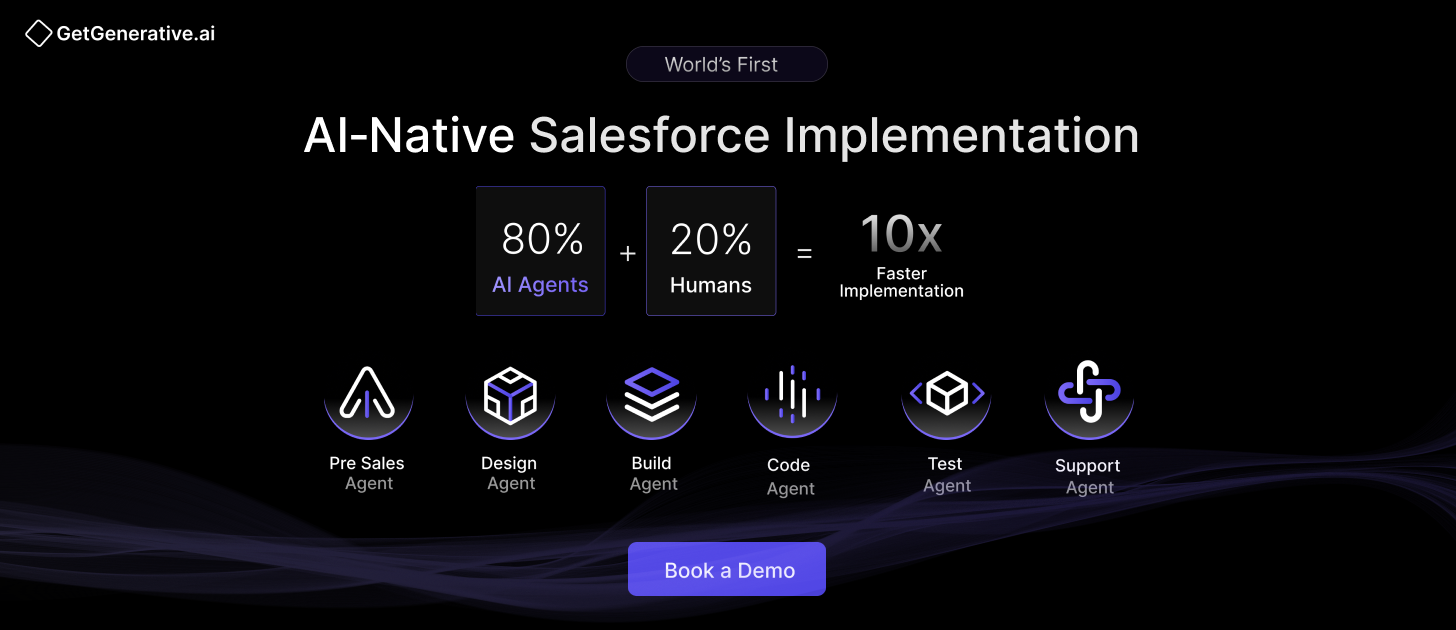
salesforce consulting services

At GetGenerative.ai, we’ve reimagined Salesforce implementation—built from the ground up with AI at the core. This isn’t legacy delivery with AI added on. It’s a faster, smarter, AI-native approach powered by our proprietary platform.

👉 Explore our Salesforce AI consulting services

The Future of Salesforce Consulting: From Siloed Teams to Agile Human–Agent Pods

For decades, Salesforce consulting has relied on a well-defined delivery model: rigid roles, hierarchical teams, and linear execution. In a typical implementation, you’d find a Project Manager managing timelines, a Business Analyst gathering requirements, a Technical Lead shaping architecture, Developers writing Apex, Admins configuring the platform, and Testers ensuring quality.

This model thrived in an era when complexity was best handled through specialization, and “fast” delivery still meant months, sometimes years. But that era is ending. The rise of AI-native consulting and specialised Salesforce AI Agents is dismantling the assembly-line approach.

The future belongs to agile human–agent pods, compact, high-performance teams where a few versatile humans collaborate seamlessly with AI Agents to deliver Salesforce projects faster, more cost-effectively, and with higher quality than ever before.

Why the Traditional Model Is Breaking Down

The old Salesforce delivery structure was built on industrial-age thinking, inspired by manufacturing lines where each person owned a fixed part of the process. The logic was simple:

  • Assign specialists to specific tasks
  • Keep roles separate to maintain deep expertise
  • Coordinate through multiple management layers

In practice, this created chronic inefficiencies:

  • Excessive handoffs: requirements bounced from BA to Tech Lead to Developer to Tester, with delays and misinterpretations at each stage.
  • Role silos: limited cross-visibility and little empathy between disciplines.
  • High fixed costs: larger headcounts to keep all roles staffed.
  • Slow adaptability: workload imbalances created bottlenecks that couldn’t be quickly resolved.

AI breaks this model because it eliminates many of the repetitive, document-heavy tasks traditionally spread across roles. With AI Agents doing the mechanical work, consultancies no longer need an army of narrowly focused specialists.

The Human-Agent Pod: The New Standard

In the emerging human–agent pod model, a Salesforce delivery team becomes:

  • A small group of 2–5 humans
  • Augmented by multiple AI Agents, each tuned for a specific phase in the Salesforce lifecycle
  • End-to-end owners of delivery, from requirements to deployment

Instead of discrete, sequential roles, the pod shares responsibility for the entire project. AI Agents handle routine work, from documenting requirements to generating test cases, while humans focus on judgment calls, creative problem-solving, and client relationships.

How AI Agents Fit into Salesforce Delivery

Today’s Salesforce AI Agents already cover much of the project lifecycle:

  • Pre-Sales Agent: Drafts proposals, estimates, and solution blueprints in minutes.
  • Design Agent: Converts requirements into technical designs, ERDs, and data models.
  • Build Agent: Generates declarative configurations, code stubs, and integration scripts.
  • Test Agent: Produces test cases, scripts, and defect logs.
  • Support Agent: Handles triage, root cause analysis, and knowledge base updates.

In a pod, these Agents are not “assistants”; they are core team members, working in parallel with humans. Tasks that once took days can now be completed in minutes, leaving humans free to focus on the strategic, creative, and relational work AI cannot yet replicate.

Humans in the Pod: Versatility Over Specialisation

In this model, versatility becomes the defining human skill.

In the old structure, a BA might never touch a data model, and a Developer might never attend a stakeholder workshop. In the pod structure, the same human might:

  • Refine requirements with the client in the morning
  • Adjust a data model in the afternoon
  • Prompt the Test Agent to run regression suites before a sprint review
  • Present a project demo by the week’s end

This isn’t about diluting skills; it’s about broadening capabilities so each person can operate effectively across the Salesforce delivery lifecycle.

Also Read – From SaaS to AI: Overcoming Data and Security Fears in the AI Era

The AI-Ready Skillset: 5 Core Competencies for the New Era

Versatility is the foundation, but AI-readiness is the competitive advantage. The best pod members will master meta-skills that allow them to extract maximum value from AI Agents.

1. Systems Thinking

Understanding the ripple effects of every change:

  • How a schema update affects reporting, security, and integrations
  • How processes, architecture, and data flows intersect
  • How to address root causes instead of symptoms

AI can identify dependencies, but humans decide the trade-offs that align with business priorities.

2. Prompt Engineering

In this model, prompts are the new specifications.

  • The clarity and context of your instructions directly determine AI output quality
  • The best prompt engineers iterate quickly, refining inputs for optimal results
  • Prompting becomes an active design process, not a one-time task

3. Product Taste and Quality Judgment

AI can produce “good enough” work, but taste ensures excellence.

  • Humans reject clumsy or overly complex solutions
  • They guide AI toward elegant, maintainable, user-friendly designs

4. Deep Domain Knowledge

Salesforce is the tool; industry expertise is the game.

  • Knowing industry regulations, KPIs, and competitive pressures
  • Anticipating edge cases the AI can’t foresee

5. Business Engagement Skills

Pod members are client-facing, not hidden behind PMs.

  • Facilitate workshops and resolve conflicts
  • Build trust through transparency
  • Translate AI outputs into actionable business decisions

What This Means for Salesforce Consultancies

Shifting to the human–agent pod model is not just a delivery tweak; it’s an organizational transformation. For Salesforce consultancies, this requires rethinking multiple pillars of the business:

  • Recruitment: Hire for breadth and adaptability, not just narrow technical expertise.
  • Training: Upskill teams in AI literacy, prompt engineering, and systems thinking.
  • Team Design: Replace rigid hierarchies with autonomous, end-to-end pods.
  • Pricing Models: Transition from hourly billing to value-based pricing as delivery becomes faster and more outcome-driven.

The payoff is enormous: a 4-person pod with AI Agents can match, and often exceed, the output of a traditional 12–15 person team, with fewer bottlenecks, higher quality, and faster time-to-value.

A Day in the Life of a Human-Agent Salesforce Pod

Picture a real-world project in this future model:

8:30 AM: The pod meets for a quick stand-up. Overnight, the Pre-Sales Agent has already drafted a change request. Humans review, approve, and send it in five minutes.

9:00 AM: One pod member runs a requirements workshop with the client while another updates the data model in real-time using the Design Agent.

10:30 AM: The Build Agent generates 80% of the configuration and Apex code. A human refines the remaining 20% for custom needs.

1:00 PM: The Test Agent runs regression scripts, logging defects automatically. Humans review edge cases and perform exploratory testing.

3:00 PM: The Support Agent triages live issues, resolving common queries instantly and updating the knowledge base.

4:00 PM: The pod closes the day with a short sync, adjusting priorities based on client feedback and any new developments.

In this model, work is continuous, collaborative, and adaptive, with AI handling the heavy lifting while humans focus on the nuanced decisions.

The Competitive Advantage of Early Adopters

The economics of the pod model make adoption inevitable:

  • Fewer people, more output: Smaller teams delivering enterprise-scale results.
  • Faster delivery: Weeks instead of months without compromising quality.
  • Engaged human talent: Less repetitive admin, more strategic problem-solving.
  • Stronger client relationships: Direct, continuous engagement without layers of intermediaries.

Early adopters will build AI-native cultures that competitors will struggle to replicate. They’ll attract versatile, high-value talent, deliver more value per dollar, and scale without proportionally scaling headcount.

Final Thoughts

We are on the cusp of a seismic shift in Salesforce consulting. Traditional siloed delivery teams are relics of a slower, pre-AI world. The winners of the next decade will be those who embrace small, agile pods where AI-ready humans partner with specialised AI Agents to deliver unmatched business outcomes.

The future is not man vs. machine; it’s man with machine, working together as peers in the same pod.

  • If you’re a Salesforce professional, start expanding your skill range.
  • If you’re a consultancy leader, begin dismantling role silos.
  • If you’re a client, demand AI-augmented delivery from your partners.

Because the pods are coming, and they will change everything.

Salesforce Financial Services Cloud vs Sales Cloud: Key Differences

Salesforce Financial Services Cloud vs Sales Cloud: Key Differences


The global finance cloud market reached $32.8 billion in 2024 and is projected to grow at a 22.7% compound annual growth rate through 2034, according to Global Market Insights. This explosive growth reflects a critical shift: financial institutions are embracing specialized cloud solutions to future-proof their business models and drive sustainable value.

At the center of this shift lies a key decision for technology and business leaders: should they adopt Salesforce Sales Cloud, a versatile and widely adopted CRM platform, or Financial Services Cloud (FSC), a vertical-specific solution built for the unique needs of banks, credit unions, wealth managers, and insurers?

Let’s find out in this blog! 

What is Salesforce Sales Cloud?

Sales Cloud is Salesforce’s original and most widely adopted platform. Designed as a general-purpose CRM, it supports the sales lifecycle across industries—from lead acquisition to opportunity management, forecasting, and deal closure. It’s used by over 150,000 companies globally, including more than 80 percent of the Fortune 500.

The platform delivers a comprehensive set of tools for sales teams. It includes advanced lead scoring powered by Salesforce’s Einstein AI, intuitive deal management interfaces with Kanban-style visualization, real-time pipeline and revenue forecasting, and built-in tools for quoting and proposal generation. Sales reps benefit from streamlined data entry, automated workflows, and predictive analytics that suggest next-best actions based on historical customer behavior.

One of Sales Cloud’s major strengths is its flexibility. Companies can start small and scale over time, choosing between different editions with increasing levels of sophistication. Sales Cloud can be configured for small teams needing basic lead tracking, or for large enterprises requiring complex territory management, custom reporting, and AI-driven decision support.

Mobile accessibility ensures that field reps can access customer information, update opportunities, and view dashboards on the go. Built-in integrations with Gmail, Outlook, Slack, and other productivity tools enhance efficiency, while workflow automation reduces administrative burdens by up to 38 percent, according to implementation case studies.

For organizations seeking a horizontal CRM solution that adapts to a variety of sales environments, Sales Cloud offers both the stability of a mature platform and the innovation of continuous AI-driven upgrades.

What is Salesforce Financial Services Cloud?

While Sales Cloud excels in general-purpose CRM use cases, Financial Services Cloud was created to serve the unique challenges of the financial sector. FSC is more than just a re-skinned version of Sales Cloud—it’s a reimagined CRM platform with a pre-configured data model, industry-specific workflows, and regulatory compliance features built in.

FSC is used by banks, credit unions, insurance providers, wealth advisory firms, and asset managers to manage complex client relationships, meet strict regulatory standards, and deliver personalized financial experiences. It supports the full customer lifecycle—from prospecting to onboarding, servicing, and retention—with built-in support for Know Your Customer (KYC), Anti-Money Laundering (AML), and regulatory reporting.

One of FSC’s most powerful features is Household Management, which allows institutions to track and manage multi-generational relationships, legal ownership structures, business affiliations, and financial dependencies across individuals and entities. This is especially critical in private banking, family offices, and insurance, where understanding the full financial picture of a client involves more than a single account.

FSC’s Financial Account object enables firms to manage a wide range of products, including checking accounts, investment portfolios, insurance policies, mortgages, and loan instruments. Advisors can view performance metrics, balances, and milestones associated with each financial product and link them to personalized financial goals such as retirement planning, college savings, or home ownership.

The Actionable Relationship Center (ARC) further enhances visibility by offering a visual, graph-based interface to navigate relationships between clients, financial accounts, institutions, and intermediaries. This tool helps identify referral paths, detect hidden cross-sell opportunities, and personalize outreach strategies based on household dynamics.

To ensure consistency and compliance, FSC includes Action Plans, which are predefined workflow templates that guide advisors through complex tasks such as onboarding, loan origination, and claims processing. These workflows standardize the experience across teams and ensure critical compliance steps—such as document verification, approvals, and disclosures—are never missed.

From data encryption and audit trails to role-based access controls and advanced risk monitoring through Salesforce Shield, FSC is architected with security and compliance in mind. It also integrates seamlessly with Salesforce’s Data Cloud, MuleSoft, and third-party banking, wealth, and insurance systems.

Key Differences in Architecture and Capabilities

The core distinction between Sales Cloud and FSC lies in their data model and industry focus. Sales Cloud uses general CRM objects such as Accounts, Contacts, Leads, and Opportunities, which are well-suited for simple or generic sales cycles. However, adapting this model for financial services requires extensive customization, often leading to additional development time, technical debt, and maintenance overhead.

In contrast, FSC includes native support for financial services constructs like Financial Accounts, Households, Policies, Referrals, and Financial Goals. These industry objects come with associated workflows, permissions, and reporting structures tailored for advisors, bankers, and insurance agents.

For example, where Sales Cloud might treat a high-net-worth individual as a single Account, FSC would represent that client within the context of their full household, capturing spouses, children, trustees, and business interests. It would also allow advisors to track referrals from attorneys, wealth planners, or existing clients—enabling a more nuanced, relationship-driven growth strategy.

Instead of a pipeline of Opportunities with stage-based tracking, FSC allows organizations to create and manage client financial goals, aligning multiple financial products with each goal and tracking progress over time. This goal-centric model mirrors how real financial advisory relationships work and supports deeper personalization.

Finally, FSC includes regulatory support that’s absent in Sales Cloud by default. Built-in KYC and AML workflows, integration with identity verification tools, and audit logs provide critical infrastructure for compliance teams. These features make FSC more than just a CRM—it’s a compliance-ready client management platform purpose-built for finance.

Also Read – Salesforce Financial Services Cloud for Mortgage Lending

ROI, Cost-Benefit, and Total Ownership Analysis

When comparing Salesforce Sales Cloud and Financial Services Cloud, it’s essential to evaluate not just the licensing cost but also the measurable business impact, long-term operational savings, and strategic growth potential each platform enables.

Financial Services Cloud consistently delivers stronger quantified returns for financial institutions with complex compliance needs and multi-layered client relationships. In a Nucleus Research study, Trilogy Financial achieved a 147% ROI within the first year of FSC deployment, resulting in more than $972,000 in annual benefits and a one-year payback period. Other institutions have reported similar outcomes, including 27% improvements in customer satisfaction, 24% gains in employee productivity, 26% reductions in operational costs, and 28% growth in sales performance. Credit unions using FSC have documented a 45% increase in lead generation and significant reductions in manual processing thanks to AI-driven lead prioritization.

While FSC’s starting cost is significantly higher than Sales Cloud, these additional expenses are offset by avoided customization costs, faster time to value, and revenue enhancements from improved cross-selling and client retention. Many mid-sized banks that would otherwise spend hundreds of thousands of dollars customizing Sales Cloud for regulatory and household management features have saved between $200,000 and $500,000 by adopting FSC’s pre-built industry functionality.

Over a three-year period, the difference in total cost of ownership between the two platforms is often outweighed by FSC’s productivity and revenue gains. The additional investment required for FSC can be recovered in less than a year in many cases, with a three-year net benefit exceeding one million dollars.

Industry-Specific Applications

The true strength of Financial Services Cloud lies in its ability to support diverse financial services verticals without extensive modifications.

Banking and Credit Unions use FSC to unify client information across accounts, loans, and products, providing tellers and relationship managers with a complete view of each customer. Compliance workflows for KYC and AML are built in, reducing regulatory risk. Lending operations are streamlined through automated document collection, approvals, and task routing, while household views help identify relationship-based pricing opportunities and cross-sell potential.

Wealth Management Firms leverage FSC’s goal-based planning and portfolio integration to deliver highly personalized advisory services. The Actionable Relationship Center maps complex family and trust structures, enabling multi-generational wealth planning and coordinated investment strategies. Advisors can consolidate portfolios from multiple custodians, track progress toward financial goals, and manage referrals from high-net-worth networks.

Insurance Providers benefit from FSC’s policy lifecycle management, which covers everything from policy application to claims settlement. Territory management, agent productivity dashboards, and commission tracking help maximize sales performance, while integrated fraud detection workflows improve risk management. The household view also enables insurers to analyze coverage gaps across family members and propose relevant policy upgrades.

Asset Management Firms use FSC for institutional client management, capturing complex organizational hierarchies, tracking investment committee decisions, and automating regulatory reporting. These features are particularly valuable for compliance with investment advisor regulations and for managing multi-entity account structures.

Integration Capabilities

Financial Services Cloud integrates deeply into the Salesforce ecosystem and beyond. Core banking systems such as FIS, Jack Henry, and Temenos can be connected to FSC, allowing real-time balance updates, transaction history, and account status to flow directly into advisor dashboards.

Wealth and investment advisory firms can integrate FSC with portfolio management platforms and financial planning software to ensure goal tracking and performance reporting are always in sync. Salesforce MuleSoft further extends these capabilities, enabling secure API-based integrations with legacy financial systems.

From a compliance standpoint, FSC connects to RegTech solutions for automated identity verification, sanctions screening, and suspicious activity reporting. Built-in workflows trigger these processes at key client lifecycle stages, ensuring no compliance step is missed.

Also Read – Salesforce Financial Services Cloud For Insurance Service

Implementation Strategy and Best Practices

Deploying FSC requires a more specialized approach than Sales Cloud due to its advanced features and industry-specific data model. The most successful implementations begin with a thorough readiness assessment that examines data quality, integration complexity, user adoption readiness, and alignment with regulatory frameworks.

A phased rollout approach minimizes disruption while delivering early wins. The initial phase typically focuses on foundational CRM setup, migrating essential data, and connecting basic productivity tools. The next phase layers on FSC’s financial account management, household mapping, and core banking integrations. The final phase introduces advanced features such as Action Plans, ARC, and third-party system integrations.

Change management is critical. Financial institutions adopting FSC should secure strong executive sponsorship, design role-specific training programs, introduce new features gradually, and establish continuous feedback loops to fine-tune workflows.

Final Recommendations

For most banks, credit unions, insurance companies, wealth managers, and asset management firms, Financial Services Cloud represents a superior long-term investment. It delivers industry-specific capabilities, regulatory compliance, advanced analytics, and relationship management features that simply cannot be matched by customizing Sales Cloud without significant cost and effort.

salesforce consulting services

At GetGenerative.ai, we’ve reimagined Salesforce implementation—built from the ground up with AI at the core. This isn’t legacy delivery with AI added on. It’s a faster, smarter, AI-native approach powered by our proprietary platform.

👉 Explore our Salesforce AI consulting services

Salesforce Financial Services Cloud for Mortgage Lending

Salesforce Financial Services Cloud for Mortgage Lending


The mortgage lending landscape in 2025 is undergoing a fundamental transformation. Rising operational costs, increased regulatory scrutiny, and the digital expectations of modern borrowers are pushing traditional lenders to rethink their technology stacks. 

Salesforce Financial Services Cloud (FSC) is a platform purpose-built to modernize mortgage operations, reduce inefficiencies, and elevate customer experiences.

Why Mortgage Lending Needs Urgent Transformation

Today, the mortgage industry faces sobering challenges:

  • Average processing time: 46 days per loan
  • Cost per loan: $7,000–$9,000
  • Customer satisfaction score: Just 727/1000 (J.D. Power, 2024)

In an environment where digital-first competitors are gaining ground, these numbers are no longer acceptable. Implementing Salesforce FSC has helped some lenders reduce loan processing times by up to 45%, slash operational costs, and improve customer engagement significantly.

The Mortgage Industry’s Digital Crossroads

A. Key Pain Points Crippling Lenders

  • Processing inefficiencies: Fragmented systems and manual processes are slowing down approvals and increasing error rates.
  • Compliance complexity: Regulations like TRID (TILA-RESPA Integrated Disclosure) mandate exact disclosures and timelines, with violations ranking among the top CFPB citations in 2023.
  • Customer experience gap: Only 37% of home buyers are digital-first, but these younger borrowers demand mobile-friendly, real-time, and transparent processes.

B. Market Trends Accelerating Change

  • Digital mortgage software market: Valued at $3.7 billion in 2022, forecasted to reach $35.3 billion by 2032. 
  • AI adoption in mortgage lending: Jumped from 15% in 2023 to 38% in 2024
  • Lender market growth: The global mortgage lending industry stands at $15.4 billion (2024), growing at 4.8% annually

The message is clear: digital transformation isn’t a choice—it’s a necessity.

Also Read – Key Features of Salesforce Financial Services Cloud

Salesforce FSC: The Mortgage Engine for the Future

A. What Sets FSC Apart

Salesforce FSC goes beyond traditional CRM systems by offering an industry-specific data model, eliminating the need for heavy customization. It includes:

  • Prebuilt objects for loan applications, borrower relationships, and compliance tracking
  • Einstein AI for lead scoring, automated underwriting, and predictive insights
  • An Actionable Relationship Center for a 360-degree customer view

These features enable loan officers to personalize borrower experiences, uncover cross-sell opportunities, and streamline end-to-end loan management.

B. Built-In Mortgage Capabilities

Salesforce FSC delivers a robust toolkit tailored specifically for mortgage operations:

Feature

Description

Mortgage data model

Specialized objects for loan apps, borrowers, and documentation

Guided loan application flows

Customizable, compliant workflows per loan product

Document tracking

Automated reminders, review routing, and completion status

AI-driven underwriting

ML-powered decision-making with 30–50% time savings

Strategic Benefits of FSC Implementation

A. Operational Efficiency Gains

Salesforce FSC offers lenders tangible, bottom-line benefits:

  • Loan processing time: ↓ 45%
  • Underwriting effort: ↓ 30–50%
  • Operational cost: ↓ 20%, according to McKinsey
  • Scalability: Cloud-native architecture handles volume spikes with no extra staffing

B. Superior Customer Experience

By leveraging FSC, lenders transform the borrower journey:

  • Real-time updates and self-service portals reduce anxiety and loan officer workload
  • Personalized outreach based on borrower data improves conversion and satisfaction
  • Mobile-first interactions make the experience seamless and modern

C. Competitive Advantage

FSC arms lenders with technology capabilities that are hard to replicate:

  • Tech differentiation: Rapid deployment of digital services
  • Regulatory readiness: Automated compliance tracking and audit trails
  • Market agility: Easy product rollout and pricing adjustments

Also Read – Salesforce Financial Services Cloud For Insurance Service

Implementation Strategy: From Vision to Value

A. Phase 1: Assessment and Planning

  • Process Mapping: Identify inefficiencies and define success metrics
  • Data Strategy: Plan for secure, accurate data migration and integration
  • Stakeholder Alignment: Ensure business and IT are working toward shared goals

B. Phase 2: Phased Rollout

A typical roadmap looks like:

  1. Core CRM & workflow automation – unify customer data, streamline tasks
  2. Mortgage-specific modules – implement loan app flows, document management, AI tools
  3. Advanced analytics & integrations – predictive modeling, third-party system syncing

This staggered approach ensures quick wins, minimizes disruptions, and builds momentum for deeper transformation.

Integrations That Multiply Value

Integration

Value

Loan Origination Systems (LOS)

Real-time syncing to eliminate re-entry and silos

Credit bureaus & verifiers

Instant data validation and risk scoring

Core banking systems

Complete customer financial view for better cross-selling

AI-Powered Lending: From Reactive to Predictive

A. Artificial Intelligence in Action

Salesforce FSC’s integration with Einstein AI shifts lenders from reactive service models to proactive, intelligent engagement:

AI Use Case

Impact

Automated Underwriting

ML algorithms assess borrower data, cutting processing time by 30–50%

Fraud Detection

Pattern recognition reduces fraudulent applications by up to 50%

Lead Scoring & Recommendations

Intelligent scoring improves sales velocity and loan officer productivity

Predictive Insights

Anticipate borrower needs and prevent churn through proactive outreach

These tools enable lenders to make faster, more accurate decisions while reducing the burden on underwriters.

B. Intelligent Document Processing & Automation

Manual document handling is a bottleneck. FSC resolves this through:

  • OCR & NLP: Auto-extracts borrower data from scanned forms
  • Compliance Automation: Validates applications against TRID, internal policies, and investor criteria
  • Workflow Orchestration: Routes tasks based on logic, escalates exceptions, and improves turnaround time

Also Read – Top Use Cases of Salesforce Financial Services Cloud in 2025

Real-Time Analytics for Smarter Decisions

A. Operational Dashboards

FSC delivers real-time performance monitoring for:

  • Loan pipeline status
  • SLA adherence
  • Compliance metrics
  • Application bottlenecks

These dashboards empower managers to take immediate action when KPIs are off-target.

B. Customer Analytics

Understanding customer behavior is key to differentiation. FSC enables:

  • Journey Mapping: Visualize where prospects drop off and optimize accordingly
  • Personalization Triggers: Offer the right product at the right time
  • Lifecycle Analysis: Target cross-sell opportunities based on borrower stage

C. Predictive Modeling

FSC helps future-proof your strategy with:

  • Market Forecasting: Price sensitivity, demand shifts, rate impact
  • Risk Identification: Spot at-risk loans before they default
  • Revenue Optimization: Model pricing, incentive strategies, and portfolio health

Regulatory Compliance & Risk Management

A. TRID Compliance Automation

FSC addresses TRID’s timing and accuracy demands with:

  • Loan Estimate Generation: Automatically created within 3 business days of application
  • Disclosure Tracking: Monitors every touchpoint, preventing missed deadlines
  • Closing Disclosure Management: Ensures data accuracy, syncs with all parties, and supports the mandatory 3-day review period

This reduces violations while preserving borrower trust.

B. Risk Mitigation & Audit Trails

FSC enables proactive risk management:

  • Risk Scoring: Uses both traditional credit data and alternative sources
  • Portfolio Monitoring: Alerts for performance dips or concentration risks
  • Complete Audit Trails: Log every change, communication, and decision point—crucial for CFPB or investor audits

C. Enterprise-Grade Data Security

Financial institutions face stringent data privacy laws. FSC is built to comply:

  • Multi-Factor Authentication & Role-Based Access Control
  • AES-256 Encryption (at rest and in transit)
  • Consent Management tools for borrower privacy preferences
  • Audit Logging for regulatory compliance and accountability

Calculating ROI: Tangible Gains & Strategic Growth

A. Quantifiable Results

KPI

Traditional

With FSC

Improvement

Processing Time

46 days

25–28 days

↓ 45%

Cost per Loan

$7,000–$9,000

↓ 20%

~$1.4M–$1.8M annual savings (1,000 loans/month)

Customer Satisfaction

727/1000

↑ Significantly

Improved NPS, CSAT

Digital lenders using FSC report 15–20 day faster turnaround, giving them a huge edge in competitive markets.

B. Strategic Advantages

  • Digital Differentiation: Beat fintechs at their own game with faster, smarter workflows
  • Market Expansion: Serve underserved segments profitably with automation
  • Revenue Growth: Cross-sell based on data-driven insights, increase customer lifetime value

Understanding FSC Implementation Costs & Timeline

Component

Typical Range

License Fee

$150–$300/user/month (volume-based)

Implementation Services

2x–4x annual license cost

Payback Period

6–24 months (depending on deployment scope)

The initial investment pays off quickly through cost savings, faster processing, and increased loan volume. Total Cost of Ownership (TCO) is further reduced by retiring legacy systems and minimizing IT support costs.

Also Read – Why Salesforce Developers Still Matter in an AI World

The Future of Mortgage Lending with FSC

A. Emerging Technologies on the Horizon

  • Blockchain: Immutable property records, automated escrow via smart contracts
  • NLP: Conversational loan applications, automated policy reading
  • IoT Data Integration: Real-time property value inputs from smart home sensors

Salesforce’s innovation roadmap ensures FSC will continue evolving to support these next-gen capabilities.

B. Evolving Regulatory Standards

  • AI Governance: Transparent algorithms, explainable AI requirements
  • Digital Disclosure Norms: eConsent, digital document tracking
  • Data Privacy Laws: Increasingly complex—FSC’s built-in tools ease compliance

C. Competitive Shifts & Fintech Collaboration

  • Expect consolidation: Tech-savvy lenders will outpace slow adopters
  • New fintech partnerships: FSC’s open architecture makes integrations seamless
  • Customer expectations: Continuously rising—FSC helps keep up

Conclusion 

The mortgage industry is at a breaking point—46-day cycles, $9,000 per loan, and dissatisfied borrowers are no longer sustainable. Salesforce Financial Services Cloud offers an end-to-end solution that addresses today’s operational inefficiencies while future-proofing your business.

salesforce consulting services

At GetGenerative.ai, we’ve reimagined Salesforce implementation—built from the ground up with AI at the core. This isn’t legacy delivery with AI added on. It’s a faster, smarter, AI-native approach powered by our proprietary platform.

👉 Explore our Salesforce AI consulting services

Salesforce Financial Services Cloud For Insurance Service

Salesforce Financial Services Cloud For Insurance Service


According to industry studies, fewer than 50% of insurance customers are fully satisfied with their provider, and 46% say they would stay loyal to a financial services firm that delivers excellent digital experiences—even if fees increase. This growing demand for 24/7 service, mobile access, and hyper-personalized interactions is pushing insurers to adopt platforms that can modernize every touchpoint.

Enter Salesforce Financial Services Cloud (FSC) — a purpose-built CRM platform that redefines how insurance providers operate. Unlike generic CRM tools, FSC integrates deeply with insurance-specific workflows, data models, and AI capabilities. It unlocks siloed systems and helps insurers offer real-time, personalized, and compliant services at scale.

The Digital Imperative in Insurance

1. Evolving Customer Expectations

Modern insurance customers expect seamless digital experiences—comparable to those offered by top fintech or e-commerce platforms. This includes:

  • Instant quotes
  • Mobile-first claims
  • AI-powered support
  • Personalized coverage recommendations

Salesforce research shows that 65% of customers now expect faster service through AI, a significant jump from 46% in 2023. The demand for 24/7 digital assistance, proactive advice, and frictionless interactions is no longer optional—it’s the baseline.

2. Industry Challenges

Despite this shift, many insurers still run on legacy tech stacks and disjointed platforms, such as separate systems for policy administration, CRM, and billing. Salesforce found that insurance brokerages typically use three or more systems just to service clients, leading to slow service, errors, and compliance issues.

Additional pain points include:

  • Cybersecurity concerns due to fragmented data
  • Strict regulatory frameworks requiring transparent data handling
  • Talent shortages in AI, analytics, and automation domains

Insurance firms now need an integrated, secure, and intelligent platform that enables productivity while ensuring trust and compliance.

What Is Salesforce Financial Services Cloud (FSC)?

Salesforce Financial Services Cloud is a specialized CRM built for financial institutions—specifically banking, wealth, and insurance. FSC transforms traditional CRM by embedding:

  • Prebuilt insurance data models
  • Custom workflows for policy, claims, and commissions
  • AI-powered automation
  • 360° customer profiles

Unlike other CRMs, FSC includes out-of-the-box insurance objects such as:

  • Policies
  • Claims
  • Coverages
  • Life Events
  • Commissions
  • Households

These standard components connect seamlessly to deliver a unified policyholder view and streamline every aspect of insurance service delivery.

Also Read – Key Features of Salesforce Financial Services Cloud

Insurance-Specific Capabilities of Salesforce FSC

1. Unified Policyholder 360° View

FSC consolidates policyholder data into a single customer profile. All information—life, auto, health, or property policies, along with claims history and interaction logs—are readily accessible.

Use Case:

Pacific Life implemented FSC to create a central data hub, providing agents real-time access to customer profiles across regions, improving service personalization and efficiency.

2. Policy and Claims Management

FSC automates complex policy lifecycles and claims processing. With Lightning Flows and prebuilt templates, service reps can handle requests like First Notice of Loss or Beneficiary Changes without toggling between systems.

3. Commission and Channel Management

Brokers and carriers can define commission splits, automate payouts, and manage overrides—all within Salesforce. This replaces spreadsheets and ensures compliance with rules during agent transitions or policy changes.

4. Advisor Productivity and Service Console

Salesforce offers a Lightning Service Console tailored to insurance advisors with real-time dashboards, case management, and integrated omnichannel communications (email, chat, voice).

5. Analytics and AI-Powered Insights

FSC includes prebuilt reports for:

  • Policy sales
  • Renewal rates
  • Claims volumes
  • Agent performance

With Einstein AI and Tableau CRM, insurers can identify trends, automate next-best actions, and predict customer churn or fraud.

6. Multi-Channel Customer Experience

With Experience Cloud, FSC lets insurers create self-service portals where policyholders can:

  • File claims
  • Access policy documents
  • Request endorsements

All interactions are tracked, enabling omnichannel engagement with full context.

7. Embedded AI and Agentforce Capabilities

Salesforce’s Agentforce introduces autonomous AI agents that can:

  • Process entire small claims
  • Generate risk scores for underwriting
  • Handle policyholder inquiries via chatbots or voice bots

Salesforce FSC for Insurance Brokerages (2025 Edition)

In October 2024, Salesforce launched the Financial Services Cloud for Insurance Brokerages, available broadly in February 2025. This specialized edition targets agencies and brokers with tailored functionality, including:

1. AI-Driven Client Engagement

Using Salesforce Data Cloud, the brokerage edition offers real-time client profiles, alerts on expiring policies, and AI-based retention risk scoring.

Benefit: Account managers can proactively recommend new coverages or schedule follow-ups to reduce churn.

2. Commission Automation Engine

Brokerages with multi-agent policies benefit from a rules-based commission engine. Salesforce automates commission allocations even if producers exit or are reassigned.

3. Employee Benefits Management

FSC tracks:

  • Renewal cycles
  • Plan options
  • Workforce demographics

AI-driven suggestions help brokers advise employer clients with smarter plan recommendations.

4. Property & Casualty (P&C) Servicing

Specialty brokers (e.g., maritime, fleet, or real estate) gain property detail dashboards. FSC connects multiple carrier systems into one view for real-time updates, compliance, and advice.

Also Read – Top Use Cases of Salesforce Financial Services Cloud in 2025

Business Benefits and Strategic Impact of FSC

1. Operational Efficiency and Cost Reduction

FSC eliminates manual processes and system sprawl through automation and integration. Common use cases include:

  • Automated beneficiary updates
  • Policy renewals with zero manual follow-up
  • Lightning flows for claims processing

This automation enables insurers to reallocate their human capital toward higher-value roles, such as underwriting, relationship management, and sales.

2. Enhanced Customer Experience and Loyalty

FSC helps insurers provide hyper-personalized service by enabling a 360° view of policyholders. With omnichannel integration (portal, phone, chat), agents can respond in context, eliminating the need for customers to repeat details.

3. AI-Powered Decision-Making and Risk Management

With FSC + Einstein Analytics:

  • Identify churn-prone customers early
  • Score risk in underwriting using past data
  • Automate case routing based on claim type and history

4. Revenue Growth Through Cross-Selling and Upselling

With unified data and AI, insurers can identify unmet customer needs, such as:

  • Life insurance for customers with only auto coverage
  • Group policies for clients nearing HR benefits renewals

Using Marketing Cloud, insurers can automate outreach with personalized, data-driven campaigns that increase conversion.

5. Improved Compliance and Trust

FSC embeds robust data governance, identity verification, and field-level security—essential in a highly regulated industry. Automated flows enforce:

  • Consent collection before policy issuance
  • Agent license verification
  • Commission audit trails

Conclusion 

Salesforce Financial Services Cloud is more than a CRM—it’s a digital transformation platform engineered for the complexities of insurance.

Your competitors are already investing. The leaders of 2025 and beyond will be those who not only adopt Salesforce FSC but also embed it at the heart of every interaction, transaction, and relationship.

salesforce consulting services

At GetGenerative.ai, we’ve reimagined Salesforce implementation—built from the ground up with AI at the core. This isn’t legacy delivery with AI added on. It’s a faster, smarter, AI-native approach powered by our proprietary platform.

👉 Explore our Salesforce AI consulting services

Top Use Cases of Salesforce Financial Services Cloud

Top Use Cases of Salesforce Financial Services Cloud

In 2025, the financial services industry is undergoing a fundamental shift. Customers now expect real-time personalization, seamless digital interactions, and financial advice powered by AI — across banking, insurance, and wealth management. Yet, fewer than 50% of financial customers today are fully satisfied with their providers, according to Salesforce industry research.

Enter Salesforce Financial Services Cloud (FSC) — the leading industry CRM purpose-built to unify client data, automate workflows, and embed financial intelligence across every touchpoint. FSC enables financial institutions to deliver a more connected, personalized, and efficient experience to clients, backed by AI, data, and compliance-grade automation.

This blog explores the top use cases of Salesforce FSC, focusing on actionable strategies across retail and commercial banking, wealth and asset management, insurance, and fintech. Let’s get started!

Top Use Cases of Salesforce Financial Services Cloud

1. Holistic Customer Onboarding and 360° Profiles

FSC eliminates the fragmented views of traditional CRMs by offering Actionable Relationship Center, a real-time dashboard of every client’s financial life — including assets, accounts, policies, and goals.

Key Benefits:

  • 360° Household & Business Views: FSC’s data model supports individuals, households, and business entities. Advisors view assets, goals, interactions, and affiliations — all in one dashboard.
  • Prebuilt Onboarding Templates: KYC, AML, digital disclosures, and credit checks are automated through low-code workflows and guided flows.
  • Accelerated Account Opening: Real-time validation, digital forms, and e-signature integrations help firms reduce onboarding times from weeks to hours.

Example: A bank using FSC automates onboarding for mortgage applicants — verifying identity, conducting credit checks, and collecting disclosures — cutting approval times by over 70%.

2. Advisor Productivity and AI-Driven Assistance

Advisors are being asked to manage more clients while delivering high-touch, personalized guidance. FSC solves this through embedded Agentforce AI and automation features tailored for financial services.

Key Features:

  • AI Meeting Prep & Summaries: Agentforce automatically builds agendas, highlights portfolio events, and generates post-meeting notes using generative AI.
  • Next-Best-Action (NBA): Einstein AI analyzes behavior and transactions to suggest optimal product offers or outreach strategies.
  • Collaborative Tools: Advisors collaborate across teams via Slack, Salesforce Inbox, and Chatter — sharing notes, documents, and plans in real time.

Example: A wealth firm deploying FSC reported a 30% reduction in proposal creation time and 2× more client meetings per month after using AI-driven tools.

3. Data-Driven Financial Planning and Insights

Modern clients don’t just want account summaries — they want to know how close they are to life goals. FSC supports goals-based planning directly within its CRM environment.

Use Case Highlights:

  • Financial Goals as Objects: Track retirement, college, homeownership, and investment goals linked directly to products.
  • Unified Data for Advisors: Advisors get live data from savings, brokerage, and credit — enabling proactive guidance.
  • Marketing Segmentation: Einstein AI groups clients by income, product mix, and life stage to tailor outreach.

Example: A retail bank uses FSC to automatically remind advisors when a client’s college savings are behind schedule — triggering a tailored 529 plan offer.

4. Intelligent Customer Service and Self-Service

Today’s clients want instant, omni-channel support — and Salesforce FSC delivers it through embedded Service Cloud features built for banking, insurance, and wealth firms.

Core Capabilities:

  • AI Chatbots: Einstein Bots handle 24/7 FAQs, transactions, and policy inquiries without human involvement.
  • Embedded Agents: Specialized flows (e.g., Banking Service Agent, Insurance Service Agent) automate issue resolution and cross-sell prompts.
  • Omni-Channel Support: Cases move across phone, email, chat, and mobile without context loss.
  • Self-Service Portals: Experience Cloud-powered portals let clients track goals, submit claims, or apply for products digitally.

Example: A wealth management firm deploys FSC’s virtual assistant to handle over 60% of service inquiries, freeing human reps to focus on complex interactions.

Also Read – Key Features of Salesforce Financial Services Cloud

5. Operational Automation and Workflow Integration

In 2025, operational agility is a competitive necessity. Financial Services Cloud enables firms to digitize complex processes using low-code automation, Action Plans, and MuleSoft-based integrations.

Key Capabilities:

  • Industry-Specific Workflow Templates: FSC includes out-of-the-box templates for credit checks, onboarding, approvals, and service protocols — reducing CRM build time from 6 months to under 12 weeks.
  • Action Plans with Compliance Guardrails: Every process step — from disclosures to manager approvals — is tracked, enforced, and auditable.
  • Real-Time System Integrations: Via MuleSoft, FSC connects with banking cores (e.g., Temenos), insurance platforms, credit bureaus, and payment networks for seamless data exchange.
  • Task and Document Automation: Tools like Flow automate policy renewals, document routing, and notifications, reducing dependency on legacy admin work.

Example: A commercial bank using Action Plans in FSC cut loan origination processing time by 50%, while a major insurer reported a 30% drop in claim resolution time by automating intake and document validation.

6. Advanced Data Analytics and AI-Powered Insights

FSC’s deep integration with Salesforce Data Cloud, Einstein AI, and analytics tools like Tableau provides financial institutions with enterprise-grade intelligence, natively within the CRM.

Top Use Cases:

  • Predictive Risk and Opportunity Scoring: Einstein AI identifies clients likely to churn, default, or respond to new products — helping advisors act faster.
  • Scenario Analysis with Real-Time Dashboards: Executives track deposit trends, conversion rates, or service case volumes — segmented by region, advisor, or cohort.
  • Customer 360 Powered by CDP: FSC unifies data from mobile apps, surveys, transactions, and external feeds (e.g., job change or college enrollment signals) to personalize engagement.

Example: A wealth firm used FSC and Data Cloud to simulate retirement readiness across clients during a market downturn — generating timely reallocation advice and improving retention.

7. Compliance, Security, and Audit Readiness

With data privacy and financial regulation tightening globally, FSC includes powerful built-in compliance capabilities to ensure traceability, approval governance, and secure data access.

Key Features:

  • Role-Based Access Controls: Only authorized users see sensitive data like SSNs, balances, or policy details — down to the field level.
  • Declarative Compliance Automation: Configure approvals for actions like wire transfers, beneficiary changes, or investment advice — all without code.
  • Audit Trails: Every user action is logged with time stamps, user IDs, and context, streamlining internal audits and regulator reviews.
  • Real-Time Screening Integrations: FSC connects to OFAC, AML, and KYC engines; if a customer is flagged, alerts are triggered in real time.

Example: A multinational bank using FSC reported 40% faster audit cycles because all steps were already logged in the platform with zero manual reconciliation.

Also Read – Salesforce Financial Cloud Implementation Guide

8. Industry-Specific FSC Applications

While the core platform is powerful, Salesforce FSC shines even brighter when tailored to sector-specific needs:

Retail & Commercial Banking

  • Loan Origination Automation
  • Corporate Account Relationship Mapping
  • Deposit-to-Product Journey Modeling

Example: A business banker sees that a client opened a new subsidiary account — FSC triggers a cross-sell suggestion for cash management services.

Wealth & Asset Management

  • Multi-Generational Planning with Household Maps
  • Goals-Based Investment Planning
  • Performance Tracking Across Accounts

Example: Advisors view parents’ retirement plan and children’s 529 accounts in one dashboard — enabling holistic family planning.

Insurance (Carriers & Brokers)

  • Policy Lifecycle Management
  • Claims Processing Automation
  • Agent Console with All Client Policies

Example: A customer calls about a car accident — the Insurance Agent console retrieves all policies, starts the claim, and guides the adjuster in real time.

FinTechs and Credit Unions

  • Personalized Outreach Using Member Profiles
  • Rapid Product Launch Using Open Banking APIs
  • Digital Member Onboarding with Auto-Approvals

Example: When a member sets up direct deposit, FSC triggers a pre-approved auto loan offer with digital acceptance workflow.

9. Strategic Recommendations for Implementation Success

For institutions looking to implement or expand Salesforce FSC, here are strategic tips:

  • Start with High-Impact Use Cases: Focus on onboarding, claims, or investment planning — the biggest ROI wins.
  • Empower with AI: Train teams to act on Einstein’s next-best-action and risk insights — monitor impact on revenue and retention.
  • Invest in Change Management: Showcase FSC dashboards and quick wins to frontline users to boost adoption and trust.
  • Continuously Optimize Workflows: Use Flow, Action Plans, and prebuilt templates to keep refining processes with minimal IT dependency.
  • Make Data Strategy a Priority: Integrate FSC with Data Cloud and BI tools to ensure clean, actionable insights drive every interaction.

Also Read – Top Challenges in Salesforce Financial Cloud Implementation

Conclusion 

Salesforce Financial Services Cloud is no longer just a CRM – it’s the operating platform for digital transformation in finance. From seamless onboarding and AI-driven client advice to compliant operations and predictive insights, FSC delivers enterprise value across the customer lifecycle.

salesforce consulting services

At GetGenerative.ai, we’ve reimagined Salesforce implementation—built from the ground up with AI at the core. This isn’t legacy delivery with AI added on. It’s a faster, smarter, AI-native approach powered by our proprietary platform.

👉 Explore our Salesforce AI consulting services

Top Agentforce Implementation Challenges & How To Avoid

Top Agentforce Implementation Challenges & How To Avoid


Salesforce Agentforce enables businesses to automate tasks, drive smarter decisions, and augment teams with intelligent digital agents. According to Salesforce, 83% of AI-enabled sales teams reported revenue growth, and 85% of AI-augmented service teams reduced costs—showcasing the platform’s transformative potential.

Yet beneath this potential lies a sobering truth: implementation is hard. Despite 5,000 Agentforce deals signed in early 2025 (3,000 paid customers, 2,000 trials), Salesforce CFO Amy Weaver described adoption as “modest”, citing slow rollouts and low near-term ROI. 

The culprit? 

Poor strategy, messy data, unrealistic timelines, and organizational resistance.

In this blog, we explore the top implementation challenges enterprises face with Agentforce—and most importantly, how to overcome them. Let’s get started!

1. Lack of Strategic Alignment and Clear Use Cases

The Problem:

Agentforce is not a plug-and-play solution. Many organizations jump in expecting the AI agents to “just work,” without defining specific business objectives. As a result, they automate low-impact tasks, misalign agents with KPIs, and see poor adoption. According to industry estimates, 80% of failed AI initiatives stem from misaligned goals and vague planning.

✅ The Solution:

Start with a business-led AI roadmap. Involve cross-functional teams—sales, service, marketing, IT—and ask:

  • What exact processes do we want to optimize?
  • What KPIs (e.g., case handle time, lead-to-opportunity ratio) should Agentforce impact?
  • How will we measure success at each stage?

Use pilot programs to validate use cases, then scale those that move the needle. For example, instead of “improve service,” define a goal like “reduce claim resolution time by 25%” using Agentforce on top of Financial Services Cloud.

2. Poor Data Quality and Technical Debt

The Problem:

Agentforce relies on structured, high-integrity CRM data. Yet many Salesforce orgs carry years of technical debt—duplicate accounts, broken workflows, inconsistent picklists, and disjointed data sources. Garbage in, garbage out: AI can’t function effectively on untrustworthy information.

✅ The Solution:

Launch a data hygiene and governance initiative before implementation.

  • Audit for duplicates, missing fields, and formatting issues
  • Use Salesforce Data Cloud, MuleSoft, or ETL tools to unify fragmented sources
  • Implement field validation rules, ownership guidelines, and metadata dictionaries

3. Weak Integration and Disconnected Architecture

The Problem:

Without integration into ERP, claims systems, contact centers, or external databases, Agentforce is flying blind. If an AI agent can’t access inventory, policy history, or transaction records, it produces irrelevant insights—or worse, incorrect ones.

✅ The Solution:

Design a unified architecture from day one. Use:

  • MuleSoft for complex integrations
  • Native Salesforce connectors for core apps
  • Real-time API syncs with ERPs or data lakes

Ensure agents can access full 360° views: claims data, customer lifecycle, KYC, billing, etc. This approach ensures a context-aware agent, not a standalone chatbot.

4. Change Management, Training, and the AI Skills Gap

The Problem:

Without proper training, your team won’t trust—or use—Agentforce. Most admins haven’t mastered prompt engineering, AI behavior modeling, or Data Cloud mapping. Meanwhile, frontline users often feel threatened or overwhelmed by new tech.

✅ The Solution:

Roll out a structured, role-based enablement plan:

  • Use Salesforce In-App Guidance and digital adoption platforms for contextual help
  • Train admins in AI model tuning, prompt creation, and agent configuration
  • Create “AI Champions” across departments to lead by example
  • Run Q&A sessions on bias, privacy, and governance to ease fears

5. Confusion Over Pricing and ROI

The Problem:

Agentforce pricing models—$2 per external conversation, $75/user/month for internal use—can feel opaque. What counts as a “conversation”? When does the meter run? If you can’t forecast ROI clearly, CFOs won’t sign off.

✅ The Solution:

  • Use Salesforce ROI calculators and dashboards from day one
  • Track metrics like:
    • Reduction in case handling cost
    • Agent deflection %
    • Increased lead conversion
  • Educate finance teams on how pricing scales
  • Run small-scale pilots and tie results to business metrics before scaling

Also Read – Why 92% of Salesforce Developers Are Using AI Coding Tools (And You Should Too)

6. AI Governance, Compliance, and Security

The Problem:

Agentforce deals with sensitive business processes and customer data—especially in finance and insurance. Without strong governance, the risks are real: leaking PII, violating GDPR/HIPAA, or surfacing biased recommendations. Worse, lax sharing rules in Salesforce can allow AI agents to “see” more than they should.

✅ The Solution:

Establish a formal AI governance framework before deployment. This includes:

  • Role-based access controls for all agent behaviors
  • Audit trails of agent actions and decision logs
  • Guardrails using Salesforce’s Einstein Trust Layer (e.g., sensitive field filtering)
  • Alignment with regulatory standards (GDPR, CCPA, HIPAA)

7. Over-Customization and Scope Creep

The Problem:

Agentforce is highly configurable—Flow, Apex, Slack actions, and more. But excessive customization creates tech debt, fragility, and bloated experiences. Enterprises often fall into the trap of building every requested feature or experimenting with all the shiny objects.

✅ The Solution:

Adopt a Minimal Viable Agent (MVA) strategy.

  • Start with the simplest, highest-value use case (e.g., FAQ deflection)
  • Build only what’s necessary to meet KPIs
  • Use change request governance boards to vet any new feature additions
  • Limit custom Apex unless there’s a measurable ROI

8. Unrealistic Timelines and Rushed Rollouts

The Problem:

AI isn’t magic—and Agentforce won’t transform operations in 30 days. Teams that rush go-live skip data prep, testing, or training phases. This results in rework, missed goals, and frustrated teams.

✅ The Solution:

Break the project into clear phases:

  • Discovery: Use case validation, data audit
  • Design: Architecture, security, prompts
  • Build: Agent creation, integrations
  • Test & Train: Sandboxes, walkthroughs, feedback loops
  • Deploy: Staged rollout, analytics
  • Improve: Ongoing tuning and governance

9. Lack of Post-Go-Live Governance

The Problem:

Once Agentforce is live, many teams disengage—no ongoing monitoring, no usage reviews, no prompt updates. Over time, the agents become outdated, irrelevant, or even inaccurate.

✅ The Solution:

Create a Center of Excellence (CoE) or agent governance board:

  • Use Agentforce Analytics to track usage, success rates, and escalations
  • Conduct monthly/quarterly audits of prompt logic and field dependencies
  • Collect real-time user feedback (e.g., “Was this helpful?” prompts)
  • Retire underperforming agents and update prompts based on changing business logic

10. Underestimating the Value of Expert Partners

The Problem:

Agentforce is a next-gen platform—it requires understanding of Salesforce AI Cloud, prompt engineering, secure data modeling, and experience in multi-cloud architecture. Many internal teams aren’t equipped to build it right the first time.

✅ The Solution:

Bring in certified Agentforce partners or consultants with industry experience. Look for:

  • Salesforce AI + Industry accreditation
  • Past success with similar orgs (e.g., Financial Services Cloud + Agentforce)
  • Full-stack support (architecture + change management + training)
  • Reusable agent templates and DevOps toolkits

Also Read – Getting Started with Code Builder and Agenforce in Salesforce

Final Thoughts 

Agentforce is not a plug-and-play chatbot. It’s an AI-native operating system that, if implemented strategically, can unlock exponential gains. But the pitfalls are real. Enterprises must treat implementation as a transformation journey—not just a tool deployment.

salesforce consulting services

At GetGenerative.ai, we’ve reimagined Salesforce implementation—built from the ground up with AI at the core. This isn’t legacy delivery with AI added on. It’s a faster, smarter, AI-native approach powered by our proprietary platform.

👉 Explore our Salesforce AI consulting services

Why Salesforce Developers Still Matter in an AI World

Why Salesforce Developers Still Matter in an AI World


The AI boom has redefined how software is built. From generating code to automating workflows, AI-powered tools like GitHub Copilot, Einstein GPT, and Salesforce Agentforce are rapidly transforming the development landscape. For many, this sparks a critical question: 

Are Salesforce developers becoming obsolete?

The short answer: Absolutely not.

While AI has become an incredible accelerator, Salesforce developers remain indispensable. Their value lies not just in writing code—but in applying strategic thinking, deep business context, and architectural expertise to solve complex problems that AI still can’t grasp. In fact, Salesforce’s own research shows that 92% of developers believe AI enhances their careers, not threatens them.

The AI Revolution in Salesforce

AI adoption in enterprise software is booming. According to IDC, global AI-related spending will exceed $300 billion by 2026, as businesses race to automate repetitive tasks and extract value from their data.

Salesforce has embedded AI deeply across its cloud offerings—from Einstein Predictions and automated workflows to Agentforce-powered bots. AI tools now assist in:

  • Predictive lead scoring
  • Personalized product recommendations
  • Auto-generated code snippets
  • Conversational agents and data summaries

Salesforce developers are embracing this shift. Surveys from Salesforce’s State of IT report reveal that:

  • 96% of Salesforce developers expect AI to improve their workflow
  • 92% believe AI agents will accelerate their career growth

Developers are optimistic about letting AI take over tedious coding so they can focus on high-value work like architecture, integration, and strategic decision-making. 

As Salesforce EVP Alice Steinglass notes:

“AI agents free developers to shift from manual coding to high-value problem-solving.”

Why Developers Still Matter in an AI Era

Despite AI’s progress, developers remain mission-critical for one simple reason: AI lacks human judgment. Let’s break down why Salesforce developers still play a central role.

1. Custom Logic and Integration

Every Salesforce org is different. Developers are responsible for building:

  • Custom Apex code to support unique business workflows
  • Complex Lightning components and secure integrations
  • Configurable data-sharing rules tailored to governance policies

While AI can write basic code, it can’t align it with specific data architectures, org models, or regulatory needs. Human developers understand how a particular lead qualification process, case escalation rule, or multi-org hierarchy works—and they write code accordingly.

2. Business Context

Developers are often the bridge between CRM processes and business goals. They understand:

  • Sales pipelines and Opportunity stages
  • Case routing and SLA compliance in Service Cloud
  • Revenue recognition and subscription billing nuances

AI doesn’t inherently know how these CRM objects interact within a company’s processes. Without this context, AI-generated outputs risk being misaligned or outright unusable.

3. Creative Problem Solving

Some use cases can’t be built using declarative tools like Flow or Process Builder. Developers:

  • Solve bottlenecks with asynchronous Apex
  • Design scalable data models and record-triggered automations
  • Implement advanced security models with custom Apex logic

In these cases, innovation, abstraction, and critical thinking are required—traits AI lacks.

4. Governance and Oversight

With AI tools producing code at scale, developers are the gatekeepers. They:

  • Review AI-generated logic for bugs and compliance
  • Apply secure coding practices (e.g., CRUD/FLS enforcement)
  • Ensure proper version control and release governance

In fact, the more AI is used, the more critical human validation becomes.

Also Read – Why 92% of Salesforce Developers Are Using AI Coding Tools (And You Should Too)

What AI Can and Can’t Do in Salesforce Development

AI tools like Copilot and Einstein GPT are undoubtedly helpful. They excel at:

✅ Generating boilerplate Apex or test classes
✅ Suggesting SOQL queries and syntax corrections
✅ Auto-generating documentation or error summaries
✅ Enhancing productivity (up to 55% faster task completion)

But they fall short in key areas:

🚫 Strategic design decisions (e.g., should this be a Flow or an Apex trigger?)
🚫 Understanding business nuances (e.g., how does this logic impact finance reporting?)
🚫 Managing multi-cloud integrations (e.g., linking Sales Cloud with external ERP)
🚫 Adapting to organizational culture or compliance risks

AI as a Developer’s Productivity Partner

Rather than replacing developers, AI is becoming their co-pilot (literally and figuratively). Examples include:

  • GitHub Copilot: Used by over 47,000 enterprise teams, it suggests Apex code in real-time.
  • Salesforce CodeGenie: Internally used to produce millions of lines of Apex.
  • Einstein Automate: Cuts manual work by 30% in some orgs, handling data entry and workflow suggestions.

A Gartner study found developers using AI tools report:

  • Higher productivity and “flow” state
  • Less time spent on boilerplate code
  • Greater job satisfaction (up to 74% of users feel more fulfilled)

This marks a significant shift: AI isn’t here to eliminate developers. It’s here to elevate them.

Evolving Developer Roles and Skill Sets

As AI automates the repetitive side of development, the role of the Salesforce developer is evolving—from coder to strategist, architect, and integrator. Here’s how:

1. From Coders to Architects

Modern Salesforce implementations often span multiple clouds—Sales, Service, Commerce, and Marketing—plus third-party systems. Developers today:

  • Design secure, scalable multi-cloud architectures
  • Choose integration patterns (middleware, APIs, event-driven models)
  • Apply compliance-by-design in regulated industries (e.g., HIPAA, GDPR)

Even as AI proposes code snippets, humans decide the why, what, and how behind the architecture.

2. Admin-Developer Hybrids

Salesforce is becoming increasingly democratized through low-code tools like Flow and App Builder. But companies still need developers who can:

  • Prototype using Flow/Process Builder
  • Extend functionality with Apex and LWC
  • Bridge declarative and programmatic development

This dual fluency is now a must-have skill, especially in fast-paced agile environments.

3. AI-Savvy Developers

Future-ready developers must now add AI literacy to their toolkits. This includes:

  • Understanding how to fine-tune LLMs or build RAG pipelines
  • Using tools like Einstein GPT, CodeGenie, or Agent Builder
  • Applying AI safely with trust layers, data privacy controls, and prompt governance

4. DevOps and Governance Experts

As AI accelerates delivery, DevOps becomes more critical. Developers are increasingly responsible for:

  • Setting up CI/CD pipelines
  • Managing release cycles with Salesforce DevOps Center or Copado
  • Reviewing AI-generated code for logic errors and performance bottlenecks
  • Enforcing coding standards and organizational security policies

AI doesn’t replace governance—it makes governance more important.

Also Read – English Is the New Apex: How Natural Language Is Changing Salesforce Development

Conclusion 

Salesforce developers aren’t going anywhere—in fact, they’re becoming more critical. AI can write code, but it can’t architect business systems, translate strategy into features, or lead teams through complex transformations.

salesforce consulting services

At GetGenerative.ai, we’ve reimagined Salesforce implementation—built from the ground up with AI at the core. This isn’t legacy delivery with AI added on. It’s a faster, smarter, AI-native approach powered by our proprietary platform.

👉 Explore our Salesforce AI consulting services

Why 92% of Salesforce Developers Are Using AI Coding Tools (And You Should Too)

Why 92% of Salesforce Developers Are Using AI Coding Tools (And You Should Too)


The Salesforce development landscape is evolving fast—and AI is at the center of this shift. According to Salesforce’s State of IT survey, a staggering 92% of developers believe AI agents will help advance their careers. This isn’t just another passing tech trend—it’s a strategic evolution redefining how developers write, review, and deploy code.

For senior professionals driving transformation within their organizations, adopting AI is no longer optional. It’s the difference between shaping the future and struggling to keep up with it.

The Numbers Don’t Lie: AI Coding Tools Have Hit Critical Mass

The data paints a compelling picture. GitHub Copilot now boasts 1.3 million paid subscribers and is used by over 50,000 enterprise customers, including a vast majority of the Fortune 500. In parallel, more than 70% of Fortune 500 companies use Microsoft 365 Copilot, and 77,000+ enterprises have adopted GitHub Copilot.

The market itself reflects this momentum. Valued at $4.8 billion in 2023, the global AI coding tools market is projected to hit $18.16 billion by 2029, growing at a CAGR of 23.2%.

Salesforce Developers Are at the Forefront

Within Salesforce, AI adoption is moving even faster than in the broader development world:

  • GitHub Copilot usage among Salesforce developers jumped from 17% to 45% between 2023 and 2024.
  • ChatGPT adoption surged from 56% to 86% in the same period.
  • Salesforce’s own AI assistant, CodeGenie, has already facilitated over 7 million lines of code, answered 500,000+ developer questions, and saved 30,000+ hours each month.

Even more impressive: 20% of all new Apex code written at Salesforce in the last 30 days was generated through Agentforce, the company’s latest AI development suite.

Also Read – How to Use Salesforce’s Prompt Builder to Speed Up Design Work

The Strategic Business Case for AI Coding Tools

While speed and efficiency often headline the benefits of AI tools, the strategic value runs deeper.

1. ROI and Performance Gains

AI tools aren’t just faster—they’re better for business:

  • Developers using GitHub Copilot complete tasks 55% faster.
  • Grazitti Interactive saw a 24% boost in developer efficiency after deploying GitHub Copilot.
  • These gains shorten time-to-market, reduce backlog, and enable teams to take on more projects—without increasing headcount.

2. Talent Experience and Retention

In today’s talent market, developer satisfaction matters:

  • Developers using AI tools are more than twice as likely to report fulfillment and flow state at work (McKinsey).
  • 74% of GitHub Copilot users say they can focus on more satisfying work.
  • 60% feel more fulfilled in their jobs.

This translates to better retention, lower turnover, and higher productivity—making AI an HR asset as much as a technical one.

3. Competitive Advantage at Scale

AI adoption delivers compounding advantages:

  • Faster Innovation: Build, test, and iterate prototypes rapidly.
  • Higher Code Quality: AI identifies bugs and security issues early.
  • Knowledge Sharing: Junior developers can leverage best practices instantly.
  • Future-Proofing: With 75% of engineers projected to use AI by 2028 (Gartner), early adopters gain a head start in skill development and integration maturity.

The Salesforce AI Edge: Purpose-Built for Platform Success

Generic AI tools are useful—but Salesforce’s Agentforce for Developers is tailor-made for its ecosystem.

Introducing Agentforce for Developers

This next-gen toolset combines proprietary LLMs—CodeGen2.5 and xGen-Code—trained specifically on Apex and LWC patterns.

What sets it apart:

  • Context-aware Code Generation for Apex, Flows, and Lightning components
  • Integrated Experience within Code Builder and VS Code
  • Security by Design via the Einstein Trust Layer
  • Production-Ready Code aligned with Salesforce’s security and governance policies

Real-World Impact

  • 90%+ internal adoption in just 3 weeks across Salesforce engineering clouds
  • Centralized dashboards via Engineering 360 track token usage, code acceptance, and productivity metrics
  • Thousands of developers report improved delivery speed and quality across teams

Also Read – English Is the New Apex: How Natural Language Is Changing Salesforce Development

Executive Concerns: Security, Quality & Governance

Many leaders still have valid concerns: Is it safe? Is the code reliable? Will it create chaos in my SDLC?

The good news? These concerns are real—but manageable with the right implementation strategy.

Security & Compliance

Tools like Agentforce for Developers operate within Salesforce’s Einstein Trust Layer, ensuring code and metadata never leave the enterprise boundary.

Across the industry, more vendors now offer enterprise-grade governance and SOC-compliant solutions. However, research shows that 17% of AI-using teams still lack proper code review and protection protocols—highlighting the need for structured governance frameworks.

Code Quality & Review

Early fears about “bad code from AI” are fading. Recent studies indicate:

  • 90% of U.S. and 81% of Indian developers see code quality improvements with AI coding tools.
  • When paired with robust peer review, AI-generated code matches or exceeds human output.

The key? Treat AI as a co-pilot, not an autopilot.

Adoption Best Practices: What Winning Teams Are Doing

From early adopters and industry benchmarks, four key best practices emerge:

  1. Start Small, Scale Smart: Pilot AI tools on low-risk projects. Measure results. Refine.
  2. Govern with Intention: Define approved tools, access policies, and review gates.
  3. Upskill Your Team: Offer AI onboarding, prompt engineering training, and ethical usage workshops.
  4. Measure Everything: Track productivity, quality, and satisfaction. Iterate based on data—not assumptions.

Strategic Implementation Roadmap: From Pilot to Enterprise Scale

To unlock the full potential of AI coding tools, organizations need a phased approach—starting small, scaling deliberately, and building governance from day one.

Phase 1: Assessment and Planning (Months 1–2)

  • Audit Current Workflows: Identify development bottlenecks, technical debt, and areas where AI could offer support.
  • Define Success Metrics: Set baseline KPIs such as lines of code, delivery timelines, bug density, and developer satisfaction.
  • Evaluate Tool Fit: Compare Agentforce, GitHub Copilot, and others against your tech stack, team composition, and security needs.

Phase 2: Pilot Implementation (Months 3–4)

  • Start with Non-Critical Projects: Test tools with high-performing teams in sandboxed environments.
  • Establish Governance: Define usage policies, review workflows, and security protocols.
  • Train Developers: Offer hands-on onboarding and guidelines on using AI effectively.

Phase 3: Scaled Rollout (Months 5–8)

  • Expand Access: Roll out to more teams based on pilot learnings.
  • Refine Processes: Monitor tool usage, acceptance rates, and output quality.
  • Foster a Pro-AI Culture: Reinforce AI as a productivity enabler—not a job replacer.

Phase 4: Continuous Evolution (Ongoing)

  • Track Long-Term ROI: Measure delivery acceleration, cost reduction, and satisfaction improvements.
  • Stay Current: Monitor new capabilities (like autonomous debugging or LLM version upgrades).
  • Share Best Practices: Create internal knowledge bases for prompt engineering, workflow templates, and success stories.

Salesforce vs. Generic AI Tools: What Should You Choose?

When choosing an AI coding assistant, the big decision is between platform-specific tools like Agentforce and general-purpose assistants like GitHub Copilot or ChatGPT.

Agentforce for Developers (Platform-Specific)

  • Pros:
    • Deep Apex and LWC understanding
    • Native integration with Salesforce CLI, Code Builder, VS Code
    • Einstein Trust Layer ensures enterprise-grade security
    • Output complies with Salesforce’s secure coding standards
  • Best For: Organizations deeply invested in Salesforce

GitHub Copilot, ChatGPT (Generic Tools)

  • Pros:
    • Multi-language support
    • Works across diverse tech stacks
    • Large developer community and plugin ecosystem

Best For: Teams working across multiple platforms (e.g., Java + Apex + Node.js)

Also Read – Prompt Engineering for Salesforce Developers

Looking Ahead: The AI-Native Development Era

The Trajectory Is Clear

  • Gartner predicts 90% of enterprise developers will use AI code assistants by 2028.
  • The shift is not about AI writing all the code—but about augmenting human creativity and accelerating delivery.

Emerging Capabilities on the Horizon

  • Autonomous Code Generation: Create entire features from simple prompts
  • Smart Debugging: AI identifies root causes and suggests fixes
  • Architecture Advisory: Receive design patterns based on system context
  • Predictive Maintenance: Get alerts before technical debt turns into failure

Organizational Impact: Roles, Skills & Culture

The rise of AI-native development is reshaping team dynamics and job descriptions.

Role Evolution

  • From Coder → Problem Solver
  • Developers become orchestrators, combining human judgment with AI capability

Skill Requirements

  • Prompt engineering becomes a core skill
  • Teams need fluency in AI tool governance and collaborative workflows

Team Dynamics

  • Developers + AI = Hybrid delivery model
  • Requires training, documentation, and new team rituals (e.g., prompt reviews)

Conclusion 

For Salesforce-centric organizations, the choice is even more compelling: tools like Agentforce offer secure, optimized, and governance-ready AI development.

salesforce consulting services

At GetGenerative.ai, we’ve reimagined Salesforce implementation—built from the ground up with AI at the core. This isn’t legacy delivery with AI added on. It’s a faster, smarter, AI-native approach powered by our proprietary platform.

👉 Explore our Salesforce AI consulting services

How to Use Salesforce’s Prompt Builder to Speed Up Design Work

How to Use Salesforce’s Prompt Builder to Speed Up Design Work

Salesforce’s Prompt Builder, part of the Einstein 1 platform, exemplifies this shift. It empowers admins and designers to embed reusable, AI-powered prompts directly into CRM workflows, reducing manual content creation and dramatically speeding up design work.

With up to 90% productivity gains reported for AI-supported tasks and 93% of marketers using AI to generate content faster, Prompt Builder transforms routine tasks like email drafting, record summarization, and narrative content generation into one-click actions—all while keeping data safe within Salesforce’s secure environment.

What Is Salesforce Prompt Builder?

Prompt Builder is a no-code prompt engineering tool built directly into the Einstein 1 platform. Unlike generic AI chat interfaces, Prompt Builder is tightly integrated with Salesforce data and workflows. It lets admins build reusable AI prompt templates that:

  • Use merge fields from CRM records
  • Pull context from Data Cloud or external systems
  • Operate within Salesforce’s Einstein Trust Layer

Key Capabilities at a Glance

  • No-Code Templates: Write prompts like “Draft a follow-up email for {Lead.Name}…” with click-to-activate templates
  • Data Grounding: Merge real-time CRM values into prompts for factual, personalized outputs.
  • Einstein Trust Layer: Protect sensitive data through encryption and masking before interacting with LLMs.
  • Workflow Integration: Embed prompts into record pages, Flows, Copilot sidebars, or Agentforce actions.

In short, Prompt Builder enables Salesforce admins to act as in-house prompt engineers, creating safe, scalable, and structured AI experiences that are embedded directly into day-to-day design workflows.

How Prompt Builder Accelerates Design Workflows

Prompt Builder accelerates content design by automating time-consuming tasks such as writing, formatting, and summarizing—without compromising control or compliance.

1. Reusable Templates with Guardrails

Admins can create prompt templates using structured instructions and conditional logic. For example, a “Deal Summary” prompt might include:

  • Sections like Summary, Contacts, Risks, and Next Steps—only if relevant data exists
  • HTML formatting rules or bold headings
  • Guardrails to exclude empty fields or avoid filler phrases

This ensures consistent, high-quality output—without requiring each user to write from scratch or worry about formatting.

2. Data-Driven Personalization

By merging live Salesforce fields into prompts, Prompt Builder enables the creation of hyper-personalized content. For example:

A prompt like “Send a follow-up email to {Lead.Name} about {Product.Name}” generates a custom email for every lead, complete with dynamic subject lines and tone-of-voice instructions.

This eliminates repetitive personalization work for reps and content creators.

3. Embedded in the UI

Prompt Builder integrates tightly into the Salesforce experience. You can:

  • Place buttons on record pages to generate summaries or emails
  • Use Lightning App Builder or Flows to fetch data and trigger prompts
  • Embed prompts into Slack, Copilot, or mobile apps for contextual access

For example, admins have created a “Summarize Open Cases” button on the Account page that generates a paragraph summarizing all open issues—ready for review with a single click.

4. One-Click Output and Iteration

Prompt templates offer instant results. Users trigger them manually or via Flow, preview the output, and edit if needed. Admins can:

  • Test prompts with sample data in Preview mode
  • Tweak instructions, tone, and structure
  • Apply updates globally across workflows

This shortens iteration cycles and guarantees accurate AI output—without code.

Also Read – Prompt Engineering for Salesforce Developers

Common Use Cases for Designers and Admins

Prompt Builder’s design impact is most visible in high-volume, repetitive tasks. Key examples include:

1. Email & Document Drafting

Designing marketing or sales emails? Prompt Builder can handle:

  • Outreach, confirmation, or follow-up emails
  • Personalization using CRM fields
  • Tone control (“Avoid clichés like ‘hope this finds you well’”)
  • CTA structuring and formatting rules

A single prompt template can replace dozens of manually written emails per day.

2. Dynamic Content Generation

Prompt Builder’s Field Generation templates convert structured data into polished narratives:

  • Retailers: Auto-generate product descriptions from SKUs
  • Support teams: Summarize open cases with issue counts and key terms
  • Sales: Turn opportunity fields into formatted deal reports

One click replaces hours of writing.

3. Record Summaries & Reports

Need exec-level summaries? Prompt Builder can:

  • Output HTML-rich record summaries
  • Exclude null or empty values
  • Add links, format dates/currency, and structure content for easy reading

Example: A “Lead Summary” includes key info, status, and activities in a neatly formatted block embedded into Lightning pages or PDF exports.

4. Marketing & Creative Work

Prompt Builder supports brainstorming and creative content:

  • Generate campaign taglines, landing page copy, or blog intros
  • Output draft versions for A/B testing or stakeholder review
  • Power content templates for Journey Builder personalization

This frees marketing and design teams to focus on strategy, not filler text.

Also Read – The Ultimate Salesforce Prompt Builder Cheat Sheet

Best Practices: Designing Effective Prompts That Scale

To fully realize the benefits of Prompt Builder, organizations should apply prompt engineering best practices that maximize accuracy, consistency, and ROI.

1. Start with Clear Objectives

Every prompt should serve a measurable purpose. Ask:

  • What task are we automating?
  • What does ideal output look like?
  • What’s the KPI—time saved, output quality, user adoption?

Example: Instead of “Write a sales email,” use:
“You are a sales engineer writing to {Lead.Name} to follow up on {Product.Name}. Keep tone professional, CTA at the end, max 100 words.”

This clarity enables better design outcomes and meaningful performance tracking.

2. Use Role–Task–Format Structure

This 3-part structure improves prompt reliability and comprehension for the LLM:

  • Role: “You are a support agent…”
  • Task: “…summarizing open cases…”
  • Format: “…in a paragraph under 150 words, plain language, no bullets.”

Including example inputs and outputs (few-shot prompting) or step-by-step logic (chain-of-thought) can dramatically improve results, especially for decision-making prompts.

3. Leverage Merge Fields and Flow Variables

To make prompts data-grounded, include tokens like {!Opportunity.Stage} or variables from Flows. This ensures personalization and factual accuracy.

As Gearset notes:

“Grounding the prompt in your Salesforce data is key to getting the most relevant, personalized responses.”

When prompts require aggregated data (like open case summaries), Flows can fetch and pass the necessary context into the template.

4. Define Guardrails Clearly

Avoid hallucinations by explicitly telling the AI how to behave with missing or incomplete data:

  • “Do not include empty fields”
  • “If ‘Next Step’ is unavailable, omit that section”
  • “Stick to US English; no Markdown formatting”

These constraints ensure clean, predictable output and reduce error handling overhead.

5. Iterate Prompt Designs with Testing

Use Prompt Builder’s Preview mode to:

  • Test with real data
  • Review edge cases
  • Refine tone, structure, and word choice

As Salesforce recommends, templates should be:

“Tested, revised, customized before going live.”

Regularly iterate based on user feedback, evolving business needs, or updated regulations.

6. Track Usage and Outcomes

Use reporting tools and Agentforce analytics to answer:

  • Are users adopting the prompt?
  • How much time is it saving?
  • What’s the acceptance rate of AI-generated content?

Example: For a “Case Summary” prompt, measure how often agents accept vs. edit the AI output.

These metrics inform prompt refinement and help justify continued investment.

7. Establish Governance and Ownership

Treat prompt templates like enterprise assets. That means:

  • Version control (e.g., via DevOps Center or metadata APIs)
  • Permission sets for creation and execution
  • Change review and approval workflows

Train admins and designers in prompt engineering, and assign roles for ownership and iteration. For regulated industries, implement formal approval chains and audit logging.

Also Read – Getting Started with Code Builder and Agenforce in Salesforce

Security, Compliance, and Trust

Prompt Builder doesn’t just offer productivity—it’s designed for enterprise-grade trust and governance.

Data Security: The Einstein Trust Layer

Every prompt runs inside the Salesforce Trust Layer, which:

  • Encrypts or masks sensitive data (like names, emails)
  • Ensures LLMs never see raw PII
  • Maintains compliance with frameworks like GDPR, HIPAA, and SOC 2

Accuracy and Bias Control

Generic LLMs risk hallucination. Prompt Builder mitigates this through:

  • Contextual grounding with real CRM values
  • Instructions like: “Only use the data provided”
  • Fallbacks for missing data (e.g., “Say ‘unknown’ if empty”)

This structure significantly reduces factual errors and hallucinated output—top concerns for over 50% of users, according to Salesforce research.

Compliance and Oversight

Especially critical for regulated industries, Prompt Builder includes:

  • Prompt Approval workflows
  • Audit logs of AI interactions
  • Role-based access control
  • Compatibility with Salesforce Shield and Security Center

Templates can be deployed via change sets, unlocked packages, or DevOps pipelines, ensuring AI governance matches your software lifecycle.

Final Thoughts 

Salesforce’s Prompt Builder marks a significant step in integrating AI into core enterprise design work. It doesn’t just speed things up—it enforces best practices, safeguards sensitive data, and enables scale with control.

salesforce consulting services

At GetGenerative.ai, we’ve reimagined Salesforce implementation—built from the ground up with AI at the core. This isn’t legacy delivery with AI added on. It’s a faster, smarter, AI-native approach powered by our proprietary platform.

👉 Explore our Salesforce AI consulting services