Solutions
Implementation Org Review Org Monitoring Managed Services
Agents
Discovery Agent Metadata Agent Design Agent Build Agent Test Agent Governance Agent Support Agent
Industry Solutions
Financial Services
Healthcare & Life Sciences
NDIS & Disability Services
Nonprofit
Not-for-Profit
Other Industries
Recruitment & Staffing Real Estate Cosmetic Procedures
Agentforce Claudeforce Blogs Pricing

AI-Generated Code: When to Trust It and When to Intervene

AI-Generated Code: When to Trust It and When to Intervene


Generative AI has entered the software development world with remarkable speed and scale. Tools like GitHub Copilot, Amazon CodeWhisperer, OpenAI Codex, and GetGenerative.ai are reshaping how code is written. 

What began as auto-suggestion tools has evolved into intelligent assistants capable of writing entire classes, tests, and integrations. According to the Stack Overflow Developer Survey, approximately 82% of developers reported actively using AI tools to write code.

The productivity gains are tangible—developers report building applications in weeks that once took months, with some citing 10× increases in output. However, this rapid transformation also presents a critical question for tech leaders and engineers alike:

When should we trust AI-generated code, and when must we intervene?

This blog answers exactly that. Let’s just dive in!

The Rise of AI in Software Development

AI-generated code is no longer experimental—it’s becoming standard. Enterprises and startups alike are integrating AI agents to handle everything from scaffolding and refactoring to test generation and documentation. As per multiple surveys:

  • 82% of developers use AI tools daily or weekly.
  • 15% say over 80% of their current codebase includes AI-generated code.
  • Half of AI adopters are from small teams (<10 developers), while a quarter of enterprises with 100+ engineers have deployed AI beyond pilot stages.

AI is now a fundamental part of the modern software development lifecycle (SDLC).
AD 4nXfDw4SJOhPN egjWivmCqe8Obo6 IXYvfVP4mw bcznmZmN2gRbYOlbFIiYcff bMuHQdlCZ 7XsKQXwgDKX9jejqQWlVq2O43kfRu2rBRyyHj6LOLmEYnVVgv2ADS1RQc9u8pPmA?key=AR3tFBiTrrMf1NhvT0JlOA

Productivity Gains: Real and Measurable

The most cited benefit of AI-generated code is efficiency.

In a case study from a mid-sized fintech startup, a solo developer using AI scaffolding built a functional, scalable web app in two weeks—a task previously estimated to take six weeks with a team of three.  

This aligns with analysis from GitHub Next, which shows that teams using AI spend less time on boilerplate and more on innovation. 

The implication is clear: when used right, AI not only speeds up development but enhances strategic output.

The Flip Side: When AI Goes Wrong

Despite its benefits, AI code generation is not without risk. Large language models (LLMs) like GPT-4, Codex, and Claude have inherent limitations: hallucinations, lack of full project context, inconsistent style, and an inability to reason about security policies.

1. Code Bloat and Duplication

AI frequently generates verbose code or duplicates existing patterns instead of refactoring. A study found:

  • 8× increase in duplicated code blocks across AI-assisted projects.
  • Repositories with high AI use had 15–50% more bugs due to redundant code.

This bloated output contributes to technical debt and creates maintainability challenges, especially when engineers trust the AI’s output without validation.

2. Lack of Global Context

LLMs—even with 100k-token windows—struggle to see and understand entire systems. This often leads to:

  • Violations of naming conventions and architecture norms.
  • Failure to reuse components or align with existing logic.
  • Generation of inefficient or incompatible code.

3. Security Vulnerabilities

Security researchers from Georgetown’s CSET and SonarSource have flagged alarming trends:

  • Nearly 50% of AI-generated code in controlled tests had exploitable bugs.
  • LLMs commonly hallucinate unsafe logic: disabling input validation, hardcoding credentials, or introducing dangerous function calls.

A growing concern is “slopsquatting,” where LLMs invent plausible—but-nonexistent library names, which attackers then register as malicious packages. This threat is especially real in npm and PyPI ecosystems.

4. Compliance and IP Concerns

Organizations must also navigate legal ambiguity:

  • Who owns AI-generated code? OpenAI’s terms differ from those of Amazon and Google.
  • Data leakage risk arises when developers paste proprietary code into public AI tools.
  • Regulatory violations (GDPR, HIPAA, SOC 2) may result from misusing external LLMs without internal governance.

Also Read – Why AI Struggles with Legacy Salesforce Orgs (And What You Can Do About It)

Trusting AI: Developer Sentiment and Behavior

Despite its power, developers remain cautious:

  • Google’s 2024 DORA report: Only 24% “trust AI code a lot.”
  • Infoworld’s analysis: Trust is often “partial and conditional.”
  • A Stack Overflow poll: Only 2.3% highly trust AI suggestions.

When and How to Intervene: High-Risk Scenarios That Require Human Oversight

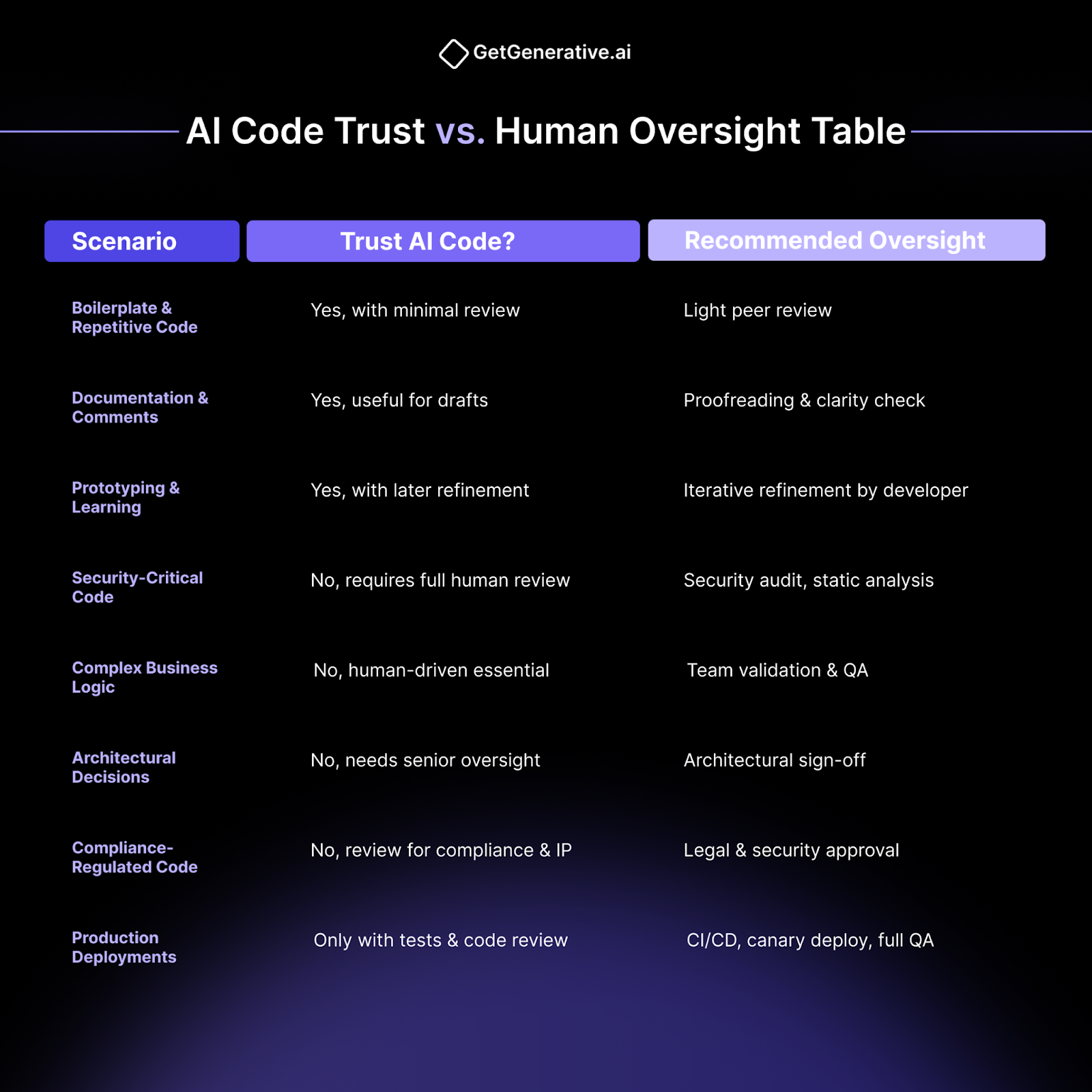
Even with clear productivity benefits, there are situations where human intervention is essential. Based on security advisories, real-world developer feedback, and expert recommendations, here are the six key scenarios where AI-generated code must be rigorously reviewed—or avoided:

1. Security-Critical Code

If the code handles:

  • Authentication
  • Authorization
  • Data encryption
  • User input validation

…then AI-generated output must be treated as untrusted until validated. AI tools are prone to introducing insecure logic, and static analysis or manual review is critical.

2. Complex Business Logic

Domain-specific functions—such as financial calculations, legal compliance rules, or logistics algorithms—require a deep contextual understanding that AI currently lacks. Always rely on SMEs and architects in these cases.

3. Architectural and Design Decisions

AI can refactor functions, but should not drive system architecture. Decisions involving data models, API boundaries, or service layers must be strategic and informed by human judgment.

4. Regulatory and IP Compliance

If your code must comply with:

  • GDPR
  • HIPAA
  • SOX
  • FINRA
  • FDA 21 CFR Part 11

…then AI-generated code must go through a compliance review. Also, validate licensing and copyright implications of code snippets generated from third-party trained LLMs.

5. Production-Grade Code

When moving from prototype to production, apply the highest scrutiny to any AI-generated block. This includes CI tests, vulnerability scans, and legal review for external dependencies.

Also Read – The ROI of AI-Powered Development in Salesforce Projects

Best Practices for Managing AI-Generated Code in Teams

To safely and systematically integrate AI into the development process, organizations should adopt the following governance, tooling, and cultural best practices:

1. Treat AI Code Like External Contributions

  • Use pull request reviews for all AI-generated code.
  • Require a developer to explain or annotate AI output in code reviews.
  • Tools like Diffblue and Sonar AI Code Assurance enforce this via rule-based workflows.

2. Automate Safety Checks in CI/CD

  • Run static analysis (SAST), dynamic tests, and license checks on every AI-assisted commit.
  • Integrate AI-aware linters that detect common hallucinations or vulnerabilities.
  • Use scanners like Semgrep, Snyk, or GitGuardian to catch embedded secrets or unsafe logic.

3. Use Guardrails and Fine-Tuned Models

  • Deploy on-prem or private models trained on your codebase.
  • Apply retrieval-augmented generation (RAG) to provide project-specific context.
  • Avoid generic models for regulated domains—use role- or industry-specific assistants like Code Agent in GetGenerative.ai or AWS’s CodeWhisperer for Healthcare.

4. Establish AI Governance Policies

  • Define:
    • What tools are approved
    • What use cases are permitted
    • What data is allowed in prompts
  • Implement Acceptable Use Policies for AI, especially for generative tools used in production.
  • Log and monitor AI tool usage to ensure compliance and transparency.

5. Encourage Developer Training

  • Teach prompt engineering and AI limitations.
  • Train teams to recognize hallucinated code (e.g., unknown libraries, API mismatches).
  • Foster a “challenge the AI” culture, where verifying AI output is not just encouraged, but expected.

6. Incremental Rollouts and Canary Deployments

  • Use feature flags, canary releases, or A/B testing to gradually deploy AI-generated modules.
  • Monitor telemetry for performance degradation, error rates, and security anomalies.
  • Roll back the AI-assisted code fast if instability is detected.

Also Read – Top AI Tools Every Salesforce Developer Should Know in 2025

How Top AI Tools Enable Responsible Code Generation

Tool

Strengths

Governance Capabilities

Use Case Fit

GitHub Copilot

IDE integration, fast prototyping

Enterprise version supports policies, logs

Best for boilerplate and JS/TS dev

Amazon CodeWhisperer

Context-aware, supports security scans

Service-linked IAM, integrates with S3/Git

AWS-native workflows

GetGenerative.ai

Salesforce-aware, metadata-driven, code + config

Custom models, org-bound security, JIRA/GitHub integration

Salesforce projects and vibe coding

Code Agent (GetGenerative.ai)

Prompt-to-Apex, tests, LWC, config deployment

Full traceability and role-based prompts

Complex Salesforce development

Cursor / Replit Ghostwriter

Instant feedback for frontend/backend apps

Limited governance (for now)

Startups, solo devs

Final Words 

AI-generated code holds the potential to transform software development—but only if adopted thoughtfully. The future of coding is not fully automated; it’s AI-assisted and human-curated.
salesforce consulting services

At GetGenerative.ai, we’ve reimagined Salesforce implementation—built from the ground up with AI at the core. This isn’t legacy delivery with AI added on. It’s a faster, smarter, AI-native approach powered by our proprietary platform.

👉 Explore our Salesforce AI consulting services
The Case for a Unified Orchestration Engine in Salesforce AI Development

The Case for a Unified Orchestration Engine in Salesforce AI Development


As conversational and agentic AI gain ground, experts are sounding the alarm. 

Gartner notes that interest will “grow in a streamlined and unified orchestration engine that coordinates across AI models, systems of record, channels, and services.”

Salesforce has begun moving in this direction with Agentforce (including the Atlas Reasoning Engine), Flow Orchestration, MuleSoft protocols like MCP and A2A, and unified data layers via Data Cloud. But enterprises need more than scattered tools—they need a unified AI command center. 

This blog makes the case for that missing link: a unified orchestration engine for Salesforce AI development. We’ll examine the core challenges, define what orchestration really means, explore how Salesforce is enabling this future, and provide strategic guidance for building such an engine. Let’s get started!

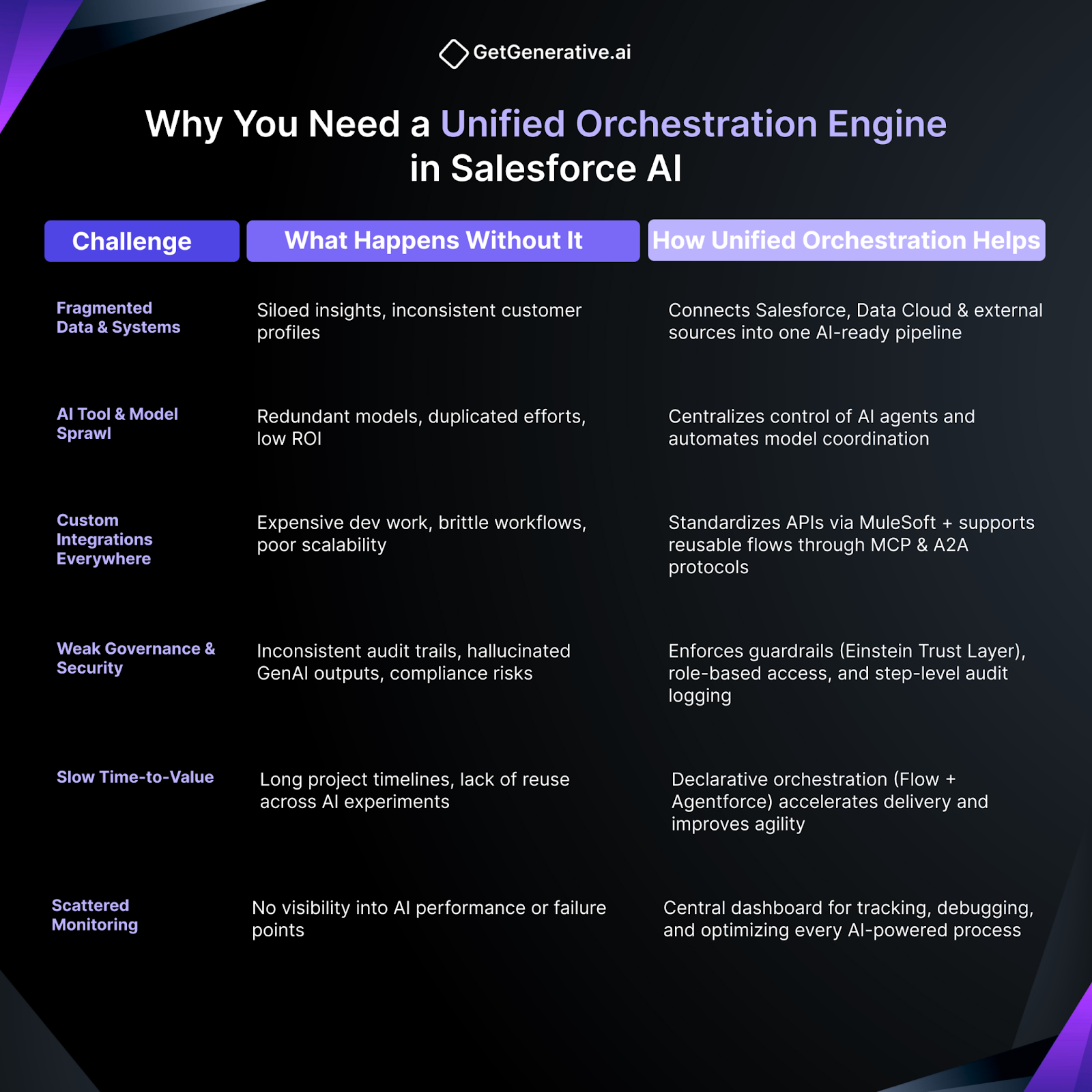
Challenges in Salesforce AI Development

1. Siloed Data and Systems

Modern Salesforce orgs are deeply interconnected, spanning CRM, ERP, marketing platforms, IoT data, and more. While Data Cloud aims to unify this information, in reality, data often remains fragmented across markets, teams, or clouds.

  • Problem: AI models trained on Sales Cloud may be blind to service data or external context.
  • Impact: Disjointed decisions, inaccurate predictions, and redundant efforts.
  • Example: In one global enterprise, marketing and service teams worked on different customer profiles due to inconsistent orchestration, resulting in fragmented experiences.

2. AI Tool Sprawl and Duplication

Admins, architects, and developers can now access Einstein Discovery, Vision, GPT copilots, and external AI APIs. However, these are rarely coordinated.

  • Salesforce reports that “thousands of models” are often deployed across orgs—yet few share workflows or learning.
  • Result: Duplicated modeling efforts, uncoordinated outputs, and lost institutional knowledge.

As one Salesforce whitepaper notes, eliminating lifecycle inefficiencies is now a top priority for enterprise AI.

3. Integration and Governance Gaps

Integration remains the top technical barrier to AI adoption, with 95% of IT leaders identifying it as a significant obstacle. In AI-driven workflows, each new use case can result in bespoke integrations, unclear approval processes, and increased risk.

  • Governance Blind Spots: 73% of Salesforce workers worry GenAI introduces new security risks.
  • Data Strategy Gap: 59% of IT leaders lack a unified data foundation for their AI stack.
  • Audit & Compliance Risk: Without orchestration, enterprises struggle to enforce consistent policies across AI agents, models, and output.

The bottom line: complexity is the enemy of scale. Without orchestration, Salesforce AI remains a set of isolated experiments—costly and hard to govern.

What Is a Unified Orchestration Engine?

A unified orchestration engine is more than a scheduler or process builder. It’s an intelligent, enterprise-grade framework that plans, executes, monitors and governs entire AI workflows—end-to-end. In the Salesforce ecosystem, this engine would connect AI agents, data services, cloud actions, and human approvals into coherent, scalable flows.

AD 4nXce1c2l7pa22ennEwtgfRbIXyw3eaYDOIwYIEQOfR

Core Capabilities of an Orchestration Engine

Capability

Description

AI Agent Coordination

Directs which AI agents to invoke, in what order, and with what inputs (e.g., prediction → outreach → task assignment)

Data Integration

Pulls and preprocesses data from Salesforce CRM, Data Cloud, external APIs, and unstructured sources

Flexible Workflows

Supports conditional logic, human-in-the-loop steps, retry patterns, and parallel execution

Embedded Governance

Enforces access controls, logs every action, and applies business guardrails automatically

Scalable Execution

Manages concurrency, queues tasks, and provisions compute to meet performance SLAs

This framework becomes the “central nervous system” of enterprise AI, much like Flow is for business automation.

Also Read – Why AI Struggles with Legacy Salesforce Orgs (And What You Can Do About It)

Foundations for Orchestration

Salesforce is not starting from scratch. Several key components already point toward a unified orchestration future:

Agentforce & Atlas Reasoning Engine

Agentforce is Salesforce’s agentic AI platform. At its heart lies the Atlas Reasoning Engine, which serves as an AI-native orchestrator. It breaks goals into steps, coordinates across specialized agents (e.g., service, billing, inventory), and ensures a cohesive outcome.

  • Use Case: A logistics request could trigger inventory checks, service scheduling, billing calculation, and customer comms—all coordinated by Atlas.
  • Benefit: AI agents act as a team, not as siloed bots.

MuleSoft MCP & A2A Protocols

MuleSoft is enabling agents and AI systems to communicate via:

  • MCP (Model Context Protocol): Wraps APIs so they become callable by AI agents.
  • A2A (Agent-to-Agent): Allows secure inter-agent communication across systems.

Together, these create a universal adapter for Salesforce, partner APIs, and even legacy systems—laying a foundation for orchestrated AI.

Flow and Flow Orchestration

Flow is evolving into the default orchestration layer across Salesforce.

  • New Use Cases: Flow will soon replace Journey Builder and be central to Marketing Cloud Next.
  • Cross-Cloud Power: Admins can now create multi-step workflows (e.g., case triage → approvals → resolution) across clouds and AI agents.

If AI actions are wrapped as Flow steps, then Flow becomes the orchestration user experience, allowing administrators and non-technical users to build AI-powered journeys.

Data Cloud & Trust Layer

Every orchestration engine depends on high-quality data. Salesforce’s Data Cloud ensures all AI models can access unified, governed customer profiles in real-time.

Paired with the Einstein Trust Layer, this enables:

  • Data Grounding: Ensuring generative AI uses up-to-date records.
  • Security Controls: Trimming sensitive fields, enforcing user permissions, and ensuring compliance.
  • Auditability: Logging every inference, decision, and action tied to customer records.

With these pieces—Agentforce, Flow, MuleSoft, and Data Cloud—Salesforce is quietly assembling the building blocks of an orchestration layer. What remains is for enterprises to connect the dots.

Also Read – How Small Teams Can Deliver Enterprise-Level Salesforce Projects with AI

Benefits of a Unified Orchestration Engine

1. Faster Time-to-Value

AI workflows can be reused, extended, and scaled without rebuilding integrations. Once the orchestration engine is in place:

  • Developers configure, not code.
  • AI services become plug-and-play.
  • PwC reports its Agent OS delivers new agents 10× faster than traditional methods.

This reduces the time from ideation to live deployment, directly accelerating innovation cycles.

2. Operational Efficiency at Scale

Salesforce’s internal orchestration engine for model training demonstrated 10,000 workflows per minute with sub-second latency. Extrapolated to AI applications:

  • AI models can scale without latency degradation.
  • Workloads are auto-distributed and optimized.
  • Infrastructure is shared across flows, reducing resource overhead.

3. Unified Compliance and Governance

A centralized engine standardizes policies across AI outputs, data access, and audit requirements.

  • Example: An AI-generated email must pass human review? The engine routes it through Flow approval.
  • Benefit: Governance is embedded by design, not enforced post-deployment.

4. Lower Total Cost of Ownership (TCO)

Instead of managing disparate tools—each with its own orchestration logic—you maintain a single, unified orchestration layer. Cost savings include:

  • Reduced dev effort on integration and monitoring
  • Less duplication of infrastructure (connectors, job schedulers)
  • Optimized compute usage across agents

5. Enhanced Agility and Iteration

Unified orchestration empowers business teams to experiment safely.

  • Marketing teams can build and test “agentic journeys” directly in Flow.
  • Service teams can adjust AI case workflows without IT rework.

6. Vendor-Agnostic Future-Proofing

The orchestration engine becomes the integration buffer between your AI stack and external services:

  • Want to switch from OpenAI to Claude? Change the integration once in the engine.
  • Need to add a compliance model from AWS? Plug it into the orchestration pipeline.

Also Read – Top AI Tools Every Salesforce Developer Should Know in 2025

Building a Unified Orchestration Engine in Salesforce 

Now that we’ve established the “why,” let’s focus on the “how.” Here’s a phased roadmap for building your orchestration engine on Salesforce:

Step 1: Define AI Use Cases and Workflow Objectives

Identify high-impact flows:

  • Sales: Lead scoring, follow-up automation
  • Service: Ticket triage → knowledge bot → case closure
  • Marketing: Segmentation → personalization → engagement

Document each flow’s data sources, model inputs/outputs, and business rules.

Step 2: Unify and Govern Your Data with Data Cloud

  • Consolidate profiles, activity logs, and external sources
  • Use Data Cloud as the real-time backbone for all AI decisions
  • Ensure data governance policies are enforced before feeding into AI pipelines

As Salesforce emphasizes, Agentforce performance depends on clean, unified data.

Step 3: Standardize Workflow UX with Salesforce Flow

  • Use Flow and Flow Orchestration for designing AI-enhanced journeys
  • Incorporate external actions, Apex calls, and human approval points
  • Provide training so admins and architects can build AI processes declaratively

Salesforce’s roadmap positions Flow as the default orchestration canvas—start building with that future in mind.

Step 4: Embrace MuleSoft MCP and A2A for Communication

Standardizing on these protocols ensures your AI agents are modular, interoperable, and future-ready.

Step 5: Use MuleSoft to Orchestrate External Integrations

  • Build API connectors for third-party services (ERP, logistics, marketing tools)
  • Convert them into agent-ready interfaces via MuleSoft Flex Gateway
  • Enable AI-to-system workflows (e.g., an agent checks delivery status via MuleSoft)

This makes every integration a reusable building block in orchestration.

Step 6: Deploy or Extend an Orchestration Framework

Depending on your enterprise maturity:

  • Use Salesforce Flow + Apex for lightweight orchestration
  • Deploy a third-party agent framework (e.g., PwC Agent OS)
  • Extend Salesforce’s orchestration engine if available

At minimum, include:

  • A workflow engine (Flow or external)
  • State management (Salesforce objects or external DB)
  • Logging and monitoring (Shield, SIEM, Flow logs)
  • Execution runtimes (Heroku, AWS Lambda, or AI services)

Step 7: Bake Governance and Audit Into the Design

  • Define AI guardrails: what actions require approval?
  • Use Shield or event monitoring for full traceability
  • Enforce role-based access, data masking, and compliance triggers

Design for responsible AI from the start.

Step 8: Pilot with a Focused Use Case

Start small. Prove ROI. Measure outcomes.

  • Time saved
  • Accuracy of predictions
  • Compliance pass rates
  • Business KPIs (e.g., conversion, CSAT)

Then scale to additional flows using the same engine.

Step 9: Upskill Teams and Drive Adoption

Invest in training across roles:

  • Admins: Flow + governance
  • Devs: APIs, Apex, orchestration tools
  • Architects: Data strategy, integration patterns
  • Business: Interpreting AI flows and outputs

Communicate the why behind orchestration. Internal trust is as critical as model accuracy.

Conclusion 

As AI expands across Salesforce orgs, fragmentation becomes the bottleneck. Without orchestration, enterprises face slower delivery, higher risk, and inconsistent governance.

The solution? A unified orchestration engine that coordinates every AI component—from data to agents to outputs. It aligns with Salesforce’s direction: Agentforce for agent coordination, Flow for orchestration UX, MuleSoft for connectivity, and Data Cloud for real-time data.

salesforce consulting services

At GetGenerative.ai, we’ve reimagined Salesforce implementation—built from the ground up with AI at the core. This isn’t legacy delivery with AI added on. It’s a faster, smarter, AI-native approach powered by our proprietary platform.

👉 Explore our Salesforce AI consulting services

Agentforce 3: How Salesforce Is Revolutionizing AI Agent Integration in 2025

Agentforce 3: How Salesforce Is Revolutionizing AI Agent Integration in 2025


In 2025, Salesforce is redefining what AI-powered enterprise platforms can be—with the release of Agentforce 3, its most sophisticated agent-based system yet. This isn’t just another AI update. It’s a complete architectural leap, one that promises to unify AI agents, automate business processes, and enable intelligent collaboration across every Salesforce Cloud. For enterprises struggling with disjointed tools, redundant automations, or inconsistent data flows, Agentforce 3 delivers a coordinated, AI-native solution.

Gartner projects that by 2026, 60% of enterprise applications will include embedded AI agents, up from less than 5% in 2023. Salesforce is at the forefront of that trend, building Agentforce 3 to help customers go beyond basic AI chatbots—and fully embrace multi-agent orchestration, autonomous workflows, and industry-specific copilots that actually understand their work.

Let’s explore what makes Agentforce 3 such a transformative leap for Salesforce users in 2025.

Agentforce: From Embedded AI to Enterprise Orchestration

Salesforce introduced its original AI agent framework under the Agentforce brand in 2023. At the time, it focused primarily on integrating AI into specific Salesforce apps—such as Sales Cloud or Service Cloud—by surfacing task-oriented copilots or embedding Einstein GPT capabilities.

Agentforce 2.0 (2024) expanded that vision with modular agents and deeper Data Cloud integration. However, it lacked cross-agent orchestration and struggled with making real-time decisions across departments or systems.

Agentforce 3 addresses these limitations head-on. It introduces a cross-cloud AI agent architecture, a central Command Center, support for open agent interoperability via the Multi-Agent Collaboration Protocol (MCP), and access to industry-specific prebuilt actions for faster time-to-value.

Introducing the Agentforce Command Center

At the heart of Agentforce 3 is the Command Center, a centralized console for managing, monitoring, and customizing AI agents across the Salesforce ecosystem.

Key features include:

  • Agent Inventory Management: View, activate, and control all agents deployed across Sales, Service, Marketing, Commerce, and more.
  • Orchestration Rules: Define how agents collaborate or hand off tasks across business domains (e.g., Sales agent → Quote agent → CPQ agent).
  • Performance Monitoring: Analyze agent effectiveness, error rates, user interactions, and contribution to KPIs using real-time dashboards.
  • Prompt Chain Configuration: Build and customize prompt chains that allow agents to complete multi-step workflows autonomously.

Example: A financial services firm uses Command Center to route a mortgage request through five agents—Discovery, Document Review, Credit Risk, Compliance, and Offer Generation—automatically, with no human handoff required.

This Command Center isn’t just a monitoring dashboard. It’s the strategic control hub of an enterprise’s AI workforce.

Related Read – Salesforce Launches Agentforce 3 With Real-Time Visibility and MCP Integration

Interoperability with the Multi-Agent Collaboration Protocol (MCP)

To ensure extensibility and compatibility with third-party AI tools, Salesforce has adopted the Multi-Agent Collaboration Protocol (MCP)—an open standard pioneered by the OpenAgents community.

With MCP, Agentforce 3 can now interact with agents from outside the Salesforce ecosystem, including:

  • Internal AI copilots built on platforms like OpenAI or Hugging Face
  • External automation tools like UiPath or Workato
  • Agent-based SaaS solutions like GetGenerative.ai, which already supports native MCP handoffs

This opens the door to multi-vendor AI ecosystems, where Agentforce agents don’t need to “own” every task—they simply coordinate the outcome.

Industry-Specific Agents and Prebuilt Actions

Salesforce isn’t taking a one-size-fits-all approach. With Agentforce 3, it now offers industry-specific agent bundles—each equipped with prebuilt actions, AI-tuned workflows, and domain-specific models.

Examples include:

  • Healthcare: Patient Intake Agent, Prior Authorization Agent, Claims AI Agent
  • Financial Services: Know Your Customer (KYC) Agent, Compliance Copilot, Wealth Profile Generator
  • Retail & Consumer Goods: Store Ops Agent, Returns Automation Agent, Promotion Optimizer
  • Manufacturing: Order-to-Cash Agent, Procurement Agent, Asset Monitoring Bot

Each of these agents is trained on structured industry data models, ensuring context-aware execution and regulatory alignment.

The Atlas AI Architecture 

Agentforce 3 is powered by Atlas, Salesforce’s new AI orchestration framework that brings coherence to agent behavior across disparate clouds and data sources.

Core capabilities of Atlas include:

  • Multi-Agent Planning Engine: Coordinates task execution among different agents with memory of previous actions and expected outcomes.
  • Cross-Cloud Knowledge Graphs: Leverages real-time customer, product, and transaction data from Salesforce Data Cloud to contextualize agent responses.
  • Auto-RAG (Retrieval-Augmented Generation): Enhances prompts with accurate, up-to-date enterprise content such as product catalogs, SLAs, or compliance rules.

This architecture allows Salesforce AI agents to move from reactive helpers to context-aware decision-makers.

Deeper Integration with Flow Orchestration and Data Cloud

Agentforce 3 doesn’t just work on Salesforce—it works with it, deeply embedding into the two most critical automation layers:

1. Salesforce Flow Orchestration

Agents can now:

  • Be invoked as Flow steps in process builders
  • Trigger follow-up automations based on event conditions
  • Collaborate in long-running workflows, such as loan underwriting or partner onboarding

2. Salesforce Data Cloud

With real-time access to:

  • 360° customer profiles
  • Streaming event data
  • Segmentation and behavioral insights

Agents are not guessing—they’re acting on live, unified data.

Also Read – Why AI Struggles with Legacy Salesforce Orgs (And What You Can Do About It)

Strategic Recommendations for Enterprise Adoption

✅ 1. Appoint an AI Governance Lead

AI agents must be governed like any digital workforce. Appoint a stakeholder to own agent inventory, permissions, training data, and oversight.

✅ 2. Start with Industry Agent Bundles

Don’t reinvent the wheel. Begin with pre-configured agent bundles tuned for your vertical, then layer custom logic on top via Command Center.

✅ 3. Integrate with Existing RAG Sources

Whether it’s SharePoint, Confluence, or GetGenerative.ai, plug in your enterprise knowledge bases for richer, contextual prompt completion.

✅ 4. Monitor with AI KPIs

Go beyond user clicks. Track Agent ROI, agent error rate, average time to resolution, and workflow handoff success as new north stars.

✅ 5. Pilot Before Scaling

Start with low-risk use cases (e.g., email summarization, quote generation) and gradually expand to complex workflows with high business impact.

Conclusion 

With Agentforce 3, Salesforce has created more than an update—it has launched a platform shift. The rise of AI agents in enterprise software will redefine workflows, reduce manual effort, and unlock new levels of autonomy. 

salesforce consulting services

At GetGenerative.ai, we’ve reimagined Salesforce implementation—built from the ground up with AI at the core. This isn’t legacy delivery with AI added on. It’s a faster, smarter, AI-native approach powered by our proprietary platform.

👉 Explore our Salesforce AI consulting services

Why AI Struggles with Legacy Salesforce Orgs (And What You Can Do About It)

Why AI Struggles with Legacy Salesforce Orgs (And What You Can Do About It)


AI is revolutionizing how businesses engage with customers, automate workflows, and uncover data-driven insights. Nowhere is this transformation more evident than in the Salesforce ecosystem, where AI-powered tools like Einstein GPT and Agentforce promise smarter decisions and hyper-efficiency.

But for many enterprises, that promise remains frustratingly out of reach, especially those running on legacy Salesforce orgs. These older environments, weighed down by years of technical debt, disconnected systems, and outdated configurations, often create more friction than function. In fact:

  • 98% of IT leaders report major barriers to leveraging data for AI initiatives
  • Only 37% of enterprises say they can keep pace with digital transformation.
  • A staggering 89% of organizations cite integration complexity as a core challenge.

If your AI project is stuck in neutral, the issue might not be the AI—it’s likely your legacy Salesforce setup that’s holding you back.

This blog unpacks the core reasons why AI struggles in legacy Salesforce environments. We’ll explore technical, architectural, and organizational pitfalls—and more importantly, provide a strategic roadmap for transformation. Let’s get started!   

The Promise of AI vs. the Reality of Legacy Salesforce Orgs

Salesforce is leading the charge in AI innovation. Einstein GPT, Agentforce, and Data Cloud are reshaping how CRM platforms operate—offering predictive analytics, automated case resolution, next-best-action recommendations, and more. CEO Marc Benioff has predicted over one billion AI agents will operate within Salesforce environments in the near future.

The business case is clear:

  • 60% of enterprises are actively exploring AI to enhance customer engagement
  • AI is expected to contribute $15.7 trillion to the global economy by 2030
  • Salesforce’s own reports suggest AI increases team productivity by 29% on average

But these benefits are elusive in legacy Salesforce orgs—those that have evolved over time with outdated custom code, rigid workflows, siloed data, and disconnected systems. In these environments, AI tools can’t operate as intended because the infrastructure isn’t built to support them.

AD 4nXciHoNU0SkhMudJY 4FZvZfF6nu0L2YA bGZuBA86cgB48ykhZirY0 tx5lZGBl6K6GbhsXjXI0X1AnvDrt7QppMOFiYrdN0TPDxBHE1cE7R2gHfO7PxDe 5Zf1U2Y79XTbi8bJ?key=gbGttllCs4Cv9pxPw 7 g

Also Read – The ROI of AI-Powered Development in Salesforce Projects

Why AI Struggles with Legacy Salesforce Orgs

AI isn’t magic. It needs clean data, scalable infrastructure, real-time integrations, and user trust to function effectively. Legacy Salesforce orgs often fall short on all fronts.

1. Data Silos and Integration Bottlenecks

Legacy Salesforce implementations are notorious for relying on point-to-point or batch integrations with ERP systems, on-premise databases, or third-party tools. These outdated methods can’t keep pace with modern AI tools that require real-time data streaming and API-first architecture.

When data is trapped in silos or updated only once a night, AI models lack the real-time visibility they need to generate accurate predictions or personalized recommendations. These blind spots result in half-baked insights, missed opportunities, and flawed automation.

Example: An AI-powered customer churn predictor is only as good as the behavioral and transaction data it can access. If customer service interactions live in one system and billing data in another—and neither syncs seamlessly with Salesforce—your AI model is flying blind.

2. Poor Data Quality and Context

The saying “garbage in, garbage out” is especially true for AI. Legacy orgs often accumulate:

  • Duplicate records
  • Incomplete fields
  • Inconsistent naming conventions
  • Outdated metadata and obsolete custom objects

These issues make it hard for AI to derive meaningful insights. AI systems depend on structured, accurate, and contextualized data. If a contact record has three different email addresses or a case history lacks resolution details, AI-powered workflows like lead scoring or case classification will fail to deliver value.

Example: A Salesforce chatbot trained to answer service inquiries can’t function well if the knowledge base is outdated or case notes are inconsistent. AI needs a clean, consolidated context to be effective.

3. Technical Debt and Complex Customizations

Legacy Salesforce environments often evolve into “Frankenstein orgs”—full of hard-coded Apex triggers, deprecated Visualforce pages, overlapping workflows, and inconsistent automation layers. These elements create:

  • Performance bottlenecks
  • Unpredictable automation clashes
  • High maintenance overhead

This technical debt doesn’t just slow down daily operations—it actively impedes the integration of AI tools, which require streamlined, well-documented, and modular systems to operate correctly.

Example: If your Salesforce org still relies on legacy Workflow Rules or Process Builder flows, they may conflict with AI-triggered automations. This creates instability and makes it hard to debug when things go wrong—especially at scale.

4. Outdated Platform Features

Many legacy orgs are still running on Salesforce Classic UI or haven’t migrated to Data Cloud—the backbone of Einstein GPT and other generative AI capabilities. These environments are missing out on the following:

  • Real-time data unification
  • Industry-specific data models
  • Embedded AI insights and predictive scoring

Example: Einstein GPT requires access to Data Cloud for customer history, behavioral signals, and transaction context. Without these in place, the AI either cannot be deployed or delivers subpar results.

Older editions may also lack the scale and elasticity needed for AI-powered workloads like document generation, code analysis, or case triaging—all of which involve compute-heavy operations.

5. Security and Compliance Risks

AI introduces new risks around data privacy, consent, and ethical usage. Legacy Salesforce orgs often fall short in:

  • Field-level encryption
  • Secure APIs for third-party AI connections
  • Audit trails and access logging
  • Consent tracking and GDPR/CCPA readiness

Example: An AI tool trained on service case data could inadvertently access sensitive health or financial info unless proper controls are in place. Older systems may not have modern controls to segment or anonymize data before sending it to an LLM.

Without tight integration security and modern encryption standards, organizations open themselves to breaches, fines, and reputational damage—especially when AI is involved.

6. Organizational and Skill Gaps

It’s not just about code—it’s about people. Teams that have maintained a legacy org for years often lack exposure to modern Salesforce tools, AI principles, or data science practices. Furthermore:

  • Change resistance is common
  • AI is viewed as a threat, not a tool
  • Hiring modern AI-Salesforce experts is difficult

Example: Your admin may know Visualforce and Workflow Rules inside out, but be unfamiliar with Flow Builder, Einstein AI, or Lightning Web Components (LWC). This skill gap creates friction in both adoption and maintenance of AI initiatives.

Also Read – Why AI Developers Are the New Full Stack Engineers

6 Proven Strategies to Enable AI in Legacy Salesforce Orgs

1. Modernize Integrations and Break Down Data Silos

To support AI, your data must be accessible, unified, and updated in real-time. That requires moving beyond outdated point-to-point connections and adopting a modern, scalable integration architecture.

Recommended Approach:

Implement an Integration Platform as a Service (iPaaS) like MuleSoft to establish API-led connectivity between Salesforce and other enterprise systems (ERP, analytics, databases, etc.).

Real Example:

INSEAD used MuleSoft to integrate 100+ siloed applications, cutting manual effort by 60% and dramatically improving decision-making speed across departments.

Action: Audit your current integrations. Identify batch jobs or outdated sync tools and replace them with real-time APIs or event-driven flows using platforms like MuleSoft or Workato.

2. Invest in Data Cleanup and Governance

AI is only as smart as the data it ingests. Poor-quality, incomplete, or duplicate data will undermine AI accuracy, adoption, and trust.

Steps to Take:

  • Launch a Salesforce data quality assessment
  • De-duplicate leads, contacts, and accounts using native or third-party tools like DemandTools, Cloudingo, or Informatica
  • Implement field validation rules, picklist standardization, and automated enrichment

Governance Tips:

  • Assign data owners for critical objects (e.g., Accounts, Opportunities)
  • Establish naming conventions and quality SLAs
  • Set up dashboards to track missing field rates, error rates, or data age

Action: Run a full health check using Salesforce’s Optimizer and Tableau CRM dashboards. Then, clean key objects and implement a data governance policy to maintain hygiene over time.

3. Refactor Technical Debt and Simplify Your Org

Legacy code, overlapping workflows, and redundant fields make your Salesforce org fragile and opaque—exactly the opposite of what AI needs.

Your Goal: A modular, lean Salesforce org where AI can plug into processes cleanly without conflicts.

Use These Tools:

  • Salesforce Optimizer to flag unused components
  • Panaya ForeSight or OwnBackup’s Org Compare to map and analyze legacy components
  • AI-powered tools to visualize dependencies and suggest simplifications

Action: Launch a “tech debt sprint.” Identify obsolete Apex classes, legacy automation (e.g., Workflow Rules), and unused objects. Replace them with streamlined Flow Builder processes and Lightning components.

4. Upgrade to the Latest Salesforce Platforms and Features

Legacy orgs stuck on Classic or without Data Cloud are incompatible with most modern AI features.

What to Upgrade:

  • Move to Lightning Experience for access to Einstein and modern UI components
  • Adopt Industry Clouds (like Financial Services Cloud) for built-in AI and data models
  • Enable Salesforce Data Cloud for 360° real-time data unification
  • Subscribe to Einstein GPT, Agentforce, and Einstein Discovery as needed

Action: Work with your Salesforce account team to map which features you’re missing and build a roadmap to get current. Start with what’s required for your highest-priority AI use case.

5. Harden Security and Embed Compliance into AI Workflows

Security concerns are a top AI adoption blocker, especially in regulated industries like healthcare, banking, and government.

Modernize Your Security Stack:

  • Use Salesforce Shield for field-level encryption, audit logs, and event monitoring
  • Ensure Multi-Factor Authentication (MFA) is enforced
  • Replace legacy FTP data transfers with secure APIs
  • Add privacy controls around consent, opt-outs, and PII processing

Data Governance Best Practices:

  • Create a data usage register for AI workflows
  • Define roles/responsibilities for who owns and audits AI models
  • Monitor all AI access via Salesforce Event Monitoring

Action: Conduct a Salesforce Security Health Check, including permission sets, API access, and field-level visibility. In parallel, update your company’s AI risk policy to cover model fairness, data usage rights, and regulatory alignment (e.g., GDPR/CCPA).

6. Drive Change Management and Upskill Your Teams

AI success is not only about technology—it’s about people. Teams need clarity, confidence, and capability to adopt and trust AI systems.

What to Do:

  • Define and communicate a clear AI adoption vision
  • Appoint AI champions in business and IT units
  • Offer role-specific enablement (e.g., Einstein Lead Scoring for Sales, Case Classification for Support)
  • Upskill admins and devs via Salesforce Trailhead, AI Specialist certifications, or external training programs

Action: Launch a pilot AI use case with a small team. Run workshops, gather feedback, and publicize wins internally. Pair up non-technical users with “AI mentors” to increase comfort and capability.

Also Read – Top AI Tools Every Salesforce Developer Should Know in 2025

Final Thoughts 

Your legacy Salesforce org may be a maze of technical debt, disconnected systems, and resistance to change, but it’s also a powerful asset. With the right investments in data, infrastructure, and people, you can transform it into a scalable, secure, AI-optimized platform that drives real business outcomes.

salesforce consulting services

At GetGenerative.ai, we’ve reinvented how Salesforce is implemented—AI isn’t an add-on, it’s the foundation. Our platform delivers a faster, smarter, AI-native experience from day one.

👉 Explore our Salesforce AI consulting services

A Beginner’s Guide to ApexGuru, Code Analyser, and DevOps Centre

A Beginner’s Guide to ApexGuru, Code Analyser, and DevOps Centre


In 2025, enterprises demand faster releases, better performance, and airtight compliance, all while managing increasingly complex orgs.

To meet these expectations, Salesforce has introduced a modern toolchain purpose-built for the platform’s unique development model:

  • ApexGuru: an AI-driven assistant for Apex code optimization
  • Salesforce Code Analyzer: a robust static code analysis engine
  • Salesforce DevOps Center: a visual, source-driven release management system

Together, these tools are reshaping how developers and architects build, review, and deploy applications on Salesforce — merging DevOps best practices with the power of AI and automation.

What Is ApexGuru?

ApexGuru is Salesforce’s AI assistant designed to identify and help resolve Apex performance issues automatically. Integrated into Scale Center, it uses runtime profiling and Salesforce’s own CodeGen AI models to detect critical anti-patterns and performance bottlenecks based on actual org telemetry.

What makes ApexGuru transformative isn’t just detection — it’s prescriptive, organization-specific fixes that help developers optimize code in real-time, avoiding governor limits and improving response times without trial and error.

How It Works 

Once enabled, ApexGuru scans your Apex classes weekly across four key dimensions:

Code Recommendations

It flags inefficient patterns — such as SOQL inside loops — with severity levels (Critical, Major, Minor) and displays a side-by-side comparison of “code before” and “recommended code.”

SOQL & DML Analysis

ApexGuru detects inefficient database interactions (e.g., unselective queries or excessive DML calls), and suggests indexing strategies, bulkification, and optimized patterns.

Expensive Methods

It identifies methods consuming the most CPU time, based on the last 15 days of production telemetry. Anything using over 5% of a transaction’s CPU time is flagged as critical.

Unused Classes and Methods

Dead code that hasn’t been invoked in two weeks? ApexGuru identifies and recommends cleanup, helping reduce bloat and technical debt.

 The Setup & Dashboard

Setup is seamless:

  • Go to Setup > Scale Center > ApexGuru Insights
  • Accept terms; ApexGuru starts scanning automatically
  • Results populate in a dedicated dashboard, categorized by severity

A typical dashboard might show:

  • 10 critical, 37 major, and 248 minor recommendations
  • Each flagged issue includes org-specific context and a smart fix suggestion

Real-World Benefits and ROI

✅ Performance Gains

Early adopters experienced a 70% reduction in CPU time for critical processes.

For example, two high-load transactions experienced a 60% and 45% reduction in CPU usage after implementing ApexGuru’s fixes.

✅ Reduced Technical Debt

Unused classes and anti-patterns are systematically flagged, helping clean up legacy code and prevent future incidents.

✅ Continuous Learning

By showing best practices (e.g., bulkified queries, selective filtering), ApexGuru helps developers write better Apex, not just fix what’s broken.

✅ Cost Efficiency

It’s free for Unlimited Edition, Full Copy Sandboxes, Signature, and Scale customers, making it a no-brainer for enterprise teams.

Salesforce Code Analyzer 

Where ApexGuru provides runtime insights, Salesforce Code Analyzer (SFCA) focuses on static code analysis — scanning Apex, LWC, Aura, and Visualforce components to catch security, performance, and style issues before code is ever deployed.

This tool integrates leading engines like:

  • PMD (Apex, Java rule enforcement)
  • ESLint (for JavaScript and LWC)
  • RetireJS (vulnerable JS libraries)
  • Regex engine (for custom patterns)
  • Graph Engine (for Apex data flow — in dev preview)

With 500+ rules out of the box, Code Analyzer acts as a static gatekeeper for quality and security across the entire SDLC.

Key Use Cases and Features

Real-Time Feedback via VS Code

With the Salesforce Extensions Pack for VS Code, developers get linting and suggestions instantly as they type. The extension even surfaces ApexGuru insights (in pilot) inside the IDE.

CI/CD Integration

Via Salesforce CLI, Code Analyzer scans can be run in GitHub Actions, Jenkins, or any other CI system. This enables quality gates that fail builds if critical issues are found.

GitHub + DevOps Center Integration

DevOps Center integrates Code Analyzer into the DevOps Testing Framework, automating scans at each release stage with enforcement via quality gates.

Custom Reporting

Output formats include JSON, HTML, CSV, with HTML providing severity breakdowns, rule violations, and developer-friendly filtering.

Also Read – The ROI of AI-Powered Development in Salesforce Projects

Code Analyzer v5:  What’s New in 2025 

Unified Rule Management

Configure all engines and severities in a single code-analyzer.yml file.

Salesforce Graph Engine

Deep data-flow analysis uncovers issues like SOQL injection or insecure CRUD/FLS patterns — even across method chains.

Flow Scanner Engine

Static analysis now extends to Salesforce Flows, catching misconfigurations, loops, or security vulnerabilities in declarative logic.

Lighter & Faster IDE Extension

Code Analyzer’s VS Code plugin is now 90% smaller and loads 90% faster, enhancing the developer experience.

AI-Powered Fixes

Salesforce is piloting AI-assisted quick fixes that comment recommended code blocks directly into your files — a major leap toward autonomous remediation.

Best Practices for Using Code Analyzer

  1. Treat Static Analysis as a First-Class Citizen
    Incorporate Code Analyzer scans into every commit, pull request, and deployment step.
  2. Customize Rules by Org Sensitivity
    Not every org cares equally about style vs. performance vs. security. Tailor severity levels to reflect business priorities.
  3. Automate Quality Gates
    Use DevOps Testing or CI pipelines to enforce zero tolerance for high-severity issues.
  4. Track Trends Over Time
    Utilize HTML reports and DevOps Center history to track the reduction in issue counts across sprints. Celebrate clean scans.
  5. Train Teams on Common Violations
    Recurring issues (e.g., missing FLS checks) signal areas for upskilling. Turn static analysis into a teaching moment.

What Is Salesforce DevOps Center? 

Salesforce DevOps Center is a free, Salesforce-native release management tool that replaces traditional change sets with a modern, Git-based DevOps workflow. It enables source control, CI/CD automation, and unified collaboration across developers, admins, and release managers.

With over 250,000+ Salesforce customers still relying on manual deployments, DevOps Center represents a monumental shift toward scalable, error-free releases for teams of all sizes.

Core Capabilities of DevOps Center

Work Items and Metadata Tracking

Each Work Item represents a feature, task, or bug fix. DevOps Center tracks metadata changes (custom objects, fields, Apex classes, Flows, etc.) against each Work Item automatically — no more spreadsheets or forgotten components.

Git-Based Version Control

The DevOps Center commits all changes to GitHub in real-time, abstracting Git commands for less technical users. This provides:

  • Full version history
  • Rollbacks
  • Branch merging
  • Change auditing

Note: GitHub is the only VCS supported natively today. Bitbucket or Azure DevOps users must migrate or wait for broader VCS support.

Visual Pipeline with Stage Promotion

Work Items move through a pipeline, progressing from Dev → QA → UAT → Prod, and each stage corresponds to a connected organization. Promotion is one click, with auto-deployments and Git merges behind the scenes.

Collaboration Across Roles

Admins, developers, and testers all use the same interface. Whether a Flow is built via clicks or Apex via code, DevOps Center treats both as tracked changes in the same Work Item and pipeline.

Also Read – How Small Teams Can Deliver Enterprise-Level Salesforce Projects with AI

Key Concepts & Terminology

Term

Description

Project

A logical unit in DevOps Center tied to a GitHub repo and org pipeline

Work Item

Represents a story/bug/task with associated metadata changes

Environment

A connected Salesforce org (Dev, QA, UAT, Prod)

Pipeline

The visual sequence of stages your Work Items move through

Quality Gates

Rules that must pass (tests, static analysis) before promotion

DevOps Testing Framework 

Launched in 2025, Salesforce DevOps Testing enhances the DevOps Center by adding automated test suites and quality gates for Work Items.

Supported Test Types:

  • Salesforce Code Analyzer
  • Apex Unit Tests
  • External UI tests (e.g., Selenium, Provar)
  • Custom scripts via test provider integrations

Key Capabilities:

  • Define test suites at each pipeline stage
  • Set pass/fail criteria (e.g., “No critical Code Analyzer issues allowed”)
  • Automatically block promotion if a gate fails
  • View test histories and violation details inline with each Work Item

Example: At the UAT stage, a test suite might require:

✅ 100% Apex test pass rate
✅ ≥ 75% code coverage
✅ No critical static analysis violations
✅ 0 high-severity security risks

Final Thoughts

These tools are free, natively integrated, and already powering the next wave of Salesforce innovation. By leveraging AI-assisted performance insights, automated code governance, and modern release pipelines, you gain a strategic edge, enabling your team to deliver at scale, securely, and with confidence.

salesforce consulting services

At GetGenerative.ai, we’ve reinvented Salesforce implementation from the ground up—with AI woven into every layer. This isn’t traditional delivery with a touch of AI. It’s a truly AI-native model that delivers faster, smarter results through our proprietary platform.

👉 Explore our AI Salesforce consulting services

From SaaS to AI: Overcoming Data and Security Fears in the AI Era

Learning from the Cloud Trust Journey

A decade ago, the idea of trusting third-party vendors with critical business data felt like a leap of faith. Cloud computing and its most accessible form, Software-as-a-Service (SaaS) was met with skepticism across industries. 

Would storing sensitive customer information, source code, or financial records on someone else’s servers invite disaster?

Fast forward to 2025, and that leap has turned into a global standard. Today, 96% of companies rely on public cloud services, according to Gartner. More importantly, the original assumption that cloud meant weaker security has been thoroughly debunked; 94% of businesses now report improved security after migrating to the cloud.

This transformation didn’t happen by chance. It was earned through years of investment and proof. Cloud providers like AWS, Microsoft Azure, and Google Cloud developed hardened infrastructure, 24/7 threat monitoring, zero-trust architectures, and third-party certifications. With ISO 27001, SOC 2, GDPR compliance, and industry-specific standards, the cloud established itself as not just efficient but enterprise-ready.

The takeaway? 

When implemented with due diligence and guided by a shared responsibility model, disruptive technologies can deliver both innovation and trust.

Cloud Breaches: Lessons in Misattribution

Despite high-profile cloud breach headlines, most incidents were not caused by flaws in the cloud itself, but by misconfigurations and human error. According to Gartner, 80% of data breaches originate on the user’s side, and 99% of cloud security failures through 2025 will be the customer’s fault.

Two real-world examples underscore this:

  • Capital One (2019): A massive breach exposed 100 million customer records due to a misconfigured web application firewall. The underlying AWS infrastructure remained uncompromised, the issue was entirely on Capital One’s end. The fallout included an $80 million regulatory fine and $190 million in class-action settlements.
  • Toyota (2023): A cloud misconfiguration left 260,000 customer records publicly accessible for eight years. The breach had nothing to do with a compromised cloud platform it was a simple case of overlooked permissions.

The consistent thread in these cases is clear: security failures tend to be the result of implementation flaws, not infrastructure flaws. It’s a modern echo of the old IT adage: “A secure system can still be misused.”

The AI Inflection Point: Déjà Vu?

Today, we’re witnessing history repeat itself with Artificial Intelligence (AI); particularly generative AI and large language models (LLMs).

The promises of AI are transformative: boosting productivity, automating knowledge work, accelerating development cycles, and uncovering insights hidden in data. Adoption is happening fast:

  • Within months of its launch, ChatGPT was being used inside 80% of Fortune 500 companies largely driven by grassroots employee adoption.
  • A 2025 Bain & Company survey shows 95% of U.S. businesses are already using generative AI, a 12-point increase in just one year.

Yet, familiar concerns are rising again. Companies are asking:

  • “Is our data safe with AI tools?”
  • “What happens to the information we input?”
  • “Can generative AI expose our proprietary content?”

These are valid questions. In 2023, Samsung temporarily banned ChatGPT after employees accidentally leaked confidential source code into prompts. An internal audit found 65% of surveyed staff considered generative AI a potential security risk if left uncontrolled.

And once again, the comparison to early cloud fears becomes relevant. Enterprises are facing an identical challenge: how to balance the productivity gains of AI with the need for control, compliance, and confidentiality.

Why AI Feels Risky and How to De-risk It

The fear around AI tools is partly due to their interface simplicity. With a natural language prompt and zero deployment effort, anyone can ask a model to summarize customer data, generate code, or write sensitive documentation. But this simplicity masks a deeper concern; data exposure.

What happens to the data after it’s submitted to an AI tool? Could it:

  • Be stored by the provider?
  • Be used to train the next generation of public models?
  • Leak to other users via unintentional model behavior?

These fears are not unfounded. But they are also manageable, just as they were with SaaS.

Reapplying the Cloud Trust Playbook to AI

Just like cloud providers eventually gained user trust by formalizing contracts, publishing documentation, and passing audits, AI providers must now do the same. And forward-looking vendors already are.

For example:

  • OpenAI’s ChatGPT Enterprise explicitly states that it does not train its models on enterprise data, and conversations are not stored or accessed.
  • Microsoft’s Azure OpenAI allows companies to run powerful models within their own VNETs, with encryption, governance, and compliance inherited from the Azure ecosystem.
  • GetGenerative.ai, a rising enterprise AI platform, has proactively earned ISO 27001 and SOC 2 compliance, and offers a public Trust Portal to showcase its security architecture and safeguards.

These aren’t surface-level moves. They reflect months of architectural planning, audit preparation, policy enforcement, and transparency the same ingredients that made cloud safe.

Key Security Considerations for Enterprise AI

To ensure safe adoption of AI, enterprises must apply the same rigor they used when evaluating cloud solutions. A “trust but verify” approach is essential, and here are the critical pillars for securing generative AI in enterprise settings:

1. Data Usage and Privacy Guarantees

Demand contractual clarity from AI vendors. The provider must commit that:

  • Your data won’t be used to train public models.
  • Inputs and outputs remain confidential.
  • Prompts are neither stored nor reviewed unless explicitly permitted.

For instance, ChatGPT Enterprise guarantees, “We do not train on your business data or conversations.” This ensures your private information isn’t absorbed into future model updates or accessible by others.

Action Point: Always ask for these terms in writing ideally within your Master Services Agreement (MSA) or Data Processing Agreement (DPA).

2. Isolation and Access Control

Your AI interactions should be processed in a secure, segregated environment:

  • Prefer solutions that offer single-tenant deployments or virtual private cloud (VPC) setups.
  • All data must be encrypted in transit and at rest.
  • Only authorized users with role-based access controls and audit logs should be able to view or manage AI-generated content.

If the provider offers fine-tuning or persistent memory, verify how the data is handled, where it is stored, and who can access it.

Bonus Feature to Look For: Bring-Your-Own-Key (BYOK) encryption, which gives customers complete control over encryption keys.

3. Compliance and Security Certifications

Trustworthy vendors will invest in third-party audits. Look for:

  • ISO/IEC 27001 (information security management)
  • SOC 2 Type II (controls around security, confidentiality, availability)
  • Region-specific standards like HIPAA, GDPR, or CCPA

These are not mere checkboxes they reflect comprehensive internal controls, employee training, secure development practices, and incident response plans.

Example:

GetGenerative.ai achieved both ISO 27001 and SOC 2 Type II certifications, demonstrating its maturity in managing sensitive enterprise data.

Action Point: Don’t just trust the logo. Ask vendors to share audit summaries, security policies, or even access to a Trust Portal.

4. Transparent Terms and Control Over Your Data

Know your rights and the vendor’s responsibilities regarding:

  • Data retention: How long will inputs/outputs be stored?
  • Ownership: Do you own the AI outputs?
  • Deletion rights: Can you request full deletion of data?
  • Usage limitations: Will your data ever be used beyond your org?

Leading vendors now publish privacy centers and security whitepapers to answer these questions.

Caution: If you’re using a model via an intermediary (e.g., through a SaaS product), ensure the entire chain of providers follows the same standards.

5. Internal Governance: Training and Usage Policies

Even the best technology fails if humans misuse it.

Create a generative AI policy for employees. Key elements include:

  • What kinds of data can be entered (e.g., no PII, no source code)?
  • Which tools are approved (e.g., internal vs. public)?
  • What outputs can be reused or published?
  • When to involve legal or compliance?

Example Policy Language:

“Do not paste confidential client information, customer records, or unreleased product plans into public AI chat interfaces.”

Companies like JPMorgan and Apple have gone as far as to build internal generative AI tools that enforce these rules by design.

Best Practice: Add pop-up warnings, API access limits, or browser proxy filters to gently remind users of policy boundaries.

Also Read – AI-Washing in IT Consulting: Buzzwords vs Real AI-First Firms

Case Study: GetGenerative.ai’s Proactive Security Architecture

When it comes to enterprise AI adoption, transparency breeds trust. GetGenerative.ai stands out by proactively surfacing its compliance posture and internal safeguards.

What Sets It Apart:

  • Early Investment in Security: From day one, the team prioritized earning certifications like ISO 27001 and SOC 2, sending a clear message to enterprise buyers.
  • Public Trust Portal:
    GetGenerative provides a live, always-updated Trust Portal, which includes:
    • Security architecture
    • Encryption policies
    • Certification documents
    • Governance practices
    • Contact information for due diligence
  • Comprehensive Controls:
    Their platform supports:
    • Isolated environments for customer data
    • Data encryption at every layer
    • Configurable retention policies
    • Role-based access
    • Custom API tokens with usage limits

Why It Matters

Rather than saying “trust us,” GetGenerative.ai shows its work. This echoes the most successful strategies from the SaaS era, when trust was built through disclosure, documentation, and accountability.

Final Thoughts

The cloud era taught us that fear alone is not a strategy. Initially distrusted, cloud services are now essential infrastructure because the industry tackled security concerns head-on.

AI is now going through the same evolution.

Yes, AI raises legitimate data and security questions. But the answers exist. We already have mature tools, trusted compliance frameworks, and proven vendor practices to reduce risk without sacrificing progress.

The AI Trust Playbook:

  • Vet the provider.
  • Enforce usage policies.
  • Encrypt and isolate data.
  • Demand transparency.
  • Train your people.

Enterprises that master this playbook won’t just keep pace; they’ll pull ahead. 

The benefits of AI are too significant to delay. From faster decision-making to cost savings, developer velocity, and customer personalization, the ROI is clear.

The ROI of AI-Powered Development in Salesforce Projects 

The ROI of AI-Powered Development in Salesforce Projects 


According to Salesforce’s State of IT, 61% of professionals are currently using or planning to use generative AI. Among Salesforce developers, this adoption is accelerating rapidly. Between 2023 and 2024, GitHub Copilot usage among Salesforce devs jumped from 17% to 45%, while ChatGPT usage soared from 56% to 86%. 

With Salesforce’s own tools like CodeGenie, Einstein Dev Assistant, and Agentforce, the development process is becoming increasingly automated.

This shift is not just technical—it’s strategic. AI is reducing repetitive workload, improving code quality, accelerating delivery, and directly contributing to business impact.

AI is Your New Co-Developer in Salesforce Projects

Generative AI is no longer just generating suggestions—it’s taking on full developer tasks. From boilerplate Apex logic and Lightning Web Component templates to automated test cases and documentation, AI is becoming an embedded co-developer.

“Tasks that once required an entire team can now be done by two developers and an LLM.”

— Salesforce Architect, AI-Powered Engineering Team

AI agents don’t just write code—they debug, refactor, standardize syntax, flag edge cases, and even suggest reuse of legacy logic. This allows human developers to focus on architecture and innovation. Salesforce’s own engineering teams report using AI to improve development velocity and enforce best practices through standardized code generation.

Five Core ROI Drivers of AI-Powered Salesforce Development

1. Faster Time-to-Market

In a controlled GitHub study, developers using Copilot completed tasks 55% faster than non-users. Another enterprise report found that AI-powered teams completed 26% more development tasks.

For Salesforce teams, this translates into:

  • Shorter sprint cycles
  • Quicker feature rollouts
  • Reduced time between user story creation and production deployment

When Salesforce uses its own Agentforce AI to auto-generate test cases and code snippets, setup time drops significantly. These faster iteration loops let businesses capture market opportunities quicker and respond faster to customer needs, both key ROI accelerators.

2. Higher Developer Productivity Without Headcount Increase

AI makes junior developers more capable and allows senior developers to focus on complex tasks. Instead of hiring five engineers, organizations can upskill two with AI tools and match or exceed previous output.

Key stats:

  • Developers using AI tools report 2–3x productivity in boilerplate-heavy tasks
  • Organizations see flatter engineering structures as AI reduces the need for hierarchical review pipelines

By reducing the need for additional hires, leaders can reallocate budget toward innovation, strategic initiatives, or customer-facing work.

3. Improved Code Quality and Reduced Rework

Tools like Diffblue Cover offer over 70% test coverage through AI-generated tests. Salesforce’s embedded agents detect:

  • Data integrity issues in Apex
  • Security vulnerabilities
  • Non-compliant logic

AI enables what Salesforce calls “prompt chaining,” where one prompt generates boilerplate, and a second reviews or refactors it for edge-case logic. This dramatically reduces post-release bugs and production incidents, lowering support costs and increasing trust in new releases.

4. Lower Developer Burnout and Higher Retention

According to Gartner, 73% of developers report higher satisfaction when repetitive tasks are offloaded to AI.

Mundane work (e.g., documentation, comments, formatting) is a key cause of burnout. AI shifts the workday toward creative problem-solving and innovation. Happier engineers mean:

  • Lower turnover
  • Less onboarding and ramp-up time
  • A more stable, productive development culture

Salesforce found that 92% of its developers now measure success by business impact, not just output—highlighting how AI is aligning developer motivation with organizational value.

5. Business Outcomes Beyond the Dev Team

Salesforce’s “Customer Zero” initiative offers compelling ROI proof points:

  • $25 million in sales value identified through unified data + AI
  • 60% improvement in marketing lead value
  • 35,000+ support hours saved via Agentforce
  • 85% resolution rate from autonomous AI service agents

These figures show how AI-enabled development doesn’t just save engineering time—it increases revenue, reduces churn, and boosts efficiency across sales, marketing, and service.

Also Read – How Small Teams Can Deliver Enterprise-Level Salesforce Projects with AI

AI as a Force Multiplier: Small Teams, Big Outcomes

AI changes the math of software delivery. A two-person team using an LLM-powered workflow can now handle what once took a team of ten. AI-assisted developers spend more time shipping real features, driving customer success, and collaborating cross-functionally.

Metrics That Matter in AI-Powered Salesforce Development

Realizing ROI from AI adoption means more than tracking velocity. Leading organizations use a balanced scorecard that spans delivery performance, code quality, developer experience, and business impact.

1. Development Productivity Metrics

  • Cycle Time: Time from user story to deployment.
  • Code Throughput: Total code shipped per sprint, per developer.
  • DORA Metrics: Deployment frequency, lead time for changes, change failure rate, and time to restore service.

2. Code Quality Indicators

    • Post-release defects
    • Security vulnerabilities flagged by tools like Snyk or SonarQube
  • Test coverage improvements from AI-generated tests

3. Developer Experience and Engagement

  • Survey Scores: eNPS, satisfaction with dev environment, perceived productivity.
  • Flow Metrics: % time spent in deep work (vs. meetings, reviews).
  • AI Tool Usage: Copilot prompt volume, Agentforce interaction frequency.

4. Business-Level Impact Metrics

  • Cost savings from reduced dev hours (saved hours × loaded hourly rate).
  • Time-to-value for new Salesforce features
  • Revenue impact (e.g., CRM updates that improve conversion or CSAT)
  • Support cost reduction from AI-powered automation

Also Read – Top AI Tools Every Salesforce Developer Should Know in 2025

Best Practices to Maximize AI ROI in Salesforce Projects

Maximizing AI impact in Salesforce development isn’t just about tool usage—it’s about strategic implementation. Below are proven tactics drawn from Salesforce and other enterprise adopters:

1. Set Clear AI Objectives and KPIs

Don’t deploy AI for the sake of innovation. Define outcomes first:

  • Reduce feature development time by 40%
  • Improve test coverage by 60% using AI-generated tests
  • Reduce critical bugs post-release by 30%

Map these to business goals (e.g., sales cycle time, user satisfaction, NPS).

2. Build Data and Model Governance

AI’s effectiveness depends on quality input:

  • Use clean, unified Salesforce data via Data Cloud
  • Ensure codebases are well-documented and structured
  • Create prompt templates with project-specific context
  • Set policies on PII, API usage, and LLM input security

3. Standardize AI Tools Across Dev Teams

  • Use Salesforce-native AI tools: Agentforce for Developers, Einstein Dev Assistant
  • Embed Copilot or CodeWhisperer into IDEs
  • Integrate AI into CI/CD, Jira workflows, and code review pipelines
  • Roll out internal enablement sessions (“AI Productivity Thoughtlucks,” as Salesforce calls them)

4. Document and Share AI Playbooks

  • Maintain prompt libraries for tasks like schema changes, test generation, and data mappings
  • Host Slack channels or Notion hubs for AI insights
  • Run internal hackathons to share success stories

5. Monitor, Iterate, and Adapt

AI is not “set and forget.” Track KPIs, gather feedback, and adjust:

  • Replace underperforming tools
  • Update prompts and context templates
  • Monitor AI model roadmap updates (e.g., Salesforce LLM upgrades)

Include developers, product managers, and stakeholders in review cycles to stay aligned with evolving needs.

Navigating Risks and Pitfalls

Every technology shift carries risk. For AI in Salesforce development, watch out for:

Quality and Hallucinations

AI can generate flawed or outdated logic. Enforce review processes:

  • Mandatory peer review of AI-generated code
  • Use Salesforce-specific linting rules and unit tests
  • Restrict deployments from LLM-sourced code without approvals

Prompt and Skill Gaps

AI tools are only as good as the prompts they receive. Upskill teams:

  • Run prompt engineering workshops
  • Document prompt patterns that produce high-quality results
  • Create internal knowledge bases for successful prompt use cases

Change Management Resistance

Some teams fear AI will replace developers. Reframe the narrative:

  • Emphasize augmentation, not automation
  • Highlight new opportunities for innovation
  • Involve devs early in tool trials and decision-making

Data and Compliance Risks

  • Create rules for what can/can’t be sent to external LLMs
  • Mask sensitive Salesforce fields before AI access
  • Ensure external tools meet your org’s SOC2, GDPR, or HIPAA standards

Also Read – How to Master Vibe Coding: Tools, Mindset, and Best Practices

Conclusion 

AI-powered development in Salesforce is not hype—it’s real, measurable, and here to stay. Forward-thinking leaders recognize that AI doesn’t just cut costs. It multiplies impact. It frees engineers to innovate. It shortens time-to-value. And when deployed correctly, it transforms the ROI equation across the Salesforce lifecycle.

salesforce consulting services

At GetGenerative.ai, we’ve reimagined Salesforce implementation—built from the ground up with AI at the core. This isn’t legacy delivery with AI added on. It’s a faster, smarter, AI-native approach powered by our proprietary platform.

👉 Explore our Salesforce AI consulting services

How Small Teams Can Deliver Enterprise-Level Salesforce Projects with AI

How Small Teams Can Deliver Enterprise-Level Salesforce Projects with AI


Why Lean Teams Are Outpacing Giants with Smart Automation

In a world where digital transformation is often synonymous with massive consulting budgets and sprawling project timelines, small teams are flipping the narrative. Armed with AI-powered Salesforce tools, even the leanest teams can now execute large-scale, enterprise-grade CRM implementations faster, smarter, and with fewer resources.

Salesforce reports that its Einstein generative AI helps teams reduce costs and boost productivity by automating manual tasks, freeing up time to focus on strategic initiatives. For small teams, this is a game-changer. A single developer or admin can now generate Apex code, build automated workflows, and craft customer emails in seconds. 

This blog examines how AI, low-code tools, and a focused strategy enable small Salesforce teams to achieve significant results—and supports this with industry data, best practices, and real-world case studies.

The Big Challenge for Small Salesforce Teams

Large Salesforce implementations typically involve multifaceted challenges: multi-cloud configurations (Sales, Service, Marketing), intricate user journeys, integrations with third-party systems, and compliance requirements across regions. Traditionally, these projects required expansive teams with architects, developers, QA, BAs, and project managers.

But small teams face a different reality:

  • Limited headcount


  • Tight budgets


  • Pressure to deliver fast

A major bottleneck is time. For example, sales reps spend nearly 72% of their time on non-selling tasks (Salesforce State of Sales Report), leaving little bandwidth for higher-value activities. Small firms are often hesitant to adopt large-scale CRM systems; a 2025 NFIB report found that only 24% of small businesses had implemented AI tools, compared to 78% of large enterprises. The divide highlights both the challenge and the potential for transformation.

Yet small teams have something powerful on their side: agility. They make faster decisions, adapt quickly, and can implement new technology without battling through red tape. According to Salesforce research, 95% of SMB IT leaders feel confident in their AI skills, compared to 81% of enterprise peers. This makes small teams ideal candidates for leveraging AI in Salesforce.

Bottom Line: Small teams may lack scale, but they have speed, flexibility, and the tools to amplify impact.

Amplifying Impact: AI + Low-Code as Force Multipliers

The key to success lies in eliminating repetitive tasks and accelerating delivery through AI-assisted development and declarative automation. Two transformative pillars stand out:

1. Generative AI for Faster Development

A 2023 McKinsey study showed that AI tools helped developers complete coding tasks in half the time. More importantly, quality remained consistent—or even improved. AI excels at repetitive or well-understood patterns: boilerplate code, test classes, simple integrations.

Salesforce’s Einstein for Developers lets devs use natural language to generate Apex code or LWC components. For example, asking “Build a Lightning page showing Account and Opportunities” returns ready-to-use code scaffolding.

This dramatically improves prototyping and onboarding. Developers can:

  • Auto-generate classes and trigger frameworks


  • Refactor legacy code


  • Write tests and deployment scripts faster


  • Use AI to resolve common deployment errors

2. AI-Driven Low-Code Automation

Salesforce’s declarative tools have long empowered non-developers, but Einstein brings superpowers to Flow, App Builder, and bots.

Take Einstein for Flow—admins can simply describe what they want in plain English:

“Create a flow that assigns a follow-up task when a new Opportunity is created…”

Einstein then builds the process automation, complete with screens, record updates, and logic. Minimal tweaking is needed.

Additional AI-powered tools for admins include:

  • Einstein Bots – Easily configured to answer FAQs


  • Einstein Activity Capture – Auto-logs emails, syncs meetings, and summarizes threads


  • Salesforce App Builder – AI suggests page layouts and field placements


These features enable small teams to build and iterate quickly, with enterprise-grade stability but without writing complex code.

Automating Business Operations with Einstein GPT

Salesforce’s embedded AI tools now extend well beyond development:

Einstein GPT for Sales and Service

  • Sales GPT drafts personalized outreach emails, meeting summaries, and call logs.


  • Service GPT generates support responses, articles, and knowledge base updates.


This reduces response time and ensures consistency across interactions.

Result: A small team can maintain high-quality customer engagement without additional staff.

Einstein Activity Capture

By syncing calendars and inboxes, this tool auto-logs activity and generates insights.

BACA Systems uses it to track every email and call. Sales reps no longer dig through inboxes—Einstein captures and summarizes every touchpoint.

Einstein Bots + Agentforce

These tools handle FAQs, lead qualification, and ticket triage.

No more waiting for support agents to log basic tickets—bots work 24/7.

Also Read – How to Master Vibe Coding: Tools, Mindset, and Best Practices

Strategic Best Practices for Small Teams Delivering Big

Having the right tools is only half the equation. For small teams to consistently succeed with enterprise-scale Salesforce projects, strategy, process discipline, and skill-building are equally critical. Here are proven best practices:

1. Align Work to a Clear Roadmap

Without a clear plan, it’s easy to get distracted by shiny features or one-off requests. A focused roadmap helps prioritize efforts that align with business goals.

Salesforce Foundations and Pilot features can be invaluable here—teams can test innovations without long-term commitment.

2. Leverage AppExchange and Prebuilt Tools

Why build from scratch when 80% of the functionality may already exist?

  • Salesforce AppExchange features over 7,000 prebuilt apps and components


  • Small teams can combine these with native capabilities to deliver complex functionality quickly


  • Use Salesforce Optimizer to identify underused features and quick wins


As one expert put it: “AppExchange lets small teams deliver like large teams—with less effort and more confidence.”

3. Build a Learning Culture

Lean teams win by investing in continuous learning. Salesforce’s Trailhead platform and community resources make it easy.

  • Encourage admins and business users to upskill on Einstein GPT, Flow Builder, App Builder, and DevOps


  • Empower end users to handle basic automations and dashboards—this reduces backlog and boosts adoption

4. Prioritize Data Hygiene and AI Governance

AI is only as good as the data it learns from. Poor data = poor predictions and automation breakdowns.

Best practices:

  • Set up regular data validation routines


  • Implement naming conventions and field usage rules


  • Train teams on Salesforce’s AI Trust Layer, which anonymizes data, restricts sharing, and ensures ethical AI use


  • Assign review and approval workflows for AI-generated output (especially emails, code, and case responses)

5. Apply Agile and DevOps Practices

You don’t need a huge team to adopt Agile. Even two developers can iterate in short sprints, use version control, and test continuously.

Tools that help:

  • Salesforce DX for source tracking


  • Copado, Gearset, or Flosum for CI/CD


  • Scratch Orgs for isolated testing


  • Einstein for Developers for automatic test class generation

This setup gives small teams the same operational muscle as a large enterprise delivery squad.

6. Know When to Partner

Despite best efforts, some tasks may exceed your internal bandwidth. For specialized integrations (e.g., SAP, Oracle, external ERPs), consider:

  • Hiring Salesforce-certified contractors for time-bound help


  • Engaging Salesforce Consulting Partners


  • Co-delivering with agencies using your existing Salesforce org and governance model


Often, limited and strategic outsourcing saves time and avoids burnout while preserving team autonomy.

Also Read – Traditional vs. Vibe Coding Lifecycle: A Step-by-Step Comparison

Case Studies 

Let’s revisit four standout examples that showcase how AI-enabled small Salesforce teams deliver like large enterprises:

RealZips

A niche data services company that used Einstein AI to transform its GTM execution:

  • 30% increase in website traffic


  • 40% growth in new-account outreach


  • 10x faster email creation


  • Built campaigns and journeys without needing a marketing automation team


Takeaway: With AI handling the bulk of execution, a small marketing team operated with enterprise velocity.

BACA Systems

A manufacturer running Salesforce Sales Cloud with only one dedicated admin. Using Einstein Activity Capture, Flow, and GPT tools:

  • Doubled sales productivity


  • Reduced admin workload by several hours per week


  • Increased sales reps face time with clients

Crexi

This real estate platform optimized its sales process using Einstein GPT and automation:

  • Saved 5 hours per day per rep


  • Reps now spend 80% of their time in high-value sales activities


  • AI handles lead routing, follow-ups, and content drafting


Result: Sales engagement and closing rates rose significantly with the same headcount.

Ennube Solutions

A small Salesforce consultancy needing multi-language outreach. By adopting Einstein 1 Sales:

  • 5,600% increase in emails sent


  • 50% faster sales cycle


  • Personalized emails are auto-generated, overcoming content and language barriers

Conclusion 

The message is clear: you don’t need a big team to build big things.

Thanks to Salesforce’s AI-first ecosystem—including Einstein GPT, Flow, Developer Copilot, and low-code platforms—small teams can scale their efforts, automate intelligently, and deliver solutions once reserved for large enterprise players.

Implement Salesforce at Lightning Speed

salesforce consulting services

At GetGenerative.ai, we don’t just add AI to legacy systems—we’ve rebuilt the Salesforce implementation process from the ground up with AI at its core. 

The result? A smarter, faster, AI-native approach that helps you go live in days, not months.

👉 Explore our Salesforce AI consulting services

Top AI Tools Every Salesforce Developer Should Know

Top AI Tools Every Salesforce Developer Should Know

In 2025, 86% of IT leaders expect generative AI to play a significant role in enterprise operations, according to Salesforce’s latest IT Innovation Pulse survey. For developers, this means adapting fast to a new set of AI-augmented tools designed to speed up workflows, improve code quality, and surface deep insights across applications.

In this blog, we explore the top AI tools every Salesforce developer must know. From native Salesforce AI platforms like Agentforce for Developers and Einstein GPT, to third-party tools like GitHub Copilot and ChatGPT, we break down how these tools work, what value they offer, and how to use them responsibly and strategically. Let’s get started!

Salesforce’s Native AI Tools for Developers

Agentforce for Developers

Agentforce for Developers is a purpose-built Visual Studio Code (VS Code) and Code Builder extension powered by Salesforce’s proprietary LLMs like CodeGen and SFR. This tool turns natural language prompts into ready-to-deploy Apex and Lightning Web Components (LWC).

Key Features:

  • Natural language to code: Type “create a trigger for Opportunity stage changes,” and Agentforce generates complete Apex code.
  • Smart autocomplete: Context-aware suggestions for Apex, SOQL, and LWC markup.
  • Dev Assistant & Agent Palette: Use chat-based Q&A or invoke agents to auto-generate unit tests and documentation.
  • Secure by design: Built on the Einstein Trust Layer, ensuring no training on customer org data.

This tool allows developers to generate boilerplate, explain unfamiliar code, and create automated tests, significantly reducing development time for standard tasks.

Einstein for Developers in Code Builder

Salesforce Code Builder now includes Einstein-driven code completions and prompt-based generation features. Whether you use the web-based IDE or install the Salesforce Extension Pack in VS Code, you’ll benefit from:

  • Real-time Apex/LWC/HTML/CSS completions
  • Natural language prompts for generating classes and components
  • Automated suggestions to improve syntax and reduce errors

Salesforce emphasizes that this is part of their mission to “enable conversational AI at your fingertips” through Einstein 1, their unified AI platform.

Salesforce Code Analyzer & ApexGuru

Salesforce has upped its code quality game by integrating AI into its static analysis tooling:

  • Salesforce Code Analyzer: Scans Apex, LWC, Flow, and more for security issues and best practices. Powered by Einstein AI, it flags anti-patterns such as SOQL inside loops or missing bulkification.
  • ApexGuru: Launched in 2024, this tool analyzes runtime performance logs and suggests optimized Apex refactors. In one Salesforce case study, applying ApexGuru recommendations reduced CPU time by up to 60%.

Together, these tools support enterprise-grade development by identifying issues early and guiding devs toward scalable, high-performance code.

Summary of Key Native Tools:

Tool

Core Functionality

Ideal Use

Agentforce for Developers

Natural language code generation, inline suggestions, test case automation

Writing Apex/LWC faster, reducing dev effort

Code Builder + Einstein

Inline AI completions, prompt-to-code

Writing cleaner code with fewer errors

Salesforce Code Analyzer

Static analysis with AI insights

Pre-merge quality control, CI/CD gating

ApexGuru

Runtime log analysis + generative refactoring

Performance tuning, scalability improvement

Generative AI Assistants for Developers

ChatGPT (OpenAI)

ChatGPT has become a go-to assistant for Salesforce developers. You can use it to:

  • Generate Apex code and SOQL queries
  • Debug logic errors
  • Write user-story-based test scenarios
  • Translate pseudocode to actual implementation

However, since ChatGPT isn’t Salesforce-specific out of the box, its output requires human validation. It may suggest unsupported features or ignore governor limits, so use with caution.

GitHub Copilot

Powered by OpenAI’s Codex, GitHub Copilot is especially useful for:

  • Writing boilerplate Apex code
  • Auto-suggesting controller methods or formula expressions
  • Speeding up repetitive dev tasks in Lightning components

GitHub’s internal studies show:

  • 90%+ of devs completed tasks faster with Copilot
  • Users reported a ~24% boost in development efficiency after adoption (source: Grazitti Interactive report3)

As with ChatGPT, Apex-specific logic needs manual refinement.

Other AI Code Assistants

Tool

Feature Highlights

Notes

Tabnine

On-premise AI assistant for security-conscious orgs

Private LLM support

Amazon CodeWhisperer

Multi-language suggestions

Limited Apex support

Google Gemini / Anthropic Claude

Long-context reasoning, natural-language dev assistance

Best used for complex tasks or documentation

AI-Enhanced Code Quality and Optimization Tools

As Salesforce orgs scale, maintaining clean, efficient, and secure code becomes increasingly critical. Beyond Salesforce’s native analyzers, several AI-powered tools are making this process smarter.

Metazoa Snapshot – AI for Org Intelligence

Metazoa Snapshot, available on the Salesforce AppExchange, offers developers and admins advanced visibility into metadata, code health, and deployment activity. Its AI-enabled capabilities include:

  • Intelligent Metadata Search: Query your org in plain English (e.g., “Find unused validation rules” or “List Apex classes with highest CPU time”).
  • Technical Debt Scanner: Identify and suggest fixes for underutilized fields, deprecated logic, or security gaps.
  • Deployment Governance: Reconcile metadata differences across sandboxes and prod environments.

For teams managing complex Salesforce environments with multiple sandboxes and CI/CD pipelines, Snapshot reduces manual effort by automating environment analysis and flagging drift or risk conditions early.

AI-Driven Static Analysis & Security

Besides Salesforce’s own Code Analyzer, devs should explore:

  • Checkmarx and SonarQube: These security-focused tools now offer Apex support and use machine learning to detect emerging threats.
  • Custom AI rules: Build custom JavaScript or Apex-based rules to scan code for your org’s unique security or quality concerns.

Also Read – How to Master Vibe Coding: Tools, Mindset, and Best Practices

AI-Powered Testing and DevOps

AI is radically accelerating the testing and release phases of the Salesforce development lifecycle.

Copado Robotic Testing & CopadoGPT

Copado Robotic Testing is a Salesforce-native automation platform with self-healing test capabilities. The real innovation, however, is CopadoGPT (also branded as TestAgent), which uses LLMs to:

  • Turn user stories into complete test scripts.
  • Adapt test cases when UI or metadata changes.
  • Enable intent-based testing through natural language prompts.

Example: A test prompt like “Verify user can escalate a case to Tier 2 via Omni-Channel flow” yields step-by-step execution scripts covering login, navigation, input, and verification—all AI-generated.

AI in DevOps Pipelines

While Salesforce’s DevOps Center doesn’t embed AI natively yet, developers are integrating AI into deployment workflows:

  • Run ApexGuru and Code Analyzer checks on each pull request.
  • Use LLM-based assistants (like ChatGPT APIs) to review PR descriptions or generate release notes.
  • Automate dependency impact analysis and change risk prediction.

AI for Data, Analytics, and Customer Intelligence

Salesforce development is increasingly data-driven. Developers now build apps that don’t just automate workflows, but predict outcomes, recommend actions, and learn from user behavior.

Einstein Discovery (Predictive AI)

Einstein Discovery, embedded within Tableau CRM, empowers developers to:

  • Build predictive models from Salesforce data (no code).
  • Surface insights like “Which factors drive churn?” or “What’s the win rate for this opportunity segment?”
  • Embed predictions directly in Apex logic, Lightning components, or Flows.

Salesforce Data Cloud (The AI Fuel)

With AI depending heavily on clean, real-time data, Salesforce Data Cloud becomes the backbone. In FY2025, Salesforce’s Data Cloud + AI revenue surpassed $900M, highlighting its strategic role.

Why it matters to devs:

  • Unified Customer Profiles: Access real-time data across all touchpoints (Salesforce, Snowflake, third-party sources).
  • Real-Time APIs: Developers can query unified profiles to personalize app content or feed predictions.
  • Agentforce Integration: Data Cloud powers generative agents with live customer context, enabling apps that understand users.

Collaboration AI and Workflow Intelligence

AI isn’t just coding—it’s shaping how developers collaborate, document, and communicate.

Slack GPT

Slack GPT, integrated with the Slack + Salesforce stack, empowers developers to:

  • Pull data like “list all fields onthe  Case object” via chat
  • Summarize metadata, release notes, or project updates
  • Draft user stories from chat conversations

This accelerates documentation and cross-team updates, reducing back-and-forth between devs, admins, and stakeholders.

Also Read – Why AI Developers Are the New Full Stack Engineers

Einstein Bots & Copilot Agents

While Einstein Bots have long enabled service automation, 2025 marks the rise of Agentforce-based DevOps Agents:

Agent Type

Function

Onboarding Agent

Guides new devs through org setup

Code Review Agent

Flags risky code, security gaps

Release Manager Agent

Handles deployment plans and smoke tests

Each “agent” acts as a virtual teammate, handling repetitive tasks while maintaining audit trails and documentation sync.

Conclusion 

Salesforce’s evolution from CRM to AI-first enterprise platform is reshaping what it means to be a developer. Those who embrace tools like Agentforce, ApexGuru, CopadoGPT, and Einstein Discovery will not only build faster—they’ll deliver better experiences, optimize performance, and scale with confidence.

Salesforce, Delivered in Days—not Months

salesforce consulting services

At GetGenerative.ai, we’ve redesigned implementation from the ground up with AI at the center. This isn’t old delivery with AI sprinkled in—it’s a fast, intelligent, and truly AI-native approach powered by our proprietary platform.

👉 Discover our AI-powered Salesforce consulting services

How to Master Vibe Coding: Tools, Mindset, and Best Practices

How to Master Vibe Coding: Tools, Mindset, and Best Practices


As of 2025, 25% of Y Combinator startups report using AI to generate up to 95% of their code. The implications are profound: AI tools like GitHub Copilot, ChatGPT, Cursor, and Lovable are not just assistants — they are collaborators. Vibe coding is now recognized by experts and platforms like Merriam-Webster, Fast Company, and TechCrunch as the next major evolution in software development.

This guide offers a comprehensive playbook for mastering vibe coding. Whether you’re a CTO, engineering lead, or senior developer, you’ll find practical strategies, mindset shifts, best practices, and tool recommendations to help you:

  • Integrate AI into your coding workflow
  • Choose the right LLM tools for the job
  • Maintain quality, security, and scalability
  • Cultivate a prompt-first development mindset

By the end, you’ll have the insights to not only adopt vibe coding, but lead its strategic application in your organization.

What Is Vibe Coding?

Vibe coding is the practice of writing software through AI-driven natural language interfaces, rather than manually typing each line. Developers provide prompts, such as “Create a responsive login form with user validation in React,” and the AI outputs complete components, scripts, or even entire applications.

How It Works

Instead of starting with syntax and structure, developers guide the AI using natural language prompts. The role shifts from manual coding to prompt engineering, validation, and architectural oversight. As Karpathy explains, it’s “conversational programming”: you say things, run things, copy-paste things — and it mostly works.

Key aspects include:

  • Natural language input → Code generation via LLMs (e.g., GPT-4, Claude)
  • Iterative refinement → Prompt → Code → Test → Refine loop
  • Reduced manual control → Increased abstraction and faster iteration

According to Merriam-Webster, vibe coding implies the developer may not fully understand how the code works, and should accept a certain level of ambiguity or bugs. This raises flags for some, but opens unprecedented speed and access for others.

Democratizing Software Development

The New York Times’ Kevin Roose notes, “you don’t have to know how to code to vibecode.” Non-technical founders, hobbyists, and domain experts can now build prototypes, apps, or tools with just a vision and a few prompts.

Tech media reports and funding trends reflect the momentum:

  • Cursor, Replit, and Lovable have collectively raised over $100M+ in funding
  • Copilot users complete tasks ~55% faster, according to GitHub’s internal research
  • Over 60% of developers now use AI tools weekly (Stack Overflow Developer Survey, 2024)

Also Read – Vibe Coding in Salesforce: What It Is and Why It’s the Future

Essential Tools for Vibe Coding

Mastering vibe coding requires selecting the right tools based on your goals — whether you’re building UI components, scaffolding APIs, or deploying full-stack applications.

1. AI Code Assistants

These integrate with IDEs like VSCode, JetBrains, and others to generate code snippets, complete functions, or suggest fixes in real time.

Tool

Key Features

Notable Stats

GitHub Copilot

Code suggestions, autocomplete, test generation

Users complete tasks 55% faster

Codeium / TabNine

Multi-language support, autocomplete for enterprise use

Growing adoption in dev teams

ChatGPT / Codex

Long-form code generation via natural language

Used for code generation, debugging, and documentation

2. Conversational IDEs

Tools like Cursor, Replit Ghostwriter, and ChatGPT’s Code Interpreter offer full conversational interfaces, letting developers build software by chatting with AI.

  • Cursor Composer can scaffold apps from natural language
  • Replit Agents now support full-stack deployment through conversational input
  • Some IDEs allow push/pull from GitHub directly, bridging AI output with developer workflows

These tools lower the barrier to entry and make AI development accessible to non-experts.

3. AI-Powered App Builders

Platforms like Lovable, Bolt, and Uizard cater to non-developers and startup teams by generating working apps from structured prompts or even sketches.

  • Lovable: Create apps from business logic prompts
  • Bolt: Visual app building with AI-assist on logic and data models
  • Uizard: UI-to-code via image upload or sketches

No-code tools were already rising; AI has now supercharged this space.

4. Prompt Engineering Tools

Prompt quality determines the quality of output. Tools like:

  • Sonnet: Tailored for debugging and explanation
  • OpenAI Playground: For fine-tuning prompt behaviors
  • Promptable and FlowGPT: Community-driven prompt sharing

These help developers refine, reuse, and document prompts.

5. Supporting Tech Stack

For best results, use:

  • TypeScript, Python, or JavaScript (strong LLM support)
  • TailwindCSS, Next.js, Firebase, or Supabase for web apps
  • .env files and secret managers for secure deployments

Use Git for version control and commit AI-generated code often — a crucial best practice.

6. Debugging and Visualization Aids

Tools like:

  • Copilot for Test Generation
  • ChatGPT for Code Review
  • SAST tools (e.g., SonarQube, Semgrep) for static analysis

These aid in catching hallucinations, vulnerabilities, and regressions — especially when reviewing large volumes of AI-generated code.

Also Read – A Comprehensive Guide to Vibe Coding Tools

The Vibe Coding Mindset

Tools alone aren’t enough — mastering vibe coding demands a shift in how we think, plan, and operate as software engineers.

1. Think in Prompts, Not Syntax

Prompt engineering replaces low-level coding. Break requirements into focused, structured prompts like:

  • “Create a responsive navbar in React with logo and login button”
  • “Write a secure Node.js endpoint for user login with JWT”

Avoid multitasking in prompts. Prompt one task at a time, test, then iterate.

2. Review, Don’t Just Generate

You are now a code overseer. Always:

  • Review AI outputs line-by-line
  • Ask the AI to explain if unclear
  • Run tests, check logic, and scan for vulnerabilities

As Diana Hu (YC) advises: “You must still be good at finding bugs.”

3. Stay Technically Grounded

Even with AI, technical fundamentals matter:

  • Know when the AI is wrong
  • Understand architecture trade-offs
  • Guide AI with clean, modular thinking

Your CS education is your best ally in vibe coding.

4. Plan First, Prompt Second

Before touching an LLM:

  • Write a Product Requirements Document (PRD)
  • Sketch basic wireframes
  • List dependencies and setup steps

This upfront clarity improves prompt success and reduces AI confusion.

5. Iterate Rapidly

Use a looped approach: prompt → test → revise → re-prompt. This helps:

  • Catch errors early
  • Validate outputs fast
  • Reduce rework and scope creep

Iterate, don’t overplan, and don’t hesitate to scrap and restart if needed.

6. Prioritize Security and Ethics

LLMs may output insecure or copied code. Protect your product and your users:

  • Run security audits (SAST, GPT-4 review, etc.)
  • Manage API keys and secrets properly
  • Avoid deploying without proper testing

Also Read – Can Vibe Coding Work in Regulated Industries? Here’s What You Need to Know

Best Practices for Vibe Coding

Even with advanced AI tools, success with vibe coding hinges on a structured approach grounded in engineering discipline. Below are tested strategies that leading developers and early adopters use to bring order, quality, and scalability to their AI-assisted development workflows.

1. Plan Thoroughly: PRDs, Wireframes, and Specs

Don’t skip the groundwork.

  • Write a Product Requirements Document (PRD): Define core features, flows, and expected behaviors. Use ChatGPT or Claude to refine it.
  • Create UI wireframes: Visuals help clarify logic and reduce misinterpretation by AI tools.
  • List out dependencies, secrets, and tech stack: Tools like Zapier emphasize prepping databases and API keys before AI prompting.

2. Use Version Control Religiously

  • Set up Git repositories from the start
  • Commit frequently after each prompt-based change
  • Tag commits with descriptions (e.g., “AI-generated login form”)

GitHub integration is available in tools like Cursor and Replit. You can also automate pull requests and diff reviews using AI tools for transparency and rollback protection.

3. Start With Core Setup First

Install your project environment step-by-step:

  • Choose and install the framework (e.g., React, Express)
  • Add linters, formatters (Prettier, ESLint), and base configurations
  • Scaffold your folders and API endpoints before styling UI

Avoid AI confusion by sequencing tasks predictably. Skipping ahead (e.g., calling Stripe APIs before setting up user models) often leads to errors.

4. Modular, Iterative Development

Use prompt chunking: one module, one prompt.

Example:

  1. Prompt: “Create a React login form with email and password”
  2. Test output
  3. Next prompt: “Add Tailwind styling and validation to the form”
  4. Continue iterating

Keep each module small, testable, and reusable. Mat Medeiros and others warn that asking for too much at once often results in broken or bloated output.

5. Always Test, Even with AI

AI code isn’t bug-free. Create and run:

  • Unit tests (use Jest, Mocha, etc.)
  • Integration tests
  • End-to-end smoke tests using Cypress or Playwright

AI tools like ChatGPT or Copilot can also generate test cases. Make testing part of every prompt cycle.

6. Review and Debug Actively

Don’t trust the AI blindly.

  • Use the “rubber duck” method: explain the code back to yourself or the AI
  • When errors arise, paste them into GPT-4 and prompt: “Fix this error and explain what caused it”
  • Maintain a debug log or error journal to track prompt-related issues

7. Use AI for Security Audits

Paste sections of code into GPT-4 or Claude and prompt:

  • “Check this for security flaws”
  • “Look for injection risks or outdated libraries”
  • “Audit this form for XSS or CSRF”

Augment this with static analysis tools like:

  • Semgrep
  • Snyk
  • SonarQube

Run these checks in your CI pipeline to automate compliance and reduce the human workload.

8. Handle Secrets and Environment Variables Securely

Never hard-code credentials.

  • Use .env files and exclude them via .gitignore
  • Leverage secrets management in platforms like Replit or Vercel
  • Double-check that no secrets are exposed before deployment

This is often overlooked in rapid prototyping, and frequently exploited in real-world security breaches.

9. Treat Prototypes Like Real Software (When Needed)

If your AI-coded project grows beyond MVP:

  • Add CI/CD pipelines (GitHub Actions, CircleCI, etc.)
  • Containerize (Docker) for deployment consistency
  • Write technical docs (README, architecture diagrams)
  • Apply human PR reviews before releases

10. Don’t Be Afraid to Restart

If your code becomes inconsistent, bloated, or bug-prone:

  • Save what you learned
  • Refactor or start fresh
  • Reuse successful prompts or extract working modules

11. Document Prompts and Outcomes

Create a simple markdown file with:

  • Each prompt used
  • Output snippets (or summary)
  • Edits or fixes made post-generation

This helps with reproducibility, onboarding, and prompt refinement in future iterations. Teams can even build internal prompt libraries.

Conclusion 

Vibe coding is no longer science fiction. It’s a practical, scalable, and increasingly essential way to build modern software. Whether you’re a startup founder, senior developer, or engineering manager, embracing AI-powered development is not just an edge — it’s fast becoming the new norm.

salesforce consulting services

Salesforce Implementation. Reimagined.

At GetGenerative.ai, we don’t bolt AI onto old methods—we’ve built a purpose-driven, AI-native platform that delivers Salesforce faster, smarter, and more efficiently than ever.

Explore our next-gen Salesforce consulting services.